
A $120.2 million USDT transfer that began from a single wallet on the Tron network and later spread across multiple blockchains pushed Monero’s price up 46% within hours. On-chain investigator ZachXBT detected the movement and shared it publicly, while Tether froze $72 million in USDT held at an address connected to the transactions.
How the Movement Started
ZachXBT reported the incident on his Telegram channel on June 12. According to his post, the wallet in question received 120.2 million USDT on the Tron network on June 11. The funds did not remain there for long; shortly after, they began moving in different directions.
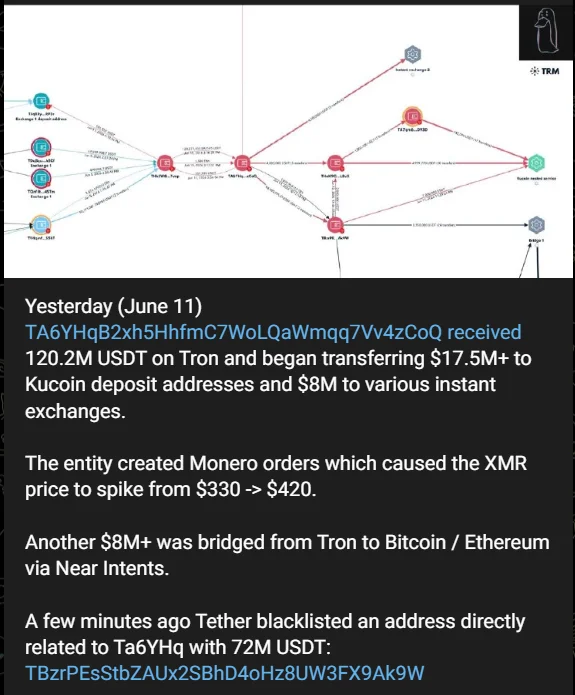
A significant portion of the transfers went into Monero (XMR) purchases. Monero is a privacy coin designed to conceal transaction history; sender and receiver information is not visible on-chain. The purchases were large enough to move the market. XMR jumped from around $300 to $438, marking a 46% increase. By Friday morning in European hours, it was trading around $382, still up roughly 8% on the day. Since Monero’s trading volume remains low compared with other major coins, a single large buy order can quickly push the price higher.
The rest of the funds were distributed through different channels. According to ZachXBT’s tracking, more than $12 million was sent to deposit addresses on the KuCoin exchange. Around $8 million moved to instant swap services, platforms that allow users to convert one coin into another without requiring identity verification. Another $8 million was transferred from Tron to the Bitcoin and Ethereum networks through a cross-chain bridge called Near Intents. Spreading funds across different coins, exchanges and blockchains is one of the known methods used to obscure transaction trails.
Tether Steps In
Within hours of the suspicious transfers, Tether intervened. The company has the ability to freeze USDT at specific addresses; through this mechanism, the tokens can no longer be moved or redeemed. According to information shared by ZachXBT, Tether blacklisted a Tron address directly connected to the wallet under investigation, rendering roughly $72 million in USDT unusable.
Neither Tether nor any law enforcement agency has issued an official statement on the move so far. The company has previously frozen wallets linked to hacks, sanctions violations or ongoing investigations; this case appears to reflect a similar assessment.
What the Picture Shows
The source of the $120 million remains unclear. However, the structure of the fund movement stands out: a rapid entry into a privacy coin, the use of instant swap services with weak identity checks, and distribution across multiple networks. This is a combination often seen in on-chain cases linked to money laundering.
Tether’s freezing decision suggests the company reached a similar conclusion. While $72 million has been immobilized, a large portion of the transfers had already spread through the system. It is not yet known whether KuCoin or any other institution has taken similar action regarding the $12 million sent to the exchange or the $8 million that flowed into swap services.