
Strategy’s latest move was unusual: instead of buying Bitcoin, it paid down debt. The company repurchased a $1.5 billion tranche of its zero-coupon convertible notes due in 2029. The amount payable was $1.38 billion, meaning the notes were bought back below their nominal value, at a discount of roughly $120 million. The transaction was funded from cash reserves, reducing the company’s cash holdings to around $871 million. The agreement was completed last week and disclosed to the public in a filing on Tuesday.
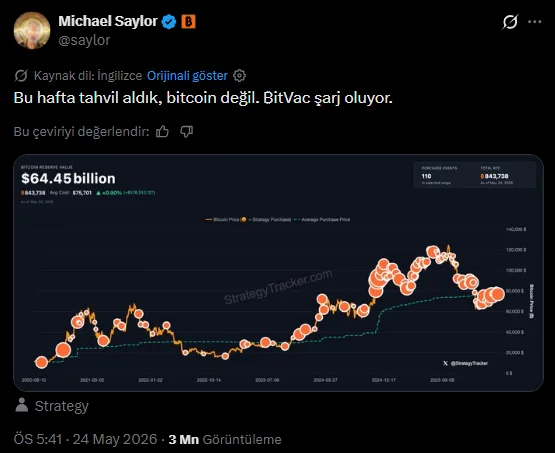
Executive Chairman Michael Saylor announced the move briefly on X: “This week we bought bonds, not Bitcoin. BitVac is charging.”
What Changed and What Stayed the Same?
Following the transaction, the company’s total debt load fell from $8.2 billion to $6.7 billion. Although it may look like a one-off move, the broader context matters. Strategy has long used various debt instruments to buy Bitcoin, but this time it focused on the liability side of its balance sheet.
Its Bitcoin treasury remained untouched. The company still holds 843,738 BTC, with an average purchase price of $75,700 per coin and a total cost of approximately $63.9 billion. This remains the largest Bitcoin stockpile held by any company worldwide.
Market Reaction Remained Limited
MSTR shares traded 1.9% higher in pre-market activity after the news. On the Bitcoin side, the picture was slightly more mixed. At the time of writing, BTC was trading at $77,172, within a 24-hour range of $76,452 to $77,703. The daily change stood at minus 0.31%, while the weekly performance remained positive at 0.64%. Over the past month, BTC was down 1.17%.
In short, Bitcoin is neither showing a strong recovery nor facing heavy selling pressure; it appears stuck around the $77,000 range. The debt repurchase did not trigger a major price move in this environment, but it can be read as a signal of balance sheet confidence.
How to Read the Move
Considering that Strategy frames its Bitcoin accumulation as a long-term game, this step looks consistent. As borrowing costs rise slightly from zero or refinancing conditions shift, it makes sense for the company to optimize its existing liabilities, especially if it can repurchase notes below their nominal value.
The company reported a BTC yield of 13.3% for the year, meaning management argues that BTC value per share has increased despite Bitcoin’s ongoing price volatility. Debt reduction contributes directly to that equation; less debt means less interest pressure and more room to maneuver.
For now, the broader strategy does not appear to have changed. Strategy continues to hold Bitcoin, and the market already knows this. But its willingness to clean up the balance sheet is also partly shaping how the bond market views the company. A debt load of $6.7 billion is still far from small.