Storj Labs filed for bankruptcy protection in the United States on Sunday. The company says its network remains operational and the STORJ token continues to serve its intended function. Storj offered a similar assurance nine months ago; this time, the circumstances look somewhat different.
Storj plans to offer token holders equity in the reorganized company. However, a judge must first approve the restructuring plan, and creditors rank ahead of token holders in the bankruptcy repayment order.
Why Storj filed for Chapter 11
Storj Labs submitted its filing to the federal bankruptcy court in West Virginia. The case number is 5:26-bk-00512.
A Chapter 11 filing does not mean the company is shutting down. It allows Storj to continue operating while restructuring its debts under court supervision.
According to Storj, these debts are legacy obligations from an earlier stage of the company. Storj has acknowledged that it cannot simply grow its way out of them.
“The infrastructure is sound and appropriately scaled. What is holding us back is the legacy liabilities from an earlier period,” said Kaloyan Raev, Storj’s director of software engineering. Raev signed the announcement, rather than CEO Colby Winegar.
What changes for token holders?
Storj says nothing has changed for the token as of today. Data continues to move between tens of thousands of storage nodes across more than 100 countries.
The company plans to offer token holders equity in the new Storj. Equity would represent partial ownership, although the company has yet to establish the rules determining who will qualify for the offer.
Those rules will matter because most of the token supply is not freely circulating. Of the total 425 million STORJ tokens, around 143.8 million are currently in circulation. The remaining two-thirds are locked or held elsewhere.
Bankruptcy proceedings also follow a strict repayment hierarchy. Creditors receive priority, while equity holders come later. Storj acknowledged this directly in its open letter to the token community: the company can promise an intention, but it cannot guarantee the outcome.
The warning sign from October
Inveniam Capital Partners announced its acquisition of Storj on October 22, 2025. At the time, the companies said there would be no changes to contracts, pricing or management.
“We are particularly excited to integrate the STORJ token into our ecosystem, enabling broader utility and interoperability across our platforms,” Inveniam Chairman and CEO Patrick O’Meara said at the time.
STORJ was trading at around $0.1872 on the day of the announcement. The token has since lost roughly 60% of its value.
A more recent warning arrived this month. MVMT Labs filed for Chapter 11 protection in Delaware on July 15. Ten days later, the MOVE token fell to a record low of $0.00964.
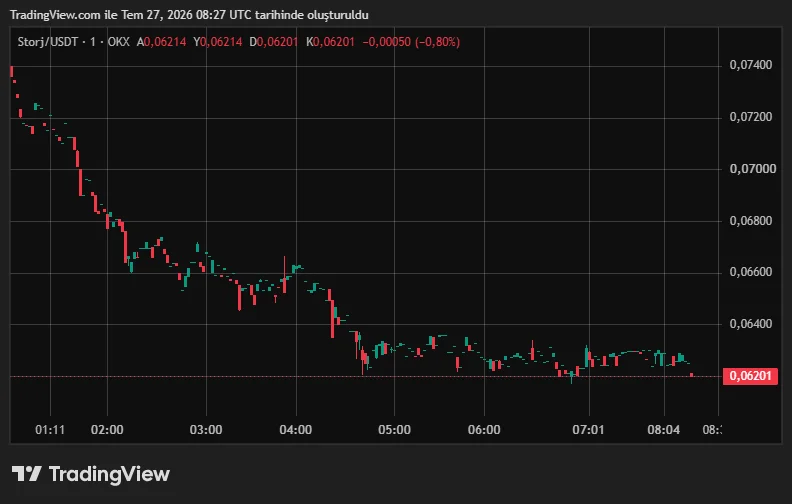
The STORJ price appears slightly more resilient for now, although the broader picture remains bleak. The token is trading at $0.0626, down 15.75% over the past 24 hours.
During the same period, STORJ moved between $0.061966 and $0.074988. The token has recovered 0.14% over the past hour, while its weekly loss stands at 14.91% and its monthly decline at 15.24%.
STORJ currently has a market capitalization of approximately $10.7 million. Its daily trading volume stands at around $5.6 million.
The broader sector presents a similar picture. Storage and infrastructure tokens continue to lag in price performance, even as network usage grows.
Storj says it will announce upcoming court dates in the coming days. The central issue remains unresolved: the finer details of the equity offer will ultimately determine what token holders are left with.v