Standard Chartered advises investors to focus on quality blockchain projects, ignoring short-term fluctuations in the crypto market. The bank sees Ethereum and Solana as top layer-1 options due to their scalability, regulatory advantages, and long-term benefit potential.
Market downturn creates opportunities
The recent sharp sell-off in the crypto market has reshaped the relative values of assets, but according to Geoff Kendrick, Standard Chartered's Head of FX and Digital Assets Research, this is a perfect buying opportunity. Kendrick says, "I'm a buyer in this digital asset downturn. Moreover, this is the beginning of a divergence period where quality projects are starting to come to the fore." The bank urges investors not to get caught up in short-term volatility and to "invest in quality." They predict that Ethereum will surpass Bitcoin, particularly due to its dominance in DeFi, scaling updates, and increasing regulatory clarity.
Kendrick, who describes Ethereum as a "quality project," shares the same view for Solana: "Like Ethereum, Solana is also quality. Invest in quality." This approach points to a phase where real gains will be made as the market eliminates the weakest links in its risk-averse mode.
Revised price predictions for Solana
Standard Chartered has lowered its end-of-2026 price prediction for Solana (SOL) from $310 to $250. This reduction is attributed to the time required for the network's next major use case to mature: "Solana's new dominant use case will take time." Nevertheless, long-term expectations have been raised; the bank predicts that SOL could reach $400 by the end of 2027, $700 in 2028, $1,200 in 2029, and $2,000 by the end of 2030.
This optimism stems from Solana's ultra-low-cost and high-volume architecture. The bank believes that Solana will move away from meme coins and become a leader in micro-payments and stablecoin transactions. While transaction volume in SOL-stablecoin pairs is increasing on Solana's DEXs, the circulation speed of stablecoins is 2-3 times faster than on Ethereum. Kendrick says, "Solana will dominate micro-payments with AI-based applications and stablecoin transactions."
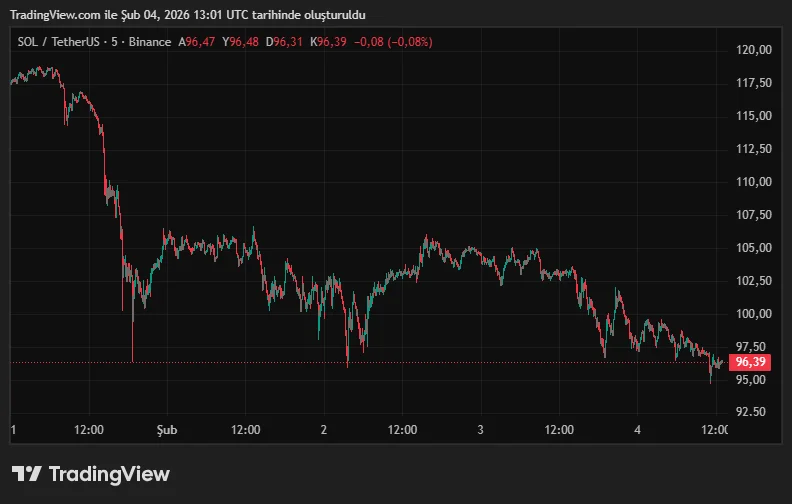
The SOL price is around $96.2 as of February 4, 2025.
Micro-payments will propel Solana forward
Solana's transaction fees average around $0.0007; this is revolutionary compared to the $0.015 fees of competitors like Base. This advantage makes previously uneconomical micro-payments possible and creates new AI-focused markets. The bank monitors the validity of this thesis by tracking stablecoin transfer volume and circulation speed. If the meme coin discount is lifted, Solana will surpass Bitcoin and approach Ethereum between 2027-2030.
Market commentators also support this view. Investor Mike Alfred describes the downturn as a "standard risk-aversion move" and says that quality projects will bounce back. Developer Mike Ippolito, criticizing the overly bearish market commentary for ETH and SOL, describes layer-1s as "the Amazon or Google of our time": with large markets, high barriers to entry, and fee revenue potential.
According to Standard Chartered, while Solana will lag behind Ethereum in 2026 and 2027, it will catch up with its scale, utility, and cost advantages. The current volatility is not a warning, but a screening mechanism; those who invest in quality projects will be rewarded. Kendrick's market-to-G metric (similar to P/E for crypto) shows that Solana is no longer trading at a discount.