
The Trading and Markets Division of the U.S. Securities and Exchange Commission (SEC) has released new guidance aimed at reducing uncertainty regarding the custody of crypto asset securities. The statement clarifies how the “physical possession or control” requirement applicable to client assets by broker-dealers applies to tokenized assets residing on the blockchain. Focusing specifically on the physical possession requirements under Rule 15c3-3, the guidance details the conditions under which brokerage firms dealing with crypto assets can be considered compliant.
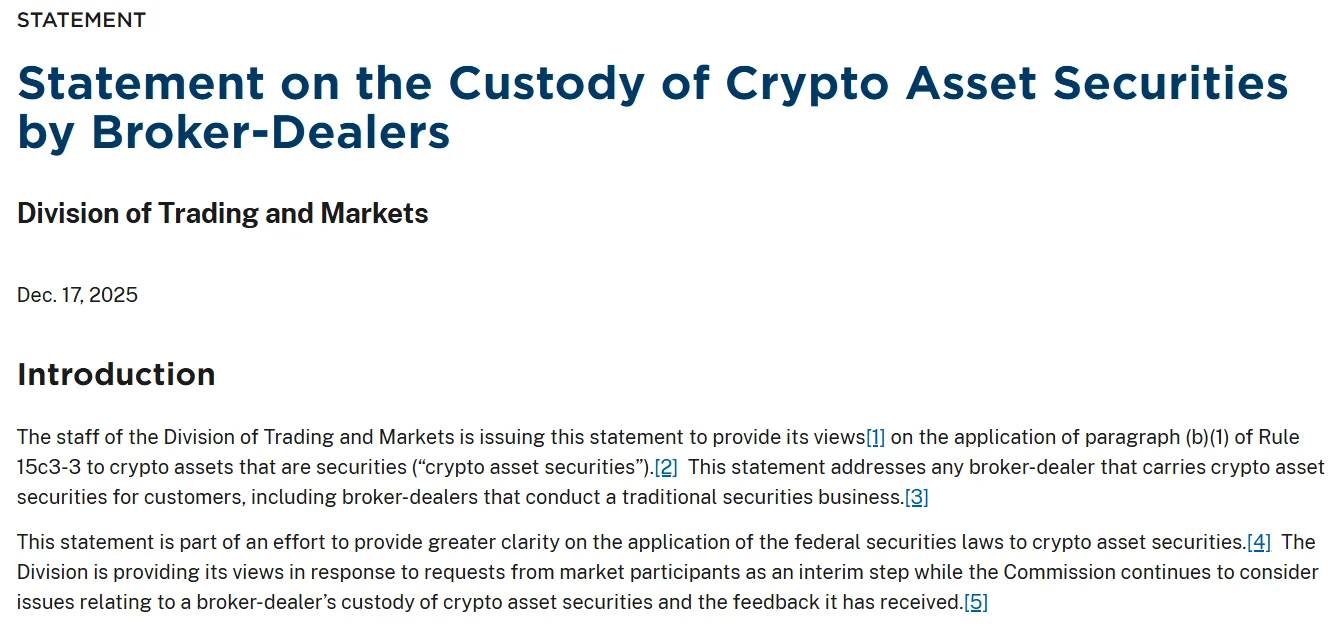
The SEC statement defines “crypto asset securities” as tokenized representations of shares or debt instruments recorded on distributed ledger technology. This definition encompasses a rapidly growing area recently, with the migration of traditional financial products to the blockchain. The Trading and Markets Division emphasizes that the guidance aims to provide greater clarity on the application of existing federal securities laws to crypto assets. It also explicitly states that the guidance was prepared as a temporary step in response to requests from market participants. The new statement targets paragraph (b)(1) of Rule 15c3-3 under the Securities Exchange Act of 1934. This provision requires broker-dealers to immediately establish physical possession or control of fully paid and over-collateralized securities held in client accounts. The SEC states that the published guidance does not redefine the concept of control in general terms, but only offers an opinion on the physical possession aspect. It is also specifically emphasized that the statement is not a binding regulation, does not impose new obligations, and does not have legal enforcement.
Five special cases listed
The most important element that stands out in the SEC's guidance is the listing of five special cases in which crypto assets can be considered within the scope of physical possession. Accordingly, for a broker-dealer to be able to offer direct custody services, they must first have immediate access to the relevant crypto asset and be technically capable of making transfers on the blockchain. This condition implies exclusive control over the private keys. The second condition requires brokerage firms to conduct comprehensive assessments of the blockchain network at reasonable intervals before and after commencing custody services. These assessments highlight elements such as network reliability, transaction speed and capacity, scalability, resilience to potential failures, and security features. The consensus mechanism, code transparency, maintenance complexity, and documentation quality are also among the considerations. Governance processes such as protocol updates, hard forks, airdrops, and token exchanges are also expected to be closely monitored. The third condition stipulates that the broker-dealer cannot claim physical possession if they are aware of serious security vulnerabilities or operational weaknesses in the blockchain they are custodians of. The fourth condition requires the implementation of strong policies and controls, consistent with industry best practices, to protect private keys against theft, loss, or unauthorized use. The fifth and final condition requires the existence of pre-planned procedures to be activated in the event of blockchain failures, network attacks, or similar disruptions. These plans also cover compliance with legal demands such as asset freezing, seizure, or token burning in accordance with court orders. SEC official Hester M. Peirce welcomed the guidance, which was released in a separate statement. Peirce stated that the text provides important clarity, especially for broker-dealers who want to offer crypto asset custody services. Noting that the emphasis on protecting private keys is consistent with established industry best practices, Peirce urged the Trading and Markets Division to promptly submit proposals to the Commission to update Rule 15c3-3 to fully cover crypto asset custody.