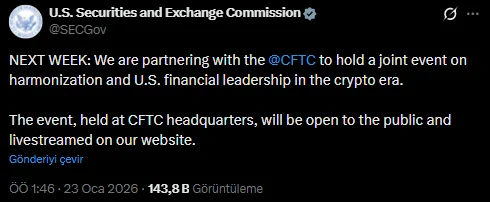
Following months of uncertainty regarding cryptocurrency regulations in the US, a significant step is being taken. The Securities and Exchange Commission (SEC) and the Commodity Futures Commission (CFTC) have announced they will hold a joint meeting on January 27 to harmonize their oversight and jurisdiction over crypto assets. This move is seen as part of President Donald Trump's efforts to create a regulatory framework consistent with his goal of making the US the "crypto capital of the world."
Crypto rules in the US are being discussed
At the event, which will take place at the CFTC headquarters in Washington DC and will be open to the public, the heads of the two agencies, Paul S. Atkins and Michael S. Selig, will outline a coordinated oversight approach to crypto markets. The meeting will also be streamed online. This is seen as a signal of a shift from the long-criticized closed-door regulatory processes to a more transparent era. SEC Chairman Atkins emphasized that companies operating in the crypto markets have been caught between unclear and conflicting regulatory boundaries for years. According to Atkins, this situation stems from a structure based on outdated divisions of jurisdiction that does not reflect today's digital asset ecosystem. CFTC Chairman Selig, on the other hand, argued that alignment between the two institutions would ensure that innovation remains within US borders and pave the way for the sector.
This development comes at a time when crypto regulations in the US have been stalled for months. The lack of progress on the CLARITY Act in Congress has particularly disappointed the sector. The draft released by the Senate Banking Committee received harsh criticism from crypto companies, resulting in a delay in the voting process. The Senate Agriculture Committee is trying to move the process forward with a more partisan text. Interestingly, the Agriculture Committee's review date of the draft coincides with the joint meeting of the SEC and CFTC. Confidence in the regulatory process also appears to be weakening. According to data from the prediction market platform Polymarket, investors are increasingly giving less chance to the CLARITY Act becoming law before 2026. The probability ratio in question has fallen by approximately 24 percent compared to its previous peak level.
This indicates that regulatory uncertainty has been priced in and expectations have been revised downwards. Disagreements are also noticeable within the crypto community. Cardano founder Charles Hoskinson sharply criticized Ripple CEO Brad Garlinghouse's "a bad law is better than no law" approach. Hoskinson argues that a hastily enacted and problematic regulation will harm the sector in the long run. In contrast, the White House is painting a more optimistic picture, believing that the CLARITY Act will be passed sooner or later, and is calling on industry representatives and public authorities to find common ground. The joint SEC and CFTC event on January 27th is also being read as a symbolic message that years of jurisdictional disputes have ended. Clearer rules are expected to emerge in areas such as spot crypto markets, DeFi applications, tokenized assets, and 24/7 digital marketplaces.