
Renewed tensions in the Middle East shaped the direction of global markets on the first day of the week. The recent increase in military tensions between Iran and the US has led to sharp movements, particularly in energy prices, and the cryptocurrency market, especially Bitcoin, is also affected by these developments. However, looking at price movements, it is noteworthy that crypto assets have shown a more limited reaction compared to traditional markets. The development that ignited the tension was the US Navy's intervention against an Iranian-flagged cargo ship in the Strait of Hormuz. The US side claimed that the ship violated the blockade and continued to proceed despite warnings. It was then announced that the USS Spruance destroyer targeted the ship's engine room, stopping it, and that US soldiers boarded the ship and took control. While Washington considered this action as "enforcing the blockade," the Tehran administration described the incident as "armed piracy." In response to this intervention, Iran reportedly launched drone attacks against US warships in the Gulf of Oman. Sources close to Iran claimed the attack was a direct retaliation for this incident, raising concerns that the ceasefire had been effectively violated. The possibility of a new conflict, particularly around the Strait of Hormuz, led to rapid price fluctuations in global energy markets.
Oil prices rose by over 6% during the day, approaching $90 per barrel. Double-digit increases were seen in European natural gas futures. This indicates that the previously declining "war premium" is being repriced. At the same time, the uncertainty surrounding the planned talks between the US and Iran in Pakistan further increased market anxiety.
Bitcoin remains more resilient
Despite the increasing geopolitical risks, Bitcoin's price movement remained relatively limited. Starting the week at around $78,000, BTC fell to $73,775 during the day before stabilizing around $74,000. While the loss in the last 24 hours remained in the 1.5-2% range, it is noteworthy that it is still positive on a weekly basis. Ethereum similarly fell by slightly over 2%, while losses in Solana and other major altcoins remained below 3%.
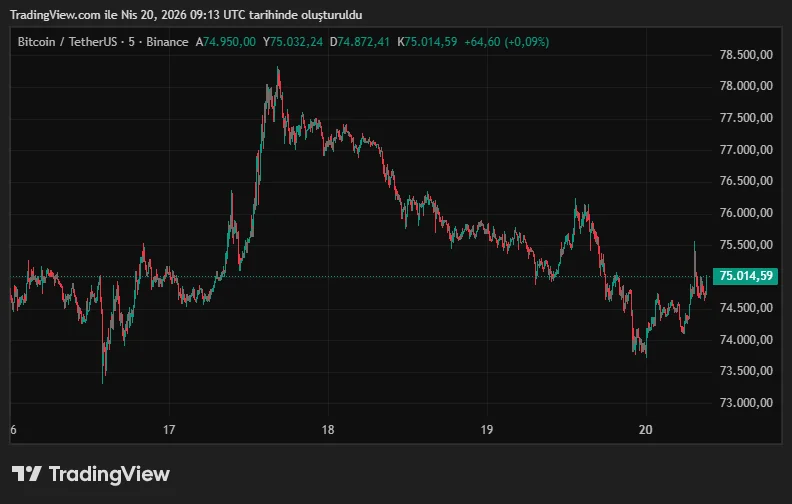
In contrast, it is noteworthy that sharper sell-offs were seen in stock futures. The divergence in the markets is not limited to price movements. The fact that Bitcoin remained relatively flat in an environment where Brent oil rose by over 5%, European stock markets signaled a decline, and the dollar strengthened suggests a possible shift in investor behavior. In particular, the base effect created by spot ETF demand may have contributed to the limited nature of the sharp weekend sell-offs seen in past cycles.
Critical levels are being monitored
Analysts believe that Bitcoin's reaction in the short term, within the $74,000-$73,000 range, will be decisive. Maintaining this band could support the asset's positioning as a "balancing factor" against geopolitical risks. A downward break, however, could indicate that the market is still sensitive to global risk appetite.
In the coming period, investors' focus will not only be on developments in the Middle East; Also included are US Treasury yields, the dollar index, and potential Fed interest rate moves. In particular, if rising energy prices push the inflation outlook upward again, the possibility of delayed interest rate cuts could put additional pressure on the crypto market.