
PEPE/USDT Technical Outlook
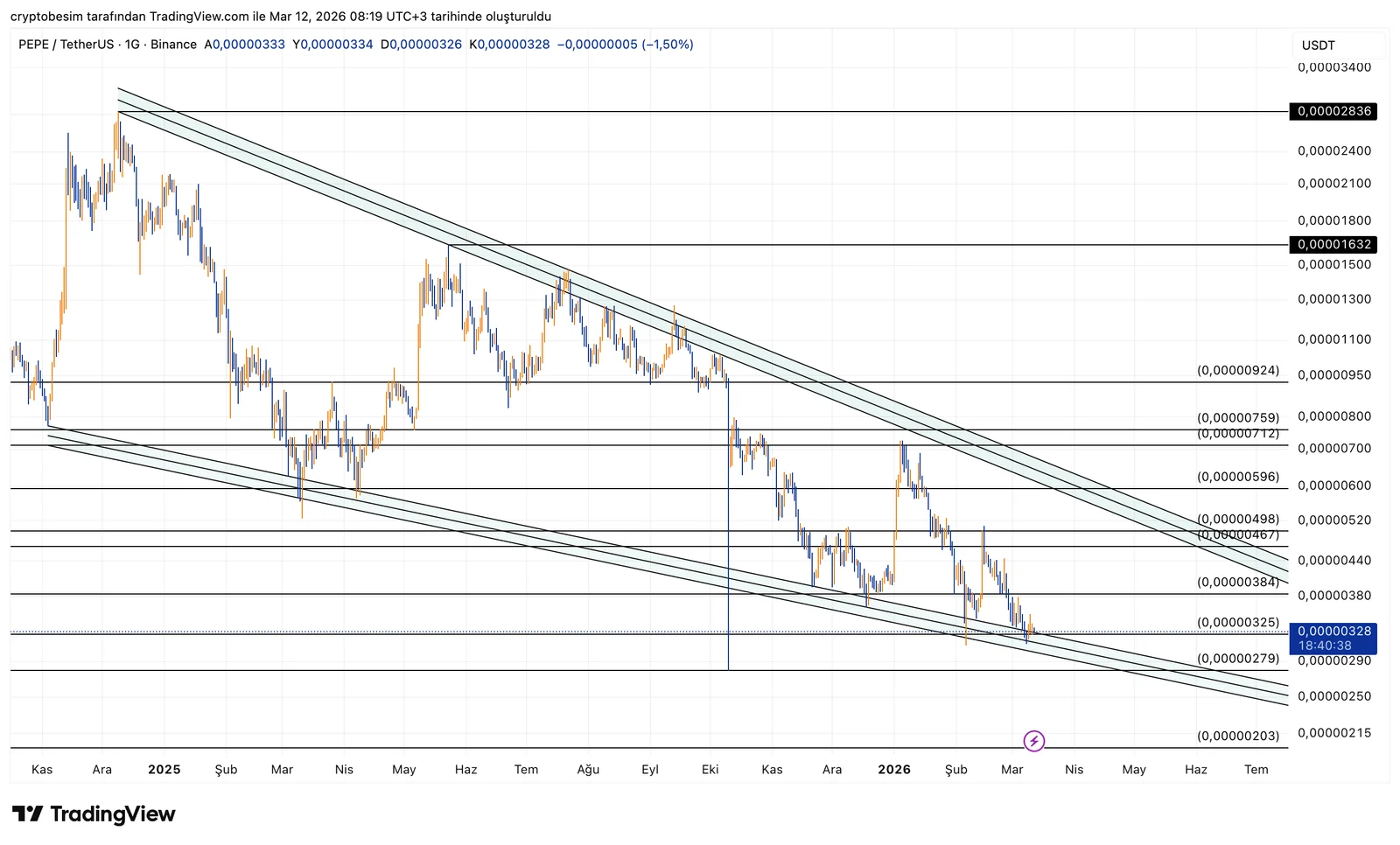
Looking at the chart from a broader perspective, a long-term falling wedge structure becomes visible on PEPE. For nearly a year, price has been forming lower highs and lower lows while moving within this narrowing formation. However, as the upper and lower trendlines move closer to each other, it shows that market compression is gradually increasing.
The current price is around 0.0000032, positioned very close to the lower band of the wedge. This area has previously produced several reactions, which suggests buyers are attempting to defend the level again in the short term. Because of that, downside momentum may struggle to accelerate unless this support is clearly broken.
On the upside, the first key area to monitor is the 0.0000046 – 0.0000049 range. This zone sits near the upper boundary of the wedge and also marks a level where price previously reversed multiple times. If price manages to break and hold above this region, the downward structure would begin to break, opening the door for a move toward the 0.0000071 – 0.0000075 area.
On the downside, the lower boundary of the wedge is gradually aligning around 0.0000027 – 0.0000028. If price falls below this support, the compression would resolve to the downside and a pullback toward the larger support area near 0.0000020 would not be surprising.
From a longer-term perspective, the situation in PEPE is relatively clear: the asset has been moving within a prolonged downtrend, but the trading range is tightening. Structures like this often lead to a significant breakout move. For that reason, the key factor in the coming period will be which side of the wedge breaks first.A break to the upside could trigger a strong recovery after the long downtrend, while a downside break may extend the decline further.
These analyses do not provide investment advice and focus on support and resistance levels that are considered to offer short- and medium-term trading opportunities depending on market conditions. However, responsibility for execution and risk management lies entirely with the user. In addition, the use of stop loss is strongly recommended.