Japanese financial giant SBI Holdings has formed a strategic partnership with the Solana Foundation to build a Japan-based onchain financial market. Under the agreement, the Solana Foundation will acquire a stake in SBI’s blockchain subsidiary, SBI R3 Japan, directly aligning the interests of the two parties under the same structure.
According to an announcement released by the company on Monday, SBI R3 Japan plans to change its name to SBI Solana Global. The new company will continue its growth strategy with SBI Holdings and Sumitomo Mitsui Financial Group as shareholders. The involvement of two major financial groups gives the initiative considerable weight in terms of both capital and institutional credibility.
The company’s priorities include issuing and distributing stablecoins, particularly the group’s yen-denominated stablecoin JPYSC. It also plans to structure, tokenize and distribute assets such as corporate bonds, commercial paper, investment funds and real estate.
The company will also work on cross-border payment infrastructure. This initiative stands out as an attempt to accelerate trade flows, particularly within Asia.
The new venture will provide onchain financial services for institutional investors and develop payment infrastructure for artificial intelligence agents. The latter is especially notable. Building a system in which AI agents can independently make payments remains an area that only a small number of companies currently take seriously.
All products will operate on the Solana blockchain.
The second major move following JPYSC
The announcement came only a few weeks after SBI launched JPYSC, described as Japan’s first yen-denominated stablecoin backed by a trust bank.
On the same day, the group announced that applications would open on July 16 for a 12-week product offering an annual return of 3% on JPYSC deposits through SBI VC Trade. The product indicates that SBI is attempting to position JPYSC as more than a payment instrument, turning it into an investment product capable of generating yield.
SBI’s recent expansion has continued at a rapid pace. Last week, the company became the sole investor in Gauntlet’s $125 million Series C funding round. During the same week, it also single-handedly funded EDX Markets’ $76 million Series C round.
The fact that both investments occurred within the same week, with SBI acting as the only investor in each deal, highlights both the group’s financial strength and its confidence in crypto infrastructure.
In June, SBI also acquired Japanese cryptocurrency exchange Bitbank for approximately $289 million. The acquisition gave the group a direct presence in the retail crypto trading market.
Taken together, SBI’s intentions are becoming clearer. The group does not want to remain an investor that simply provides capital to crypto companies. It aims to become a major operator controlling tokenization and stablecoin infrastructure.
Bitbank covers the retail market, while Gauntlet and EDX Markets strengthen the infrastructure side. SBI Solana Global completes the picture by establishing a presence in institutional onchain finance.
From the Solana Foundation’s perspective, the partnership provides a direct route into Japan, a market with a relatively mature regulatory framework, at an institutional level.
Japan’s decision to move relatively early on cryptocurrency regulation also makes the partnership with an established financial group such as SBI a strategic gain for the broader Solana ecosystem.
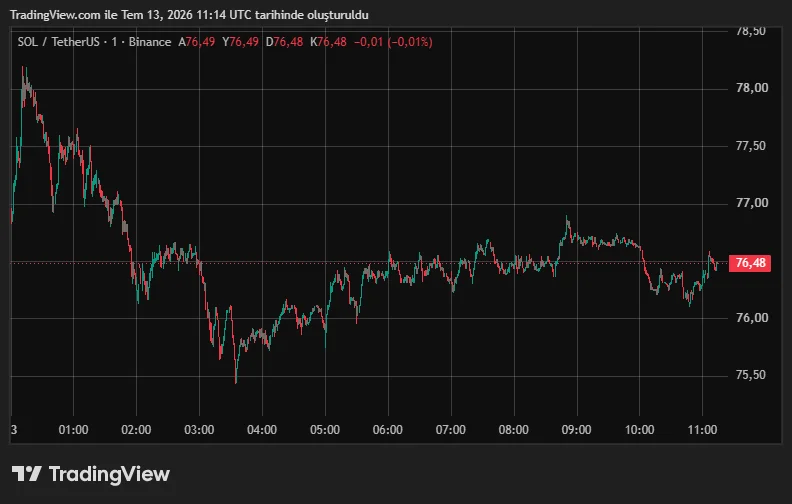
At the time of writing, Solana’s SOL token was trading at around $76.