
JPMorgan, one of the largest banks in the US, has added another step to its tokenization efforts. The bank has applied to the US Securities and Exchange Commission for a new money market fund called the JPMorgan OnChain Liquidity-Token Money Market Fund. Planned to trade under the ticker symbol JLTXX, the fund will operate on Ethereum and utilize the Kinexys Digital Assets infrastructure. According to the prospectus dated May 12th, the fund will normally invest only in US Treasury bonds and overnight repurchase agreements collateralized with Treasury bonds. JPMorgan states that the fund will be managed with a target net asset value of $1. This structure makes the product a corporate cash management solution focused on low-risk, short-term liquidity instruments. The most notable aspect of the application is the fund's connection to the stablecoin market. JPMorgan positions JLTXX to meet the appropriate reserve asset requirements that stablecoin issuers must hold under the GENIUS Act passed in the US. Thus, the fund stands out not only as a traditional money market instrument for stablecoin companies, but also as a reserve management option compatible with on-chain systems.
New model for stablecoin reserves
It is specifically emphasized that JLTXX will not be classified as a stablecoin. The fund itself is not a stablecoin issuer, and its token balances do not have stablecoin characteristics. Nevertheless, the structure may allow stablecoin issuers to manage their reserves in a more controlled, traceable, and regulated instrument.
The fund's access model will be entirely permissioned. Only verified wallet addresses will be able to conduct transactions. These addresses will be included in the allow-list system for buying, selling, redemption, and transfer transactions. Legal ownership will not be based directly on the blockchain balance, but on investor records held by the transfer agent. Therefore, token balances on Ethereum will function to transmit transaction requests and provide operational ease; legal ownership records will continue to be maintained in the traditional fund infrastructure.
On the JPMorgan stablecoin interface side, the Morgan Money platform stands out. According to the application, stablecoin services will only be offered through Morgan Money, and the supported stablecoin will be USDC. This structure shows that the bank is designing its on-chain products not entirely with an open DeFi logic, but with institutional control mechanisms.
The choice of Ethereum is no coincidence
JPMorgan's launch of its new fund on Ethereum seems consistent with the bank's previous moves. In December 2025, the bank launched its tokenized money market fund, MONY, also on Ethereum. With an initial investment of $100 million, MONY was one of the first major steps in JPMorgan's strategy to tokenize short-term Treasury assets. JLTXX, on the other hand, takes this model to a broader institutional framework. The fund will launch on Ethereum, but the prospectus leaves open the possibility of expanding to other blockchain networks in the future. This detail shows that JPMorgan does not want to be limited to a single network and is evaluating different chains for different institutional needs. Market size also played a role in the choice of Ethereum. According to RWA.xyz data, Ethereum is the network with the largest share in the distributed real-world asset market. The fact that the network has a strong ecosystem in tokenization projects, and that large institutions like BlackRock and Franklin Templeton also use Ethereum in similar products, makes this choice more defensible for JPMorgan. The Solana detail is noteworthy.
Although Ethereum stands out in the application, it is seen that JPMorgan also assigns a separate role to Solana in its institutional cash architecture. It is stated that Anchorage Digital is working with JPMorgan on a tokenized vehicle solution within the scope of its "Cashless Reserves" initiative. In this model, Solana is considered as an infrastructure that can be used for faster reserve movement and instant liquidity operations.
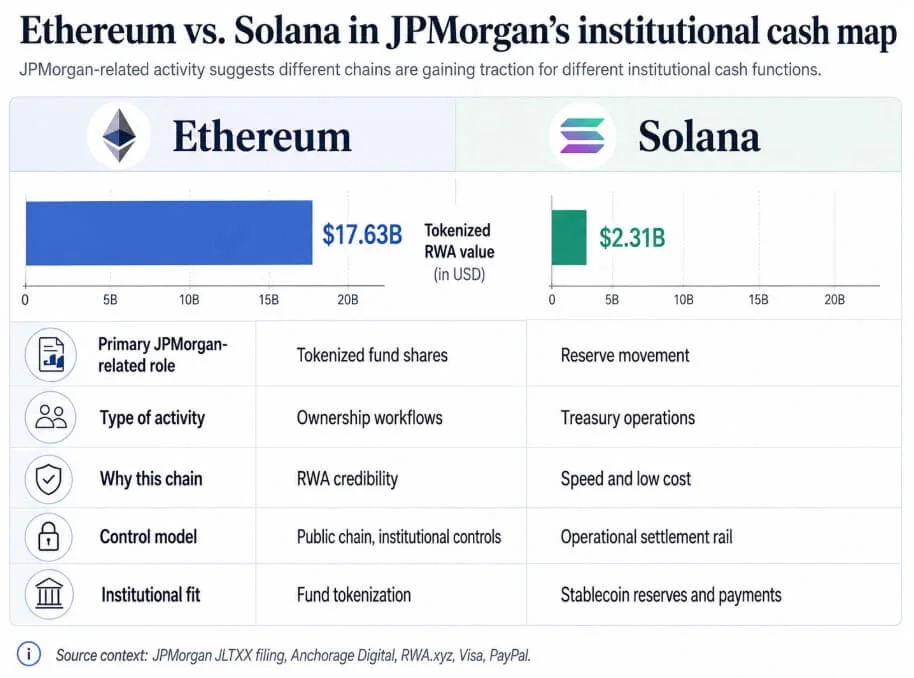
This picture shows that JPMorgan is trying to establish a multi-layered system instead of a single-chain approach in institutional cash management. While Ethereum stands out for fund shares, ownership records, and institutional distribution processes; Solana is positioned more on the side of fast reserve movements and operational liquidity.