
According to JPMorgan analysts, Bitcoin mining economics have deteriorated significantly this year. The cryptocurrency has traded below its estimated production cost for five consecutive months, increasing pressure on miners across the industry.
JPMorgan analysts led by Managing Director Nikolaos Panigirtzoglou said Bitcoin’s hash rate, which represents the network’s total computing power, and mining difficulty have become more sensitive to price movements this year. These two indicators normally move relatively independently from the price because deploying or shutting down mining equipment takes time. However, the relationship has strengthened recently.
Over the past six months, the beta of mining difficulty relative to Bitcoin’s price has risen to 0.62. According to the analysts, this suggests that a growing share of miners are operating near their break-even point and are more prepared to switch their machines on or off when the price changes. In other words, miners are now reacting to price fluctuations much faster than before.
The analysts said in the report:
“When Bitcoin trades below its production cost, higher-cost miners shut down their machines, the hash rate declines and mining difficulty adjusts downward accordingly. This pattern was also observed in the second week of June, when difficulty fell by 10%, marking the second decline of this magnitude this year. The previous drop occurred in January.”
Production Cost Rises to $78,000
JPMorgan currently estimates Bitcoin’s production cost at approximately $78,000. Bitcoin, meanwhile, is trading at around $62,500. The difference represents a gap of roughly $15,500, forcing a significant share of miners to produce Bitcoin below cost.
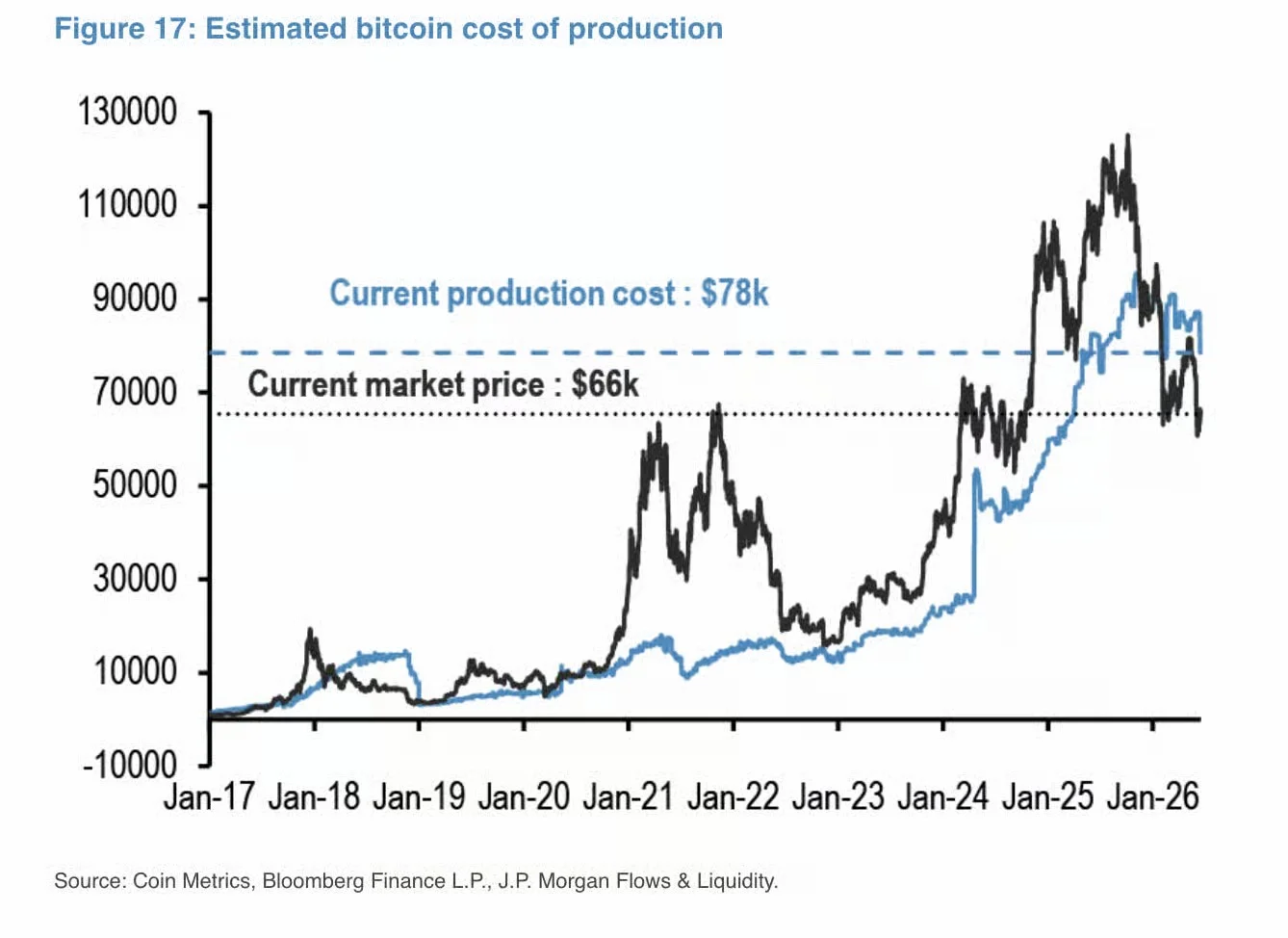
According to CoinShares’ mining report for the first quarter of 2026, approximately 20% of Bitcoin miners are now operating at a loss. This figure is considerably higher than at the beginning of the year and points to growing consolidation pressure across the industry.
Faced with these conditions, publicly traded mining companies sold more than 32,000 Bitcoin during the first quarter alone to cover their operating expenses. That figure exceeded their total sales for the entirety of 2025. The rapid depletion of miner reserves suggests that cash flow problems are affecting major publicly listed companies as well as smaller operators.
Difficulty Adjustments Expected to Become More Frequent
JPMorgan analysts expect the hash rate to remain highly sensitive to price movements as long as Bitcoin continues to trade significantly below its production cost. They also anticipate larger and more frequent mining difficulty adjustments. The current production cost is estimated at approximately $78,000.
The cycle is considered somewhat self-correcting in the short term. As weaker miners shut down, the hash rate declines, partially restoring profitability for those that remain. However, as long as Bitcoin stays below its production cost, the balance is disrupted again and the cycle repeats.
JPMorgan has previously maintained a cautious stance on the cryptocurrency market. This time, however, the analysts added an unexpected observation, describing the market’s current weakness as a potential “forward-looking bullish signal.”
According to the analysts, periods of severe stress in the mining industry have historically tended to coincide with the formation of price bottoms.