Ripple has launched its dollar-backed stablecoin RLUSD in Japan. Following approval from Japan’s Financial Services Agency, the company made the token available to institutional and retail users through its partnership with SBI Holdings and its crypto arm, SBI VC Trade. The launch makes RLUSD the second foreign dollar-denominated stablecoin to receive approval in the country; before it, only USDC was on that list.
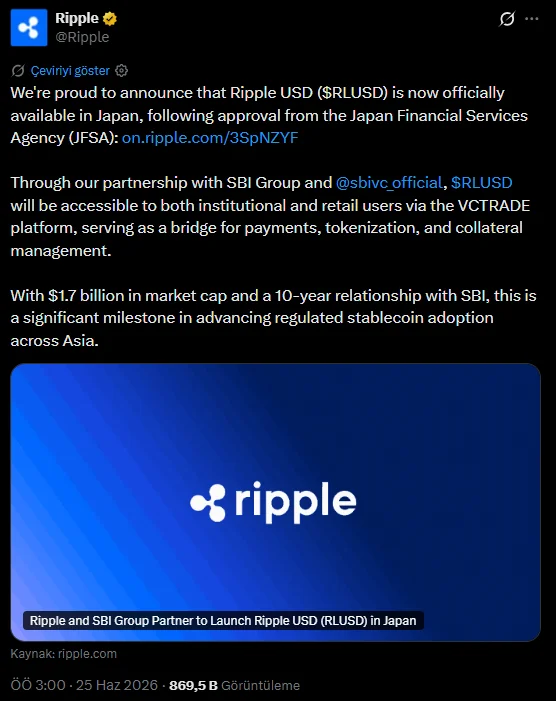
Jack McDonald, senior vice president of Ripple’s stablecoins unit, said the collaboration with SBI Group would serve as a bridge across payments, tokenization and collateral management, connecting Japanese companies and individuals to global liquidity more efficiently.
The JFSA’s approval is more than a routine permission. The agency classified RLUSD as a new type of electronic payment instrument under the Payment Services Act and granted the token “Type 4” electronic payment instrument status, a designation that no other crypto asset in the country currently holds. This category, created by the JFSA specifically for regulated stablecoins, gives RLUSD a clear legal position within Japanese payment law. The token is no longer operating in a zone of regulatory tolerance; it now functions within a legally defined framework.
Japan Opened the Door, but Kept It Narrow
In the first phase in Japan, RLUSD transactions have been capped at 1 million yen, or roughly $6,200. This limit is designed to keep early-stage volume low and make monitoring easier. The token is running on Ethereum, not Ripple’s own XRP Ledger. In other words, the first Japanese version of RLUSD has gone live on infrastructure that the company does not directly control.
The development in Japan came shortly after Ripple received preliminary approval in Luxembourg under the MiCA framework. Once the CASP license receives final approval, it will grant passporting rights across 30 countries in the European Economic Area. Taken together, the two developments mean Ripple has secured a legal foundation for RLUSD in Japan and much of Europe within a single week.
The Approval Signal the Industry Has Waited for Over the Past Decade
The stablecoin sector spent much of the past decade growing by moving around regulators. Issuers managed reserves from offshore locations, structured themselves in jurisdictions with lighter oversight and often faced enforcement only after the damage had already been done. RLUSD has tried the opposite route. It has secured licensing from two of the industry’s most important regulatory regimes; Japan and the European Union sit at the top of that list.
This is where the real significance begins to take shape. A dollar stablecoin approved by both the JFSA and MiCA is not a temporary workaround built to avoid supervision. It becomes a product that banks and regulated exchanges can hold without taking on unnecessary legal risk. In Japan, SBI’s role as distributor places RLUSD not in front of a narrow crypto-native audience, but in the hands of an established financial player. The 1 million yen cap and Ethereum-based infrastructure show how cautiously Japan is taking this step; still, the direction is now clear. The industry has argued for years that it can operate within the rules. Two strict approvals in one week create a data point that is much harder to dismiss than another offshore launch.
What remains is the question of usage. Convincing regulators was, on paper, the hardest part. Whether RLUSD can generate real volume in both regions is still untested.