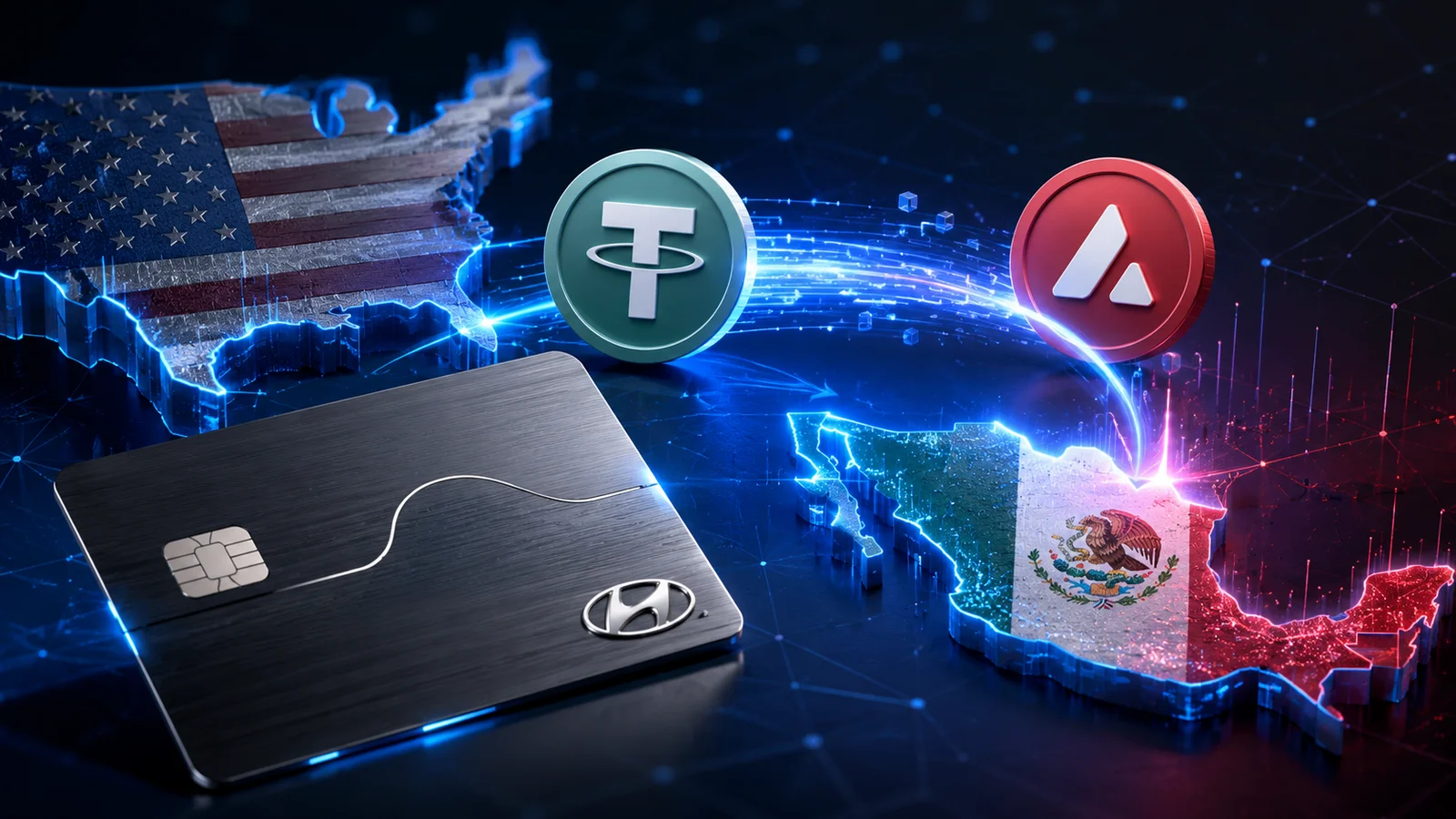
Hyundai Card has completed the first phase of a cross-border stablecoin remittance test carried out in cooperation with Tether and Avalanche. According to the announcement made on Thursday, the test was not conducted on paper. It involved a real money transfer between Hyundai Motor’s U.S. and Mexico units.
Hyundai Motor America converted a $20,000 amount into USDT on the Avalanche network. The amount was then sent to the Mexico office and converted back into dollars there. The transaction took about seven minutes. The same transfer would take three to four hours if processed through traditional interbank channels.
In traditional cross-border transfers, this delay is usually caused by the transaction passing through multiple intermediary banks. Each intermediary bank carries out its own control and settlement process, which extends the total transfer time. In a stablecoin-based transfer, the number of intermediaries decreases because the transaction takes place directly on the blockchain.
Hyundai Card emphasized that the test was not a theoretical trial and was designed around a real settlement need between the company’s overseas units. The company handled the regulatory review, legal and tax checks, and the design of the remittance structure itself. Blockchain payment infrastructure company Axiym also took part in the process.
Hyundai Card is one of South Korea’s leading credit card companies and operates under Hyundai Motor Group. The company’s test came at a time when Korean financial institutions are increasing their experiments with blockchain infrastructure. As a similar example, KB Card had also carried out a stablecoin-focused project with Avalanche in recent months.
Second Test in Europe
Hyundai will launch a second test between its European units later this month. Visa and USDC issuer Circle will also participate in this round.
In the second test, real stablecoin transfers will be tested using various local currencies besides the dollar. The goal is to see how much cost advantage stablecoin-based money transfers can provide.
While USDT and the Avalanche network were preferred in the first test, the involvement of Circle’s USDC and Visa’s payment infrastructure in the second phase shows that Hyundai Card wants to test different stablecoin and network combinations. This will allow the company to compare which infrastructure is more suitable at an institutional scale using its own data.
Institutional stablecoin use has recently attracted growing interest in sectors such as automotive, retail and logistics. For companies, the main appeal is cost as much as speed. In the traditional banking system, commissions and foreign exchange costs can accumulate even in intra-group transfers. Hyundai Card’s two-phase test approach aims to measure these costs with concrete data.
The company will decide in the coming period whether to open stablecoin-based payment infrastructure to broader use based on the results of the PoC process.