Two major institutional players pointed to two different opportunities in the crypto market in the same week. Grayscale Research Director Zach Pandl highlighted decentralized artificial intelligence and Bittensor (TAO), while Standard Chartered Head of Digital Assets Research Geoffrey Kendrick published a report projecting a 40-fold increase for Uniswap (UNI) by the end of 2030. Both analysts share a common argument: capital moving away from the risks created by centralized structures will increasingly flow toward protocol-level infrastructure.
TAO: Anthropic Crisis Draws Attention to Bittensor
The timing of Pandl’s report was no coincidence. Anthropic faced two serious issues during the same period.
The U.S. government issued an export control directive for Anthropic’s Fable 5 and Mythos 5 models on national security grounds. Although the directive applied only to foreign nationals, Anthropic had to disable the models globally for all customers in order to comply. The company objected to the directive, saying the jailbreak vulnerability cited as the reason was already present in other major publicly available large language models. At the same time, Anthropic also faced a class-action lawsuit over usage limits in its commercial Claude products. Plaintiffs claim that access under paid subscription plans was restricted in undisclosed ways.
Pandl pointed to this exact backdrop as he presented Bittensor as a structural alternative. Bittensor is a protocol that distributes AI model training and inference across thousands of independent participants instead of relying on a central authority; the TAO token rewards the subnetworks that provide the most valuable contributions. Pandl said Bittensor aims to do for artificial intelligence what Bitcoin did for digital money, arguing that this model is structurally more resilient against regulatory shocks hitting centralized providers.
The market reaction came quickly: TAO has gained around 28% over the past five days.
UNI: A Winner of the Tokenized Asset Wave
Kendrick’s assessment of Uniswap rests on a longer-term thesis. He expects tokenized assets on-chain to grow from around $340 billion today to $4 trillion by the end of 2028, while the share of these assets used in DeFi could rise from 3.5% to 30% by 2030. Under this scenario, total value locked in DeFi would reach 37 times its current level, and Uniswap’s liquidity pools would directly benefit from that growth.
Kendrick explains the difference between Uniswap and Coinbase through a YouTube-Netflix comparison: on YouTube, content is produced by users rather than the platform; similarly, Uniswap operates as open infrastructure where anyone can create liquidity pools. This structure lowers Uniswap’s capital requirements compared with Coinbase and gives it an advantage in swaps between closely linked assets such as stablecoins or staked Ethereum (ETH).
With the UNIfication upgrade in December 2025, protocol fees went live and the programmatic UNI burn mechanism was activated. Since then, the protocol has generated around $21 million in fees; together with a one-time burn of 100 million UNI, circulating supply has fallen to 622 million.
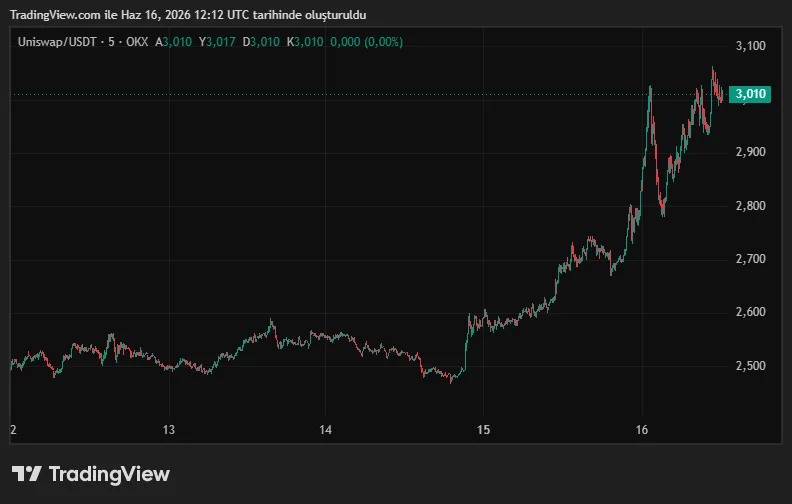
The staged price targets for UNI are as follows: $6.50 by the end of 2026, $20 by the end of 2027, $40 by the end of 2028, $65 by the end of 2029, and $100 by the end of 2030. With the token currently trading around $2.70, this would imply a 40-fold increase. Kendrick expects UNI to outperform both ETH and Bitcoin in terms of returns over the same period.