
Bitcoin started the week weakly, influenced by the increasing risk-aversion trend in global markets. With increased selling pressure in the last 24 hours, Bitcoin fell below the $88,000 level, dropping to the $87,000 range. While there is no single factor behind the decline, it is thought that investors are focusing on macroeconomic developments.
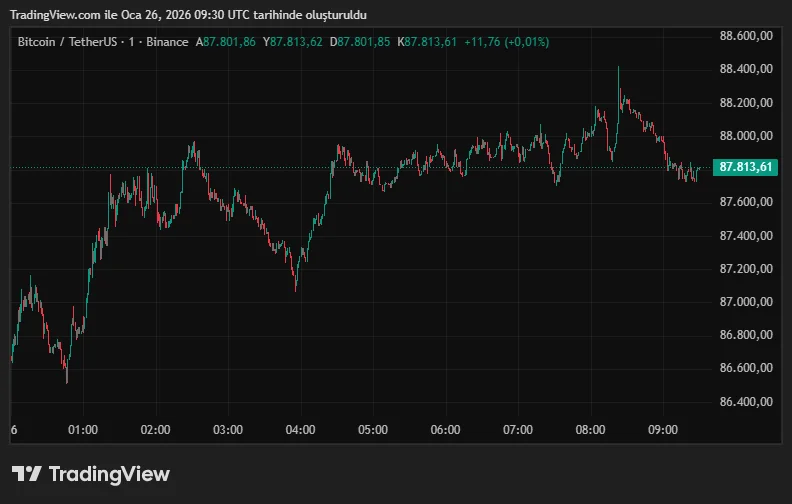
Bitcoin and altcoin prices declined
Data from the last 24 hours revealed that the sell-off was not limited to Bitcoin. Ethereum also experienced a drop of over 3% in the same period, approaching the $2,800 level. This cautious atmosphere prevailing across the market is, according to analysts, fueled by the renewed political uncertainties originating in the US.
Rick Maeda from Presto Research stated that the recent price movements in crypto assets are based on a "widespread risk-aversion reflex." According to Maeda, markets are focused more on the possibility of a partial shutdown of the US federal government rather than on crypto-specific news flow. The deadlock in budget negotiations and ongoing political infighting in Congress are putting pressure on risky assets.
Concerns about a possible US government shutdown have become more pronounced in recent days. Signals that Democrats may block the Department of Homeland Security budget bill have strengthened the perception of uncertainty. Data from the forecasting market Polymarket indicates that the probability of this scenario occurring has risen to 75 percent. This situation is leading investors to repricing their risk premiums.
A cautious stance is also noticeable on the institutional front. Spot Bitcoin ETFs traded in the US recorded a net outflow of approximately $1.33 billion in the third week of January. This figure stands out as the weakest weekly performance since February 2025. Vincent Liu, CIO of Kronos Research, said that the general ETF outflows reflect a risk-aversion trend, but some selective purchases show that long-term belief has not been completely lost.
On-chain data also confirms the fragile nature of the market. CryptoQuant notes that long-held Bitcoin holders have been selling off during recent rallies, while new investors have absorbed these sales. Glassnode points out that cost zones concentrated around $98,000 are creating strong supply pressure. This makes it difficult for the price to permanently settle above $100,000 in the short term.
Gold hits another record high
On the other hand, the search for safe havens is more clearly felt in the commodity market. Gold prices have reached record levels, rising above $5,000 per ounce, indicating that investors are turning to store-of-value assets in the face of geopolitical risks and a weakening dollar. Meanwhile, the price of gold per gram is around 7,100 TL.
In the coming days, the focus of the markets will be on the US Federal Reserve's interest rate decision and inflation data. Analysts point out that balancing ETF flows in Bitcoin and maintaining current support levels are critical for the short-term outlook. For now, the picture suggests that the crypto market has entered a horizontal and volatile period accompanied by uncertainties, rather than a new rally.