The US Federal Reserve (Fed) has withdrawn its 2023 guidance limiting interaction with crypto assets, marking a significant shift in its approach to innovation within the banking system. This decision allows banks under Fed supervision, particularly uninsured state banks, to operate more flexibly with cryptocurrencies and similar digital financial products. This move comes as US regulators have recently adopted a more positive stance towards digital assets, making it a closely watched development for the sector.
What did the 2023 guidance cover?
The guidance, published in 2023, stipulated that uninsured banks would be subject to the same rules as banks with federal deposit insurance. Based on the principle that "like pays like pays," this approach effectively prevented uninsured banks from conducting activities not permitted for national banks, such as crypto services. This created significant restrictions, particularly for crypto-focused banks, in terms of Fed membership and access to central bank systems.
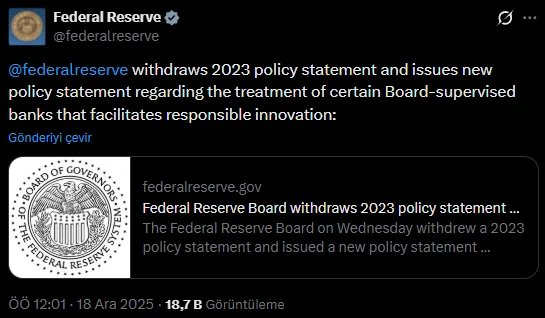
The Fed cited significant changes in the financial system over the past two years and the institution's evolving understanding of innovative products as reasons for withdrawing the guidance. The statement read, "The 2023 policy statement is no longer appropriate and has therefore been withdrawn." According to the Fed, the current framework is outdated in the face of rapidly evolving financial technologies. One of the first reactions from the sector came from Caitlin Long, CEO of the crypto-friendly Custodia Bank. In a post on social media, Long reminded that the 2023 guidance was used as the primary reason for rejecting her bank's application to open a "master account" with the Fed. A master account allows a financial institution to hold an account directly with the Fed and access the central bank's payment systems without the need for an intermediary. Long argued that the Fed used the guidance as a basis for the Custodia decision even before it officially came into effect, claiming this was illegal. The Fed's new move was not limited to simply revoking the old guidance. The institution also released a new policy framework for “innovative activities” for both insured and uninsured state banks under Fed supervision. This framework allows banks to launch products and services based on new technologies, such as cryptocurrencies, provided they meet specified risk management and compliance standards. Fed Vice Chair for Supervision Michelle Bowman emphasized that the goal of the new approach is to keep the banking sector both safe and modern. According to Bowman, when implemented responsibly, new technologies increase efficiency for banks and enable them to offer better products to customers. The Fed's goal is to encourage innovation without compromising the principles of financial stability and soundness. However, the decision was not unanimous within the Fed. Fed Board Member Michael Barr dissented, arguing that maintaining the principle of level treatment among banks is critical to preventing regulatory arbitrage. He stated that the new policy could encourage banks to adopt looser regulations, creating incentives incompatible with financial stability. Barr has been associated with the “Operation Chokepoint 2.0” debates in the past, which aimed to exclude crypto companies from the banking system, but he has also served as an advisor at Ripple and is known for supporting responsible stablecoin regulation.