The core Personal Consumption Expenditures (PCE) price index, the inflation gauge most closely watched by the Federal Reserve, rose 3.4% year-over-year in May. The data released by the U.S. Bureau of Economic Analysis (BEA) came in line with market expectations, but the figure marked the highest level since October 2023. Headline PCE reached 4.1% on an annual basis.
The core index, which excludes food and energy prices, is one of the key indicators the Fed monitors when making interest rate decisions. The fact that the May reading increased compared with April could strengthen the central bank’s message that its “job is not done yet” on inflation.
What changed in income and spending?
Personal income increased by 0.7% month-over-month in May, rising by $181.6 billion. Disposable personal income, which refers to income after taxes, also rose by 0.7%, increasing by $164.9 billion. The increase was mainly driven by higher farm proprietors’ income and wage payments.
On the consumption side, personal spending increased by 0.7% month-over-month to $156.1 billion, while the market had expected a 0.6% rise. The April figure was also revised down from 0.5% to 0.4%. Of the increase, $94.3 billion came from services spending, while $61.8 billion came from goods spending. Real PCE, adjusted for inflation, rose 0.3% on a monthly basis.
Personal savings stood at $704.2 billion in May, while the personal saving rate was 3% of disposable income. Total personal outlays increased by $159.9 billion. On a monthly basis, headline PCE rose 0.4%, while core PCE increased by 0.3%.
Why does this matter for Bitcoin?
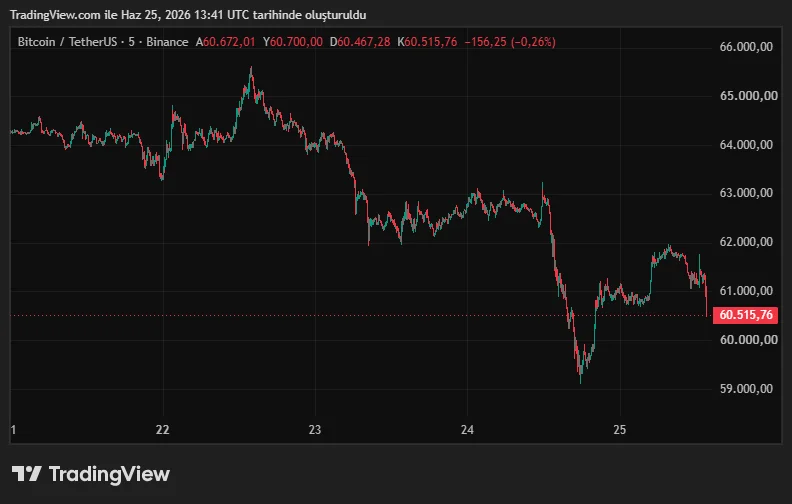
Bitcoin (BTC) continues to decline under pressure from the Fed’s hawkish tone, consecutive outflows from spot ETFs, thinner market liquidity during the summer period and quarterly options expiries set to end on June 30. Although expectations have strengthened that a U.S.-Iran agreement could lead to lasting peace in the Middle East, the inflation risk stemming from energy prices remains on the table.
At its June meeting yesterday, the Fed kept interest rates unchanged in line with expectations. While the central bank said it was prepared to act in either direction depending on inflation risks, hawkish signals from officials drew Wall Street’s attention. Some investors even began positioning for the possibility that the Fed could raise interest rates again this year after those signals.
The May PCE data, which matched expectations, did not create a surprise strong enough to change the short-term outlook. However, the fact that the core index climbed to its highest level since the fall of 2023 shows that the pace of disinflation has slowed. Markets will now focus on employment data ahead of the July meeting and next month’s PCE reading. On the crypto side, persistently high inflation remains one of the factors limiting risk appetite and fueling selling pressure on Bitcoin.