Bitcoin continues to hold above $75,000 despite increasing geopolitical and macroeconomic pressures in global markets. Ongoing tensions between the US and Iran are pushing inflation expectations higher, particularly through energy prices; investors' focus has also shifted to signals from the Federal Reserve's (Fed) monetary policy. The Fed kept its policy interest rate unchanged at its April meeting, in line with expectations. However, the decision statement and officials' remarks indicate a more cautious picture than markets anticipated. While the possibility of inflation accelerating again remains, the message conveyed is that the Fed may take steps towards tightening if necessary. This shift in tone has led to a re-pricing of the possibility of an interest rate hike, particularly on Wall Street. In this process, the Personal Consumption Expenditures (PCE) index, one of the most closely watched data sets by investors, while released in line with expectations, presented a noteworthy picture in terms of levels. According to March data, annual headline PCE inflation rose to 3.5%, reaching its highest level in recent months. Core PCE similarly maintained its upward trend at 3.2 percent.
The reason PCE data is so closely watched is that the Fed officially targets this indicator when assessing inflation. Covering a broader basket of expenditures than the Consumer Price Index (CPI), PCE is seen as a more "realistic" measure for monetary policy because it reflects changes in consumer behavior more flexibly. In particular, core PCE plays a critical role in the Fed's understanding of the medium-term inflation trend because it excludes volatile items such as food and energy.
The latest data signals a renewed acceleration in inflation; this strengthens the expectation that interest rate cuts may be postponed, or even that a new increase may be on the table if necessary. Indeed, some market participants no longer rule out the possibility of an interest rate hike in the second half of the year.
Another weak signal on the macro front came from the US growth data. In the first quarter, the economy grew by 2.0 percent, falling short of the market expectation of 2.2 percent. While this limited deviation in growth indicates that economic activity is beginning to slow, it presents a difficult balance for the Fed when considered alongside strong inflation data.
How did the Bitcoin price move?
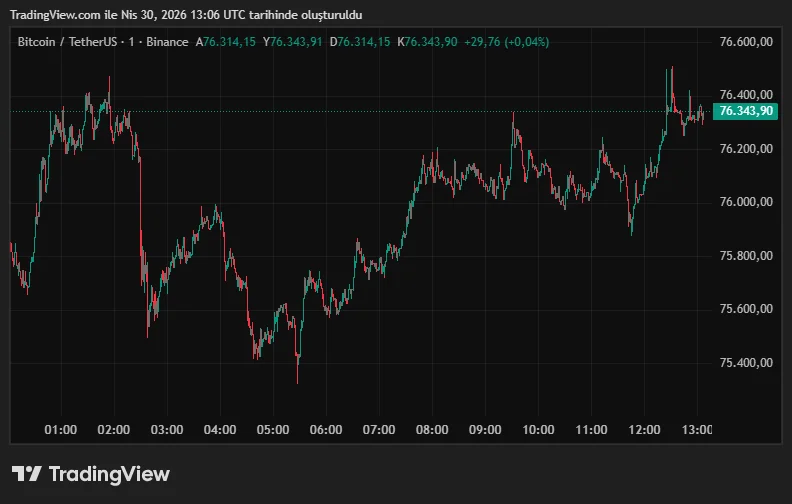
Amidst all these developments, Bitcoin's price behavior is noteworthy. As seen in the shared chart, BTC fluctuated between $75,000 and $76,400 during the day. The rapid recovery of the price despite the selling pressure, especially in the morning hours, shows that buyers have entered the market at critical levels. While the $76,000 region has become an important equilibrium area in the short term, the area around $76,400 stands out as resistance in upward attempts.