
Coinbase has signed a significant partnership with Hyperliquid, one of the fastest-growing transaction networks in the crypto market. Under the agreement, the company will act as the official treasury dispenser for USDC on Hyperliquid. This development demonstrates Coinbase's intention to place USDC directly at the heart of its on-chain transaction infrastructure, rather than limiting stablecoin liquidity to centralized exchanges and the Ethereum ecosystem. The agreement will be implemented through Hyperliquid's Aligned Quote Asset (AQA) framework. This system directly links stablecoin liquidity to Hyperliquid's transaction infrastructure. Thus, USDC will take on a more centralized role in the network's markets, while a portion of the revenue generated from reserve yields will be shared with the protocol. According to a second source, under the new AQAv2 structure, Coinbase and Circle aim to consolidate liquidity under one roof by staking HYPE and make USDC the primary quoted asset for HIP-4 markets.
USDC Liquidity Grows on Hyperliquid
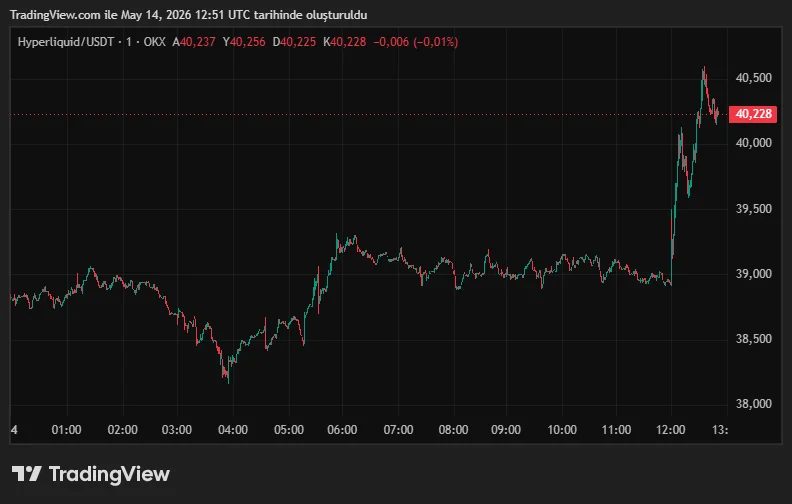
Hyperliquid has become one of the platforms closely followed by crypto investors in recent months, especially with its perpetual futures trading. Low fees, deep liquidity, and a fast user experience approaching centralized exchanges have been effective in the network's growth. With the renewed interest in DeFi, many traders have started to move their transactions to on-chain platforms. This transition has increased Hyperliquid's trading volume and weight within the ecosystem. Also, at the time of writing, the HYPE coin price has risen by 3% to above $40.
According to data reported by Coinbase, the USDC supply on Hyperliquid has nearly doubled year-on-year, approaching $5 billion. This figure shows that USDC plays a critical role in the Hyperliquid ecosystem not only as a payment instrument but also in terms of transaction, collateral, and treasury management. Stablecoins are largely used as the basic consensus layer for trading activities in the crypto market. Therefore, having strong stablecoin liquidity on a rapidly growing transaction network creates a strategic advantage for Coinbase and Circle. Another noteworthy part of the agreement concerns USDH, the stablecoin project specific to Hyperliquid. Native Markets, the developer of USDH, accepted terms granting Coinbase the right to purchase USDH branded assets. USDH will remain usable against USDC or fiat currency during the transition period. However, after this period, the product is planned to be phased out over time. This structure could pave the way for a clearer standard on the stablecoin side of the Hyperliquid ecosystem. USDH remaining in the background and USDC taking center stage as the primary quotation asset means a simpler liquidity structure for traders. It also allows Coinbase to take on a more visible role in growing on-chain transaction networks like Hyperliquid. This move by Coinbase also reveals that competition in the stablecoin market is increasingly moving to the infrastructure level. Stablecoins are no longer considered solely as standalone products. Exchanges, blockchain networks, and DeFi protocols are making these assets an integral part of transaction, collateral, and treasury systems. Especially in the 24/7 crypto market, the uninterrupted management of liquidity has become even more important for major players. Native Markets notes that Coinbase's inclusion in the ecosystem could strengthen Hyperliquid's position. A direct role for one of the largest US-based crypto companies in Hyperliquid's infrastructure could lead to the network gaining more prominence in discussions about its market structure. Coinbase also emphasizes that the partnership will contribute to creating a more unified global market for on-chain capital markets.