
Derivatives exchange CME Group has asked the SEC to withdraw its conditional approval of Nasdaq PHLX’s cash-settled Bitcoin index options. CME’s argument is straightforward: these contracts fall entirely under the jurisdiction of the CFTC, not the SEC.
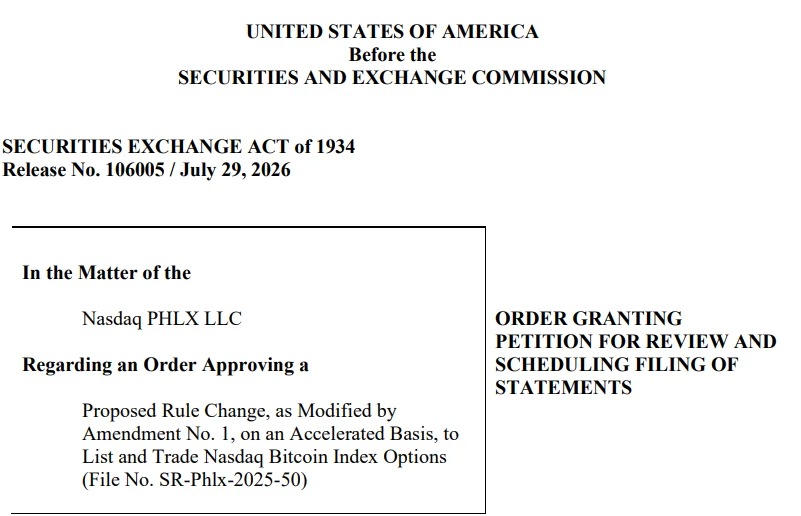
The SEC accepted CME’s petition on July 29 and stayed the approval until the full commission reviews the matter. The deadline for submitting written statements supporting or opposing the approval is August 24. The order offers no indication of how commissioners view CME’s arguments, leaving the product’s future uncertain.
What sparked the jurisdictional dispute?
Nasdaq first announced its plans for the options with CF Benchmarks in 2024. The key difference from existing options tied to spot Bitcoin ETFs lies in the underlying asset. Those products are based on securities, while Nasdaq’s proposed options would track an index linked directly to Bitcoin. That distinction sits at the center of the dispute.
The SEC’s Division of Trading and Markets approved the application on May 22 under delegated authority. However, Nasdaq still needed separate exemptions from the CFTC before trading could begin.
If granted, those exemptions would allow Nasdaq PHLX, formerly known as the Philadelphia Stock Exchange, to offer the contracts under both SEC and CFTC oversight. They would also allow the Options Clearing Corporation to clear the products without registering separately with the CFTC as a derivatives clearing organization.
CME argues that Bitcoin is a commodity rather than a security. An option tied directly to its value therefore does not qualify as a security-based derivative. Instead, CME says it meets the definition of a commodity option or swap, placing it exclusively under the CFTC’s jurisdiction under the Dodd-Frank Act.
One of the most significant points in CME’s petition concerns the limits of a CFTC exemption. According to the company, granting an exemption does not transfer jurisdiction to the SEC. In other words, the type of CFTC relief Nasdaq requires would not amount to permission for the SEC to regulate the product as well.
CME argues that the division of authority between the two agencies cannot be changed through an administrative exemption. It also rejects the idea that the SEC can claim oversight simply because the product would trade on a securities exchange. Jurisdiction, CME says, comes from the nature of the product, not the platform on which it trades.
The company further claimed that the SEC’s Division of Trading and Markets exceeded its authority and adopted an unusual interpretation of Section 717 of the Dodd-Frank Act. CME asked the commission to overturn the approval entirely.
It also issued a broader warning. If the decision stands, exchanges could potentially list options or futures tied to other non-security commodities under SEC rules.
Competition also appears to be a major concern for CME. The company said Nasdaq’s product would compete directly with its own offerings and could create additional regulatory costs for its exchange and clearing businesses.
How would the contract work?
The proposed options would trade under the symbol QBTC and reference the CME CF Bitcoin Real Time Index divided by 100. The index uses order book data from eligible Bitcoin-dollar markets and updates every 200 milliseconds.
The contracts would be European-style, meaning holders could exercise them only at expiration. Settlement would take place entirely in US dollars, with no Bitcoin changing hands.
The final settlement value would use the CME CF Bitcoin Reference Rate New York Variant, also divided by 100. Calculated once per day, the benchmark draws on Bitcoin-dollar transactions completed during a one-hour window ending at 4:00 p.m. New York time.
Nasdaq argues that the product would give spot Bitcoin ETF holders another way to hedge or adjust their exposure on a national securities exchange. Investors could also manage the options under the same margin framework as their ETF positions.