
A significant step has been taken toward the CLARITY Act (Digital Asset Market Clarity Act), which aims to bring long-awaited clarity to the cryptocurrency market in the US. The bill, introduced by Wyoming Senator Cynthia Lummis, is scheduled to be brought before the Senate in mid-January. This comprehensive text, prepared in addition to H.R. 3633, aims to clarify which institution will oversee digital assets and how.
The 278-page draft stands out as the most up-to-date version of the "market structure" regulations that both Republicans and Democrats have been working on for months. Prepared by the Senate Banking Committee, the text aims to reduce the ongoing jurisdictional confusion in the US crypto markets and create a more predictable regulatory environment.
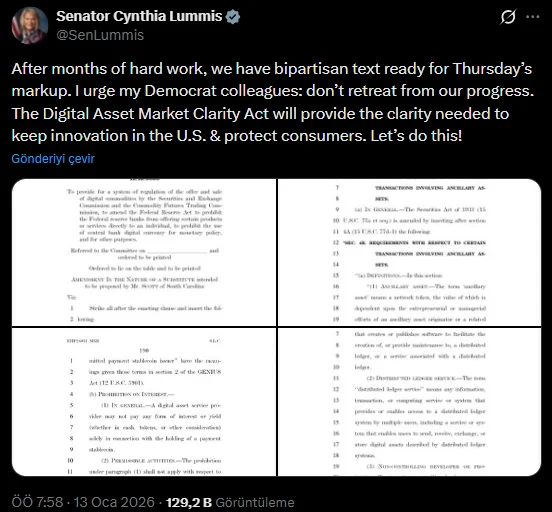
At the heart of the CLARITY Act is the long-debated issue of the division of authority between the US Securities and Exchange Commission (SEC) and the Commodity Futures Trading Commission (CFTC) regarding the oversight of digital assets. The bill aims to reduce conflicts that create uncertainty in the markets by more clearly defining which type of crypto asset falls under the supervision of which institution.
Supporters argue that this approach can limit market manipulation and create a more stable environment for both individual and institutional investors. The reduction of sudden and unpredictable enforcement processes is seen as critical for long-term institutional participation.
New Status for Cryptocurrencies with ETFs
One of the notable sections of the draft text concerns regulations for cryptocurrencies with exchange-traded funds (ETFs). If a crypto asset's ETF is listed on a national exchange in the US, no additional disclosure will be required from the SEC. Details such as who controls the project or the token distribution structure will not be requested separately. In this context, altcoins with ETFs, such as XRP, Solana, Litecoin, Hedera, Dogecoin, and Chainlink, along with Bitcoin and Ethereum, are considered under the same status. This approach is seen as a significant milestone for the altcoin market.
Interest Ban on Stablecoins, but Exceptions Exist
The bill also outlines a clear framework regarding stablecoins. Accordingly, users will not be able to earn interest or returns simply by holding stablecoins. However, rewards based on activities such as payments, transfers, providing liquidity, or active use within the platform are allowed. The Senate Banking Committee's draft aims to both protect the consumer and not completely restrict market activities with a "conditional return" approach.
This provision remains one of the most controversial topics in the sector. Stablecoin revenues are cited as one of the biggest points of disagreement on the bill.
Protection for DeFi Developers
The bill also includes the Blockchain Regulatory Certainty Act. Accordingly, DeFi developers who do not control user funds and only develop software will not be considered financial intermediaries. The aim is to bring oversight to structures that manage user assets while protecting open-source development and innovation.
Criticisms and Political Calendar
Supporters of the bill argue that the US could once again become the center of global crypto innovation. However, figures like Elizabeth Warren are warning that the SEC's powers could be weakened, creating risks for pension funds. Meanwhile, Senate Agriculture Committee Chairman John Boozman has postponed the committee's discussions on the CLARITY Act until the last week of January. This decision is interpreted as an indication that sufficient bipartisan support has not yet been secured. With the Senate Banking Committee expected to release the final text soon, the CLARITY Act is on track to become the most comprehensive framework for US cryptocurrency regulation to date. The final version of the bill and any proposed changes will be closely watched by markets in the coming weeks.