Chainlink has launched a cross-border foreign exchange initiative called Project Pangea together with 47 South Korean and European banks whose combined assets exceed $10 trillion. The project aims to settle institutional FX transactions almost instantly.
The initiative brings Chainlink together with two banking groups, Qivalis and UniKA. Qivalis is a euro stablecoin consortium made up of 37 European banks. UniKA is an alliance that includes more than 10 South Korean commercial banks.
The Target Is a Shift From T+2 to T+0
Foreign exchange transactions are currently usually settled within 48 hours, a process known in the industry as T+2 settlement. Project Pangea aims to reduce this period to nearly zero, targeting T+0 settlement. It plans to do this through regulated stablecoins pegged to the euro and the South Korean won.
The technology behind the system is called atomic payment-versus-payment settlement. Both sides of an FX transaction are completed at the same time; if one side fails, the other does not go through either. This removes the risk that one party sends the money while the other fails to complete the payment.
European banks will initiate transactions through Swift, the messaging system they have used since the 1970s. Chainlink’s infrastructure will convert these messages into atomic swaps running on an independent blockchain called the Pangea L1 Network. No major system overhaul is required on the banking side; the project is designed to work in compliance with Swift and ISO 20022 standards.
Niki Ariyasinghe, Chainlink’s head of Asia Pacific and the Middle East, said the group aims to begin live transactions within 12 months under a legal and regulatory compliance framework.
A $150 Billion Trade Corridor
The project targets the Europe-South Korea trade corridor, which handles more than $150 billion in goods and services annually. This corridor ranks among the world’s top 15 trade routes. According to industry data, 60% of global stablecoin payments take place in Asia; Ariyasinghe said this points to infrastructure gaps in emerging financial ecosystems.
LINK Price Fails to Capture Institutional Momentum
Chainlink’s institutional partnership list in 2026 is not limited to Project Pangea. In May, DTCC selected Chainlink’s Runtime Environment for its Collateral AppChain, a platform that automatically manages collateral pricing, margin and settlement. DTCC processed roughly $4.7 quadrillion in securities transactions in 2025.
Robinhood chose Chainlink as the oracle provider for Robinhood Chain, its Ethereum Layer 2 network built on Arbitrum. In the first quarter of 2026, Amundi and Spiko launched a tokenized investment fund using Chainlink technology; the fund attracted more than $400 million in assets within three weeks.
In December 2025, Chainlink worked with 24 financial institutions, including DTCC, Swift, Euroclear, UBS and BNP Paribas, to develop infrastructure for corporate actions processing, an area that costs the industry around $58 billion per year.
In the first quarter of 2026, U.S. regulators the SEC and CFTC classified LINK as a digital commodity. In April 2026, Chainlink became available on AWS Marketplace, giving millions of developers access to data streams, data feeds and proof-of-reserve tools.
Despite all these partnerships, LINK remained trapped in the $8 to $10 range for much of 2026. At the end of April, the token was trading at $9.23 after rising 9.5% over the previous 30 days; however, this still marked a 36.6% decline from the previous year. LINK remains about 82% below its all-time high of $52.70, reached in May 2021.
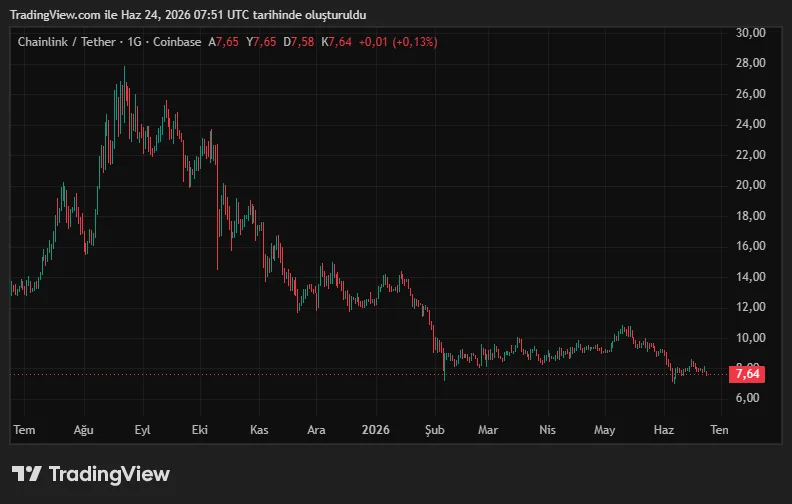
Spot ETF inflows for LINK rose from $10.82 million in March to $11.08 million in April. This marked the first monthly increase since the $59.16 million peak recorded in December.
The gap between the scale of Chainlink’s technology usage and the token’s price remains striking. The company’s total transaction volume has surpassed $28 trillion. Its Cross-Chain Interoperability Protocol handles around $90 million in token transfers per week, while tokenized real-world assets built on Chainlink reached $27 billion in 2026. For investors, the question remains the same: if institutional adoption is expanding this much, why is the price not reacting?