
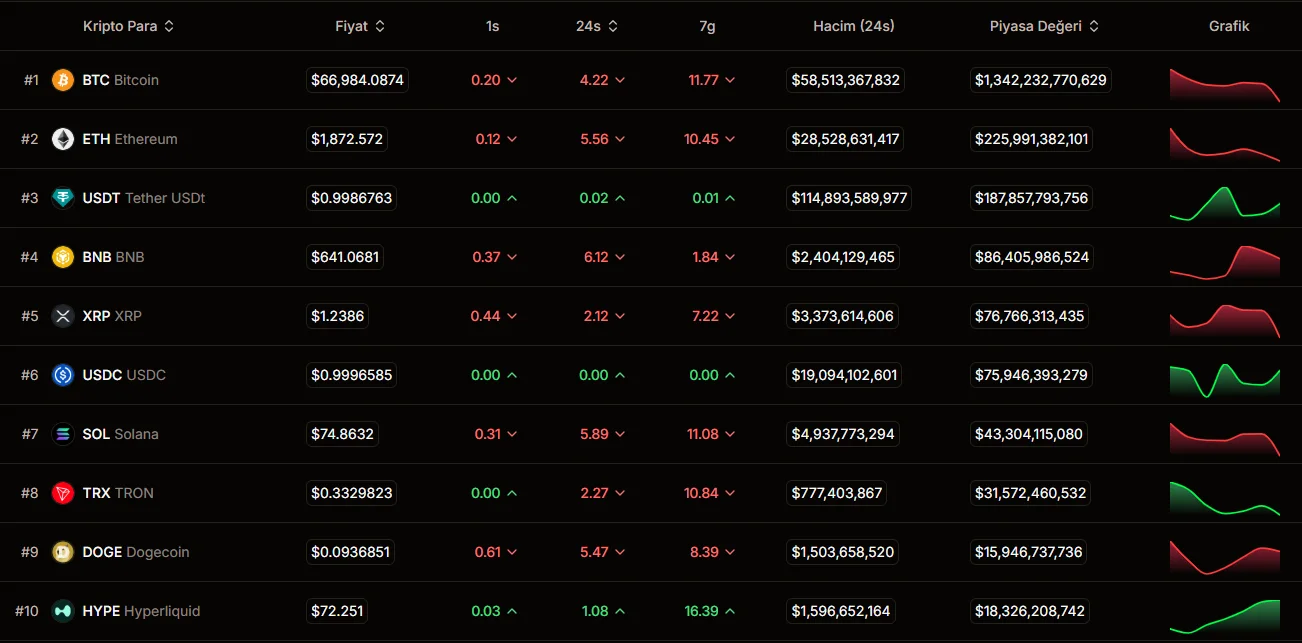
Bitcoin fell as low as $65,700 on Tuesday night. This marked one of the sharpest intraday drops seen in recent weeks. Although the asset recovered to around $66,900 shortly afterward, the broader question remains: Is this decline the beginning of a longer period of pressure?
The broader picture in the crypto market
Bitcoin’s pullback also triggered steep losses across other major cryptocurrencies. Ethereum dropped 5 percent to $1,872, while BNB fell 6 percent to $641. XRP lost 2 percent, and Solana declined 5 percent.
ETF outflows mark a 12-day negative streak
The main data point deepening the selling pressure came from the ETF side. According to SoSoValue data, U.S. spot Bitcoin ETFs recorded $519.2 million in net outflows on Tuesday. This also marked the 12th consecutive day of negative flows. Spot Ethereum ETFs also extended their uninterrupted outflow streak to 16 days, with $90.2 million in withdrawals.
Twelve consecutive days of outflows indicate that institutional investors are currently acting with significant caution in the market.
Zeus Research analyst Dominick John said three key factors were behind the decline: heavy outflows from institutional ETFs, aggressive long-position liquidations, and a broader macro shift toward risk aversion. According to John, “the forced unwinding of leveraged positions accelerated downward pressure on major assets.”
Middle East tensions weaken risk appetite
Andri Fauzan Adziima, research director at the Bitrue Research Institute, said the latest airstrikes in the Middle East pushed oil prices higher and significantly weakened risk appetite. According to Adziima, this development “triggered large-scale long liquidations, accelerated ETF outflows, and showed Bitcoin behaving more like a high-risk asset than a safe-haven instrument.”
Oil markets indeed saw a notable move. WTI crude futures rose 1.13 percent to $94.82, while Brent crude climbed 1.04 percent to $97.07. When oil reaches these levels, the environment is rarely favorable for crypto.
Asian equities followed a mixed course. Japan’s Nikkei 225 index hit a record high after rising 2.95 percent midway through the session. China’s CSI 300 index gained 1.13 percent. However, Hong Kong’s Hang Seng index fell 1.56 percent.
Strategy’s Bitcoin sale did not go unnoticed
Alongside geopolitical tensions, there was another issue markets were trying to digest: Strategy’s Bitcoin sale.
The company told the SEC that it sold 32 BTC for approximately $2.5 million between May 26 and May 31. This marked the first Bitcoin sale by the Michael Saylor-led firm since December 2022.
Peter Chung, head of research at Presto Research, drew attention to the sale’s psychological impact on the market. “Those looking for a BTC-specific narrative to explain Bitcoin’s weak 24-hour performance will inevitably point to MSTR’s sale of 32 BTC,” Chung said. However, he does not see this as a sufficient explanation. In his view, the real breakdown began a few weeks earlier and was most likely driven by selling pressure created to fund rotational buying into AI-themed equities.
Saylor had described the sale as an “inoculation.” Whether this small-scale move will be seen as a smart defensive maneuver or the final straw for an already impatient market depends largely on how investors position the sale, according to Chung.
Strategy’s Nasdaq-listed shares closed Tuesday at $136.08, down 9.15 percent. The company’s stock has lost roughly 23 percent over the past month.