
Bitcoin is trading at $62,885 today. BTC has lost 14.28 percent over the past seven days, pointing to a sharp decline in institutional demand since its January peak of $80,000.
Coinbase premium falls to February levels
The signal troubling the market most is coming from the Coinbase Premium Index. The index measures the price difference between BTC on Coinbase and Binance. That gap has now fallen to minus 0.19, its lowest level since the sudden sell-off seen in February.
This may look like a simple technical indicator, but it carries broader meaning. Coinbase is mostly used by U.S.-based institutional investors. Such a negative premium suggests that American buyers are far more cautious than offshore investors.
ETF bleeding reaches 13 days
U.S. spot Bitcoin ETFs confirm the same picture. According to SoSoValue data, the funds have recorded net outflows for 13 consecutive trading days since mid-May, with total losses reaching $4.37 billion during this period. Total net assets fell from $104.29 billion on May 15 to $82.83 billion, marking a $21.46 billion drop in roughly three weeks.
Most of the bleeding came from movements in two funds. BlackRock’s IBIT saw $342.34 million in outflows in a single day. Fidelity’s FBTC lost another $54.26 million on the same day. Alongside the decline in BTC price, the two funds fell by 2.76 percent and 2.65 percent, respectively.
The crash spreads to altcoin ETFs
For a while, altcoin ETFs had been drawing small but steady inflows thanks to retail investor interest. That picture has now changed. Ethereum ETFs recorded $52.94 million in outflows in a single day, with the largest share coming from BlackRock’s ETHA fund at $51.58 million. Solana funds saw $12.74 million in net outflows, while XRP funds lost $5.34 million.
At this point, there is almost no category left in the market showing net inflows. The only exception is ETFs tied to the Hyperliquid token, HYPE. 21Shares’ THYP fund managed to attract $2.99 million on the same day and has accumulated $139.51 million since its launch on May 12.
Grayscale also launched its own Hyperliquid product, HYPG, on the same day. The fund stands out with a lower expense ratio than its competitors, but its launch came precisely on a day when almost every other crypto ETF category was seeing outflows.
Liquidation data confirms the pressure
The futures market is pointing in the same direction. Over the past 24 hours, total liquidations across the crypto market reached $1.71 billion. Long positions accounted for 85.95 percent of this liquidation wave, meaning that most of the losses came from investors betting on higher prices. Over the past 12 hours, the share stood at 85.51 percent. Long-position liquidations alone reached $1.47 billion over 24 hours.
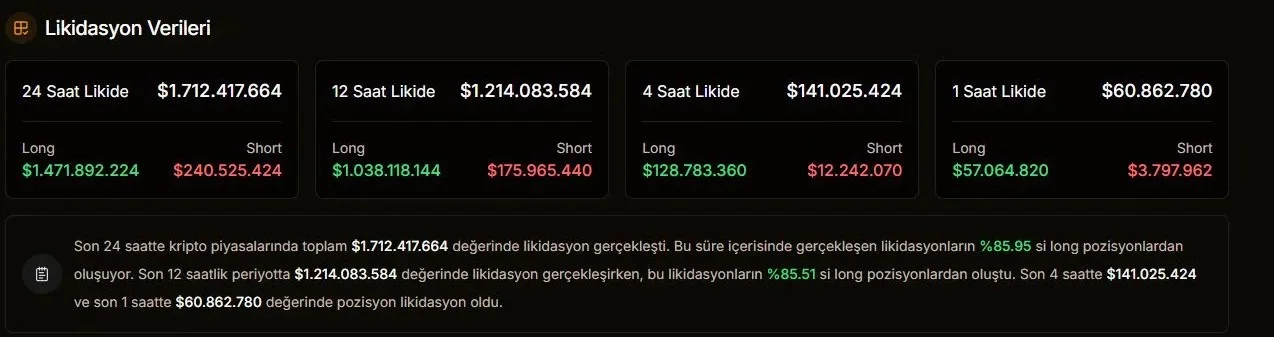
This data shows that the price decline was not only the result of weaker demand. Forced closures of leveraged long positions also intensified the selling pressure.
Citi says ETF flows explain BTC price moves
In a note sent to clients last Tuesday, Citi said spot Bitcoin ETF flows explain roughly 45 percent of weekly BTC price movements. The bank expects investor sentiment to remain under pressure as long as ETF flows stay negative and U.S. crypto market structure legislation remains stalled in Congress.
From a technical perspective, Bitcoin’s 24-hour trading range stands between $61,557 and $67,327. BTC traded above $80,000 at the beginning of May and has since lost more than 20 percent.
The main concern in the market is not retail investor fear at this stage. It is the speed at which institutional players are pulling back.