
Bitcoin extended the sharp rally that began on August 19 and broke above the $75,000 threshold overnight. The price reached $75,664, bringing its two-day gain close to 15%.
Bitcoin was trading near $75,500 on the morning of August 21. Its daily gain exceeded 8%, while its market capitalization climbed back above $1.5 trillion.
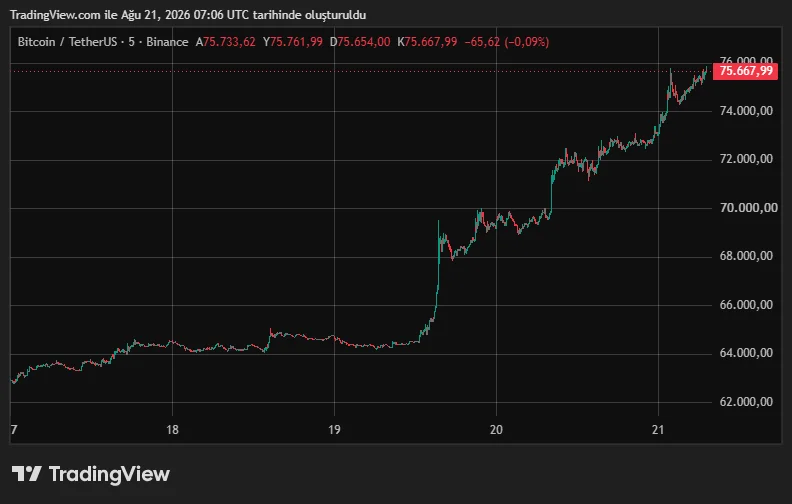
The rally has now continued into a third day following the initial wave of short liquidations. Fresh inflows into U.S. spot Bitcoin ETFs also suggest that the rise is no longer being driven solely by forced buying in the derivatives market.
Bitcoin rally reaches $75,000
Bitcoin began its move near $64,300 on August 19 before climbing to $68,700. During the initial rally covered by JrKripto, short liquidations accelerated the price increase.
BTC held on to its gains afterward. The price remained near $71,800 on the afternoon of August 20 before fresh buying emerged overnight.
By breaking above $75,000, Bitcoin recorded one of its strongest recoveries since June. The intraday high reached $75,664.
The gains also spread across the broader crypto market. Ether and other large-cap altcoins advanced, while U.S.-listed shares of crypto companies also benefited from the rally.
Spot Bitcoin ETFs receive $517 million
Forced buying in the derivatives market played a prominent role during the first stage of the rally. However, the price continuing to rise for three consecutive days indicates that demand in the spot market has also strengthened.
Data showed that U.S.-listed spot Bitcoin ETFs recorded $517 million in net inflows. This marked their largest daily inflow in roughly three and a half months.
ETF flows are among the main indicators used to track Bitcoin demand from investors in traditional markets. New Bitcoin purchases by these funds can directly tighten the available supply in the spot market.
Activity in the derivatives market has yet to subside. Short positions accounted for most of the Bitcoin positions liquidated during the latest rally. Although spot demand has strengthened, forced buying from leveraged trades is still contributing to the price increase.
U.S. Treasury decision supports risk appetite
One of the main macroeconomic catalysts behind Bitcoin’s rise was the U.S. Treasury’s decision to expand its buybacks of long-term government bonds. The department announced that it would increase the maximum size of each buyback operation for 10- to 30-year bonds from $2 billion to at least $4 billion.
According to the U.S. Treasury’s announcement, the larger buybacks will begin on September 9. Long-term bond yields declined following the decision, while pressure on the U.S. dollar increased.
Lower yields and a weaker dollar supported demand for risk assets such as Bitcoin. However, the buyback program does not amount to direct monetary expansion. The Treasury aims to strengthen liquidity in the long-term government bond market through the measure.
Developments on the regulatory front also contributed to the positive market sentiment. Following the White House crypto summit, U.S. President Donald Trump called on Congress to pass the CLARITY Act.
Which Bitcoin levels should investors watch?
The intraday peak near $75,600 has become Bitcoin’s first short-term threshold. Holding above this level could support a continuation of the rally toward the $78,000 to $80,000 range.
On the downside, the $72,000 to $73,000 range is the first key area to watch. Bitcoin remaining above $70,000 will be important for preserving the latest breakout.
Whether ETF inflows continue will also provide clues about the rally’s underlying structure. If spot demand remains strong while leverage grows at a limited pace, the move could develop on a more balanced foundation. Weaker fund inflows combined with rapidly expanding derivatives positions could increase the risk of a sharp pullback.