
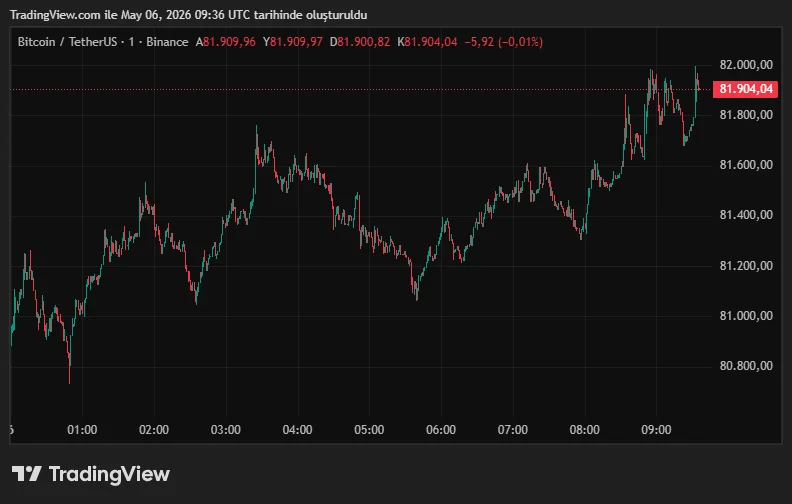
The most notable movement in global markets this week came after news that progress had been made in diplomatic talks between the US and Iran aimed at ending the war. As flight towards risky assets increased, Bitcoin approached the $82,000 level, Nasdaq futures contracts linked to technology stocks rose, and oil prices experienced a sharp pullback.
Hope for an agreement in US-Iran talks boosted risk appetite in crypto and stock markets
According to Axios, Washington and Tehran are close to agreeing on a one-page memorandum of understanding aimed at ending the war and paving the way for more comprehensive nuclear talks. As reported by Reuters, the draft contains a 14-point framework, and it is stated that Steve Witkoff and Jared Kushner on the US side are conducting direct and intermediary contacts with Iranian officials.
This development strengthened expectations that geopolitical risks may decrease in the markets. Bitcoin maintained its gains from the Asian session in European trading, hovering near $82,000. According to CoinDesk data, BTC followed the recovery in risky assets after the news flow. At the same time, Nasdaq futures saw a rise of over 1%.
The movement in the oil market was sharper. WTI crude oil futures fell by approximately 6% to $95.28 per barrel. This decline was influenced by the expectation that a potential agreement could normalize oil flow through the Strait of Hormuz. The disruption of flow in the region since the end of February had driven up energy costs, particularly in Asian markets, and increased global inflation concerns.
The Strait of Hormuz is considered one of the most sensitive transit points for global energy trade. Therefore, any news suggesting a potential decrease in tensions in the region affects not only the oil market but also a wide range of assets, from stocks to cryptocurrencies. The recent price movement also showed investors shifting away from energy risk towards risky assets like technology stocks and Bitcoin. One of the most striking points in the draft agreement was the claim that Iran might agree to remove highly enriched uranium from the country. This has long been a key demand of the US. However, market experts emphasize that a lasting agreement on this issue may not be easy.
ForexLive analyst Justin Low also stated that he is cautious about the possibility of Iran making concessions in the nuclear field. Low expressed skepticism on this point and said it is necessary to see how the process will unfold. This comment shows that despite the optimism in the markets, the agreement is not yet finalized and the diplomatic process remains fragile.
Despite this, the market reaction was strong. Traders began to price in the possibility that the risk of war might decrease and that energy supply might normalize. This picture once again revealed how sensitive Bitcoin has been to macroeconomic developments in recent days. Apparently, the drop in oil prices, the recovery in technology stocks, and the weakening need for safe haven assets created a more supportive environment for BTC. Market data also showed Bitcoin trading above $81,000 and remaining in positive territory for the past 24 hours.
In the coming period, the focus of the markets will shift to whether the US-Iran agreement is formalized. If the agreement is signed, further easing in oil prices and a new wave of relief in risky assets may be seen. Conversely, a deadlock in negotiations could create renewed pressure on global markets, particularly through energy prices.