
The crypto options market saw a major expiration event on July 31. According to data shared by Wu Blockchain, 149,000 Bitcoin options contracts expired, carrying a total notional value of $9.6 billion.
The put-call ratio came in at 0.28. The calculation is relatively straightforward: the number of put options in the market is divided by the number of call options.
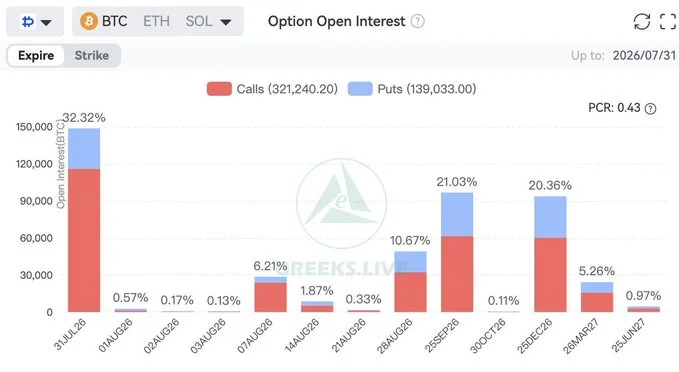
A low ratio of 0.28 means that call options outnumbered put options by nearly four to one. The overwhelming majority of the expiring positions were opened on the assumption that Bitcoin’s price would rise.
The most actively traded strike price was $64,000. A strike price determines the level at which an options contract gives its holder the right to buy or sell the underlying asset.
For example, an investor holding a Bitcoin call option with a $64,000 strike has the right to purchase Bitcoin at that price when the contract expires. The fact that $64,000 attracted the highest activity shows that market attention was heavily concentrated around this level.
Ethereum presented a more mixed picture
On the same day, 435,000 Ethereum options contracts also expired, with a total notional value of $830 million. Ethereum’s put-call ratio stood at 0.63, showing a considerably more balanced distribution than Bitcoin.
As the ratio of put options to call options rises, the market can be described as more cautious about the price outlook, or at least more willing to seek downside protection. The most active strike price for Ethereum was recorded at $1,850.
What do current prices indicate?
Bitcoin is currently trading near $63,900, down a negligible 0.05% over the past 24 hours. The picture changes slightly when the timeframe expands, as Bitcoin has lost 2.29% over the past week.
Despite the weekly decline, Bitcoin has gained 8.89% over the past 30 days. The recent cooling has therefore failed to disrupt the broader upward trend.
The chart supports this view. Bitcoin traded near $65,600 on July 27 before fluctuating between $63,600 and $65,200 throughout the week. The price later slipped to around $63,978.
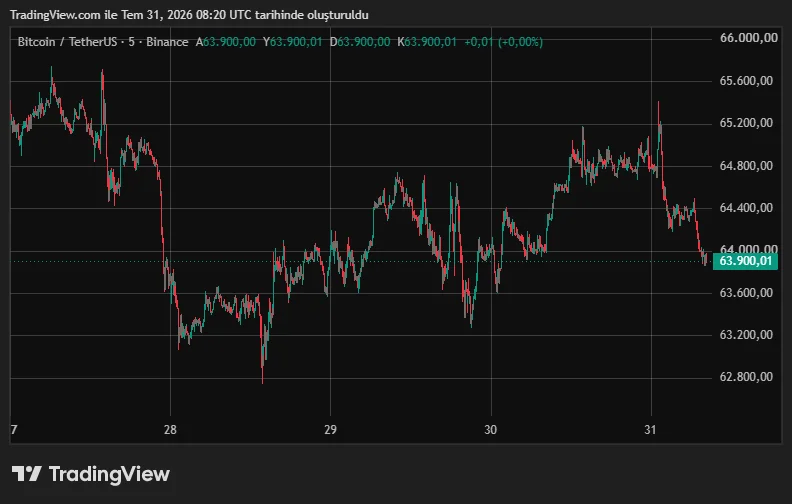
The key detail is that the $64,000 strike price was almost identical to Bitcoin’s spot price at expiration. This means that a large share of the contracts were positioned around the current market price rather than a distant speculative target.
That proximity makes the low put-call ratio more significant. Market participants appeared to expect Bitcoin to break above this price region.
Ethereum’s price action tells a slightly different story. ETH is currently trading near $1,887, down 0.79% over the past 24 hours and 0.34% over the past week.
The main difference appears in its monthly performance. Ethereum has gained 19.60% over the past 30 days, more than twice Bitcoin’s monthly return.
The chart points to a similar pattern. Ethereum traded near $1,960 on July 27 before moving within a range of $1,880 to $1,940 during the week. It later declined to approximately $1,890.
Ethereum’s $1,850 strike price also remained just below the spot price, with a gap of roughly $40. This proximity partly explains why Ethereum’s put-call ratio was more balanced than Bitcoin’s.
When the spot price trades this close to a major strike level, investors can more easily open positions on both sides of the market for hedging purposes.
Large options expirations often generate short-term volatility in the crypto market. Options writers may open positions in spot or futures markets to manage their exposure, especially when the spot price remains close to major strike levels.
This hedging activity can trigger sudden and temporary price movements as expiration approaches. Part of the volatility seen in Bitcoin and Ethereum during the week may be linked to these adjustments.
It is difficult to draw a long-term conclusion from a single day of options data. Still, Bitcoin’s low put-call ratio and the strong monthly performance of both assets suggest that the broader market trend remains upward despite the recent short-term cooling.