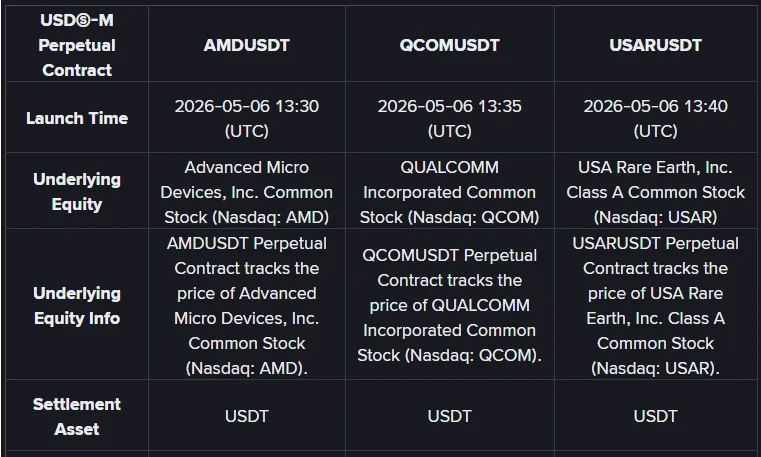
Binance, one of the largest players in the crypto derivatives market, continues to expand its product portfolio. The exchange announced it will launch three new USDⓈ-margin perpetual futures contracts to increase user trading options and diversify the experience on its platform. Accordingly, AMDUSDT, QCOMUSDT, and USARUSDT pairs will begin trading on Binance Futures on May 6, 2026. The AMDUSDT contract will be the first to be offered at 16:30 UTC (13:30 UTC), followed by QCOMUSDT and USARUSDT contracts at five-minute intervals. All three contracts will offer investors leverage up to 10x. This will allow users to access price movements of large-scale company stocks traded in traditional markets through crypto derivative instruments. One notable aspect of these newly listed contracts is their direct tracking of stock prices. The AMDUSDT contract will be based on the performance of Advanced Micro Devices (AMD), the QCOMUSDT contract on Qualcomm (QCOM), and the USARUSDT contract on USA Rare Earth (USAR) stocks.
Looking at the technical details of the contracts, the minimum transaction amount is set at 0.01 units. The minimum transaction size is kept at 5 USDT. The price increment (tick size) is fixed at 0.01 in all contracts. The funding rate is limited to +2% and -2%, and funding payments will be made every eight hours. Furthermore, the interest rate applied to these contracts is 0%.
Binance stated that these contracts will be exempt from standard rules regarding funding intervals. While under normal circumstances, if the funding rate exceeds certain limits, the payment interval can be reduced to one hour per eight hours, this change will not be made in these new products.
Traditional markets now in crypto
Binance's move shows us that crypto derivatives markets are beginning to be more than limited to digital assets. The inclusion of major players in the semiconductor sector, such as AMD and Qualcomm, as well as firms operating in the rare earth elements field like USA Rare Earth, facilitates investors' access to different sectors through a single platform. Furthermore, thanks to Multi-Assets Mode support, users can use not only USDT but also other assets as collateral in these contracts under certain conditions. For example, an investor with a Bitcoin balance can use this balance as collateral to open trades in the relevant contracts. This feature allows for the implementation of more flexible strategies in portfolio management. On the other hand, Binance emphasized that it may make changes to contract features depending on market conditions. Elements such as funding fees, maximum leverage ratios, or collateral requirements may be updated over time. This requires investors to closely monitor contract details before trading.