
Binance, one of the largest players in the cryptocurrency market, has announced a new delisting decision for spot trading pairs. According to the exchange's statement, the decision to remove certain trading pairs from the platform was made as a result of regularly conducted market reviews. The statement indicates that as of April 2, 2026, at 2 PM Turkish time, the ALT/BNB, ARB/TUSD, BNB/ARS, GALA/ETH, INJ/BNB, SOLV/FDUSD, and XRP/TUSD trading pairs will be removed from the platform. Trading in these pairs will be completely stopped after the specified time. However, this decision does not mean that the relevant crypto assets are completely delisted. Users will be able to continue trading these tokens through other trading pairs available on Binance.
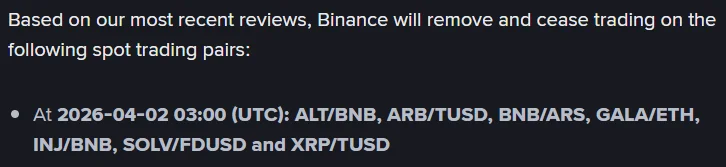
Low-volume pairs are being delisted
Exchange officials emphasized that the main purpose of such decisions is to protect users and maintain high trading quality on the platform. Factors such as low trading volume, insufficient liquidity, and weak market depth are generally considered in these evaluations. These criteria are critical to creating a healthier trading environment, especially in the volatile crypto market.
On the other hand, Binance will not only remove trading pairs; it will also terminate the spot trading bot services associated with these pairs. The exchange warned users that they should update or completely disable their active bots for the relevant trading pairs in advance to avoid any losses. Otherwise, unexpected results may occur due to transactions automatically terminated by the system.
Another important warning to users concerns open orders. Binance recommends closing open orders before the specified date. It is stated that when the delisting process begins, incomplete orders will be automatically canceled. This stands out as a risk factor that should be considered, especially for investors who engage in short-term trading.
Recently, increasing competition and regulatory pressures in the crypto market are pushing exchanges to be more selective. In this context, large platforms like Binance are shaping their listing policies according to stricter criteria. Regular reviews and the removal of underperforming trading pairs aim to both improve user experience and maintain market integrity.