
AVAX Technical Outlook
Avalanche made a strong start to 2026. In the first days of the year, the AVAX price rose by approximately 11%, while trading volume also increased significantly. Behind this rise are preparations for spot ETF products for Avalanche and signals of institutional interest. Major investment institutions such as Grayscale and VanEck updated their Avalanche ETF applications to include staking rewards, which increased investor demand for AVAX.
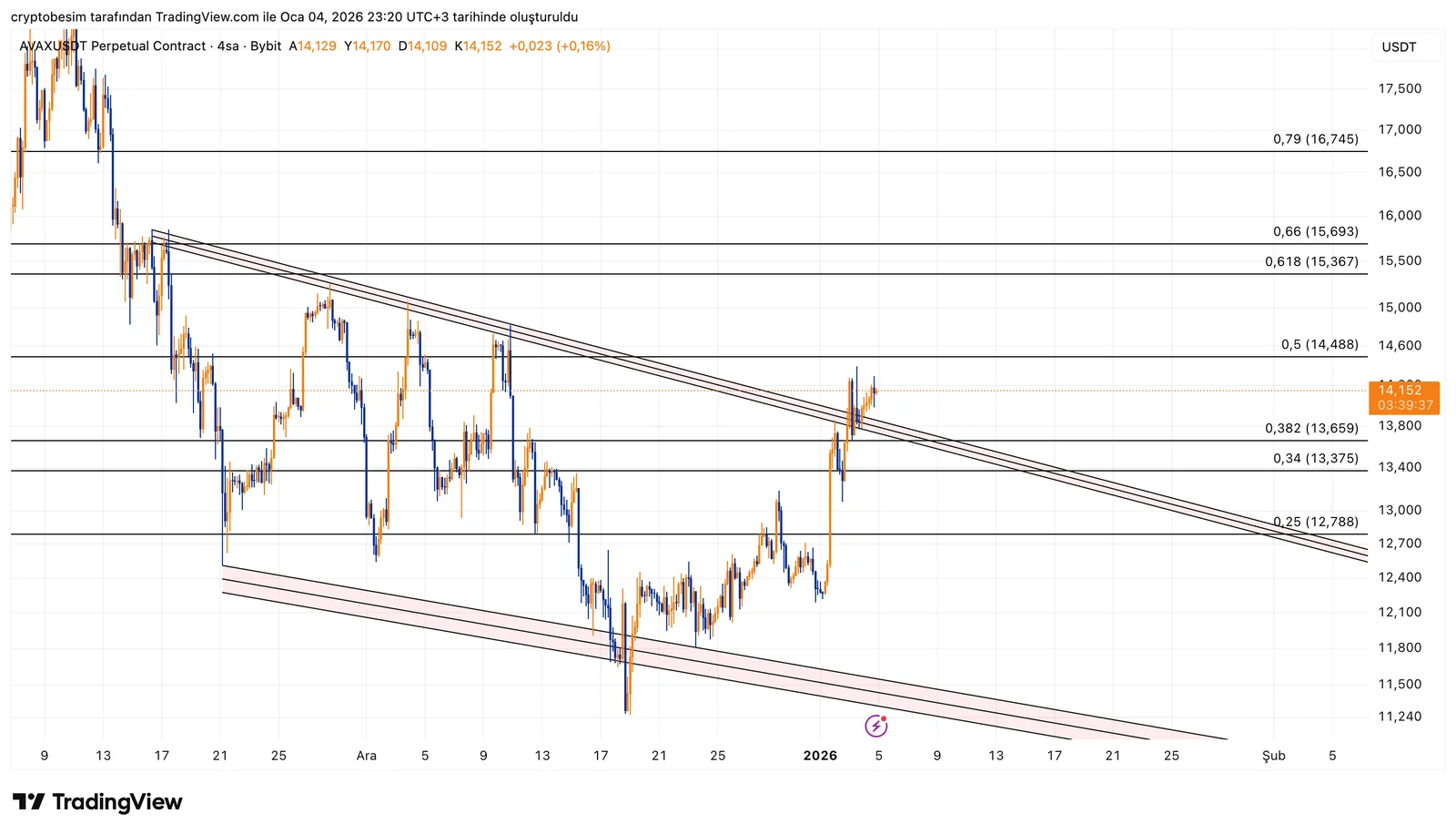
On the AVAX side, the long-followed descending channel structure has clearly been broken to the upside. The price surpassed the upper band of the channel with a high-volume candle, leaving this structure behind and now appears to have entered a post-breakout pricing phase.
After the breakout, it is technically important that the former upper band of the channel acts as support from below during pullbacks. The preservation of this region supports the view that the move is not a “fake break” but a structural trend change. The current price behavior is also progressing in line with this scenario.
On the upside, the 15.5 region stands out as the first meaningful target. This level is a natural technical target, as it was previously a strong horizontal resistance area and also overlaps with Fibonacci levels. The price is advancing toward this region gradually and in a controlled manner.
If the 15.5 region is surpassed, upward momentum may be carried into a higher band; however, it is also normal to see short-term profit-taking as this level is approached. On the other hand, as long as the price does not slip back below the 14 band, the overall outlook remains positive.
In summary, AVAX has completed a descending channel breakout and is in a structure that is trying to confirm this breakout through price behavior. In the current technical outlook, the main focus will be the 15.5 level and the price reaction in this region.
These analyses, which do not provide investment advice, focus on support and resistance levels that are thought to create short- and medium-term trading opportunities depending on market conditions. However, the responsibility for trading and risk management belongs entirely to the user. In addition, it is strongly recommended to use stop loss for the positions shared.