
The recent surge in selling pressure on the Ethereum market is centered directly on Vitalik Buterin. Onchain data reveals that Buterin has made significant sales of his Wrapped Ethereum (WETH) positions, further increasing pressure on the already fragile ETH price. According to the Arkham data, Vitalik Buterin transferred WETH via Cow Protocol in recent hours, receiving PYUSD stablecoin in return. The size of these sales, which occurred in just a short period, reached approximately $2.5 million. The transactions, spread throughout the day, suggest that these sales may not be a one-off event, but rather part of a planned and gradual process of reducing positions. Buterin's wallet movements are being monitored in real-time by on-chain analytics platforms, reinforcing the perception of a "founder sell-off" in the market.
Ethereum price falls.
These developments coincide with a period when the ETH price has fallen below the $2,000 level. Ethereum's native asset, ETH, has lost approximately 60% of its value since August and over 40% since the beginning of the year. While Bitcoin and some large-scale altcoins experienced more limited declines during the same period, ETH's negative divergence is noteworthy.
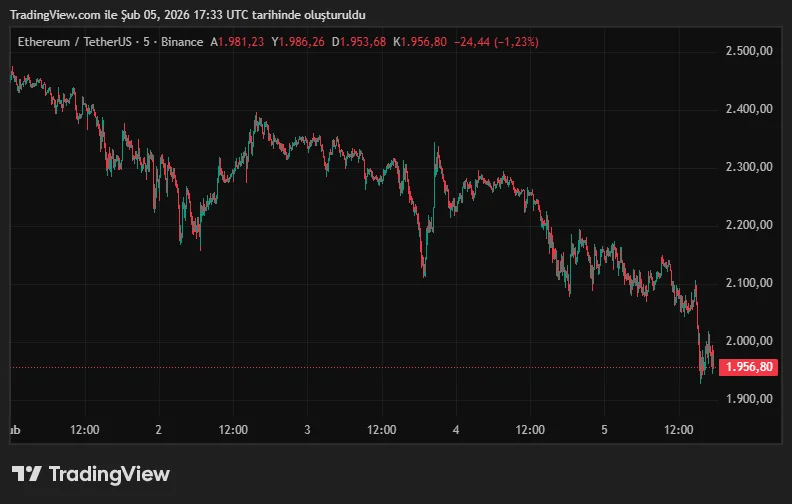
The selling pressure doesn't appear to be limited to Vitalik Buterin alone. Onchain data shows that tens of thousands of ETH have been released into the market in recent days to pay off loans on the decentralized lending platform Aave. As the price of ETH falls, its collateral value weakens, forcing borrowers to sell more ETH to avoid liquidation risk. Thus, the price drop becomes a feedback loop that triggers further selling. However, Vitalik Buterin's sales have a separate symbolic significance within this picture. While the reduction of positions by founding figures technically creates limited volume, its psychological impact can be much greater. Market participants interpret the selling by an "insider" as a strong signal of weakening risk appetite. On the other hand, the picture isn't bright for ETH on the institutional side either. Companies that emerged in the last year, dubbed the "ETH treasury," added ETH to their balance sheets as a long-term strategic asset. One of the best-known proponents of this approach, Tom Lee, has long maintained an optimistic stance on ETH. However, the sharp price drop has left a significant portion of these companies facing substantial unrealized losses. The general market perception is clear: the buying side for ETH is weak. Sales aren't solely driven by leveraged positions or fear of liquidation; founder sales, unraveling in derivative markets, and long-term investors incurring losses are all at play simultaneously. Ethereum's technical superiority or its leading position in the ecosystem is not being questioned in this process. However, pricing is shaped more by market psychology than fundamental data. Vitalik Buterin's WETH sales have further exacerbated this psychology. While it remains uncertain whether sales will continue, finding a strong short-term recovery narrative for ETH is becoming increasingly difficult. In the current landscape, ETH is acting less like an asset held by strong hands and more like an asset that nobody wants to get their hands on.