
Venture capital firm Andreessen Horowitz (a16z) has revealed key trends expected to dominate 2026 in a new research report published by its crypto team. According to the report, stablecoins, tokenization of real-world assets, and privacy-focused infrastructure are among the most critical forces shaping the next growth phase of the crypto ecosystem. a16z emphasizes that the sector is now beginning to move beyond the experimental phase and towards real use cases at the infrastructure level.
The a16z report identifies crypto trends
The report highlights that stablecoins are no longer a niche crypto product. According to a16z data, stablecoins reached approximately $46 trillion in transaction volume last year. This figure points to a scale comparable to large payment networks like PayPal, and also comes very close to the US ACH system. The near-instant and very low-cost nature of stablecoin transfers has positioned digital dollars as a powerful payment and consensus tool in the global internet economy. However, the report notes that the biggest obstacle facing the sector is still the “entry and exit ramps.”
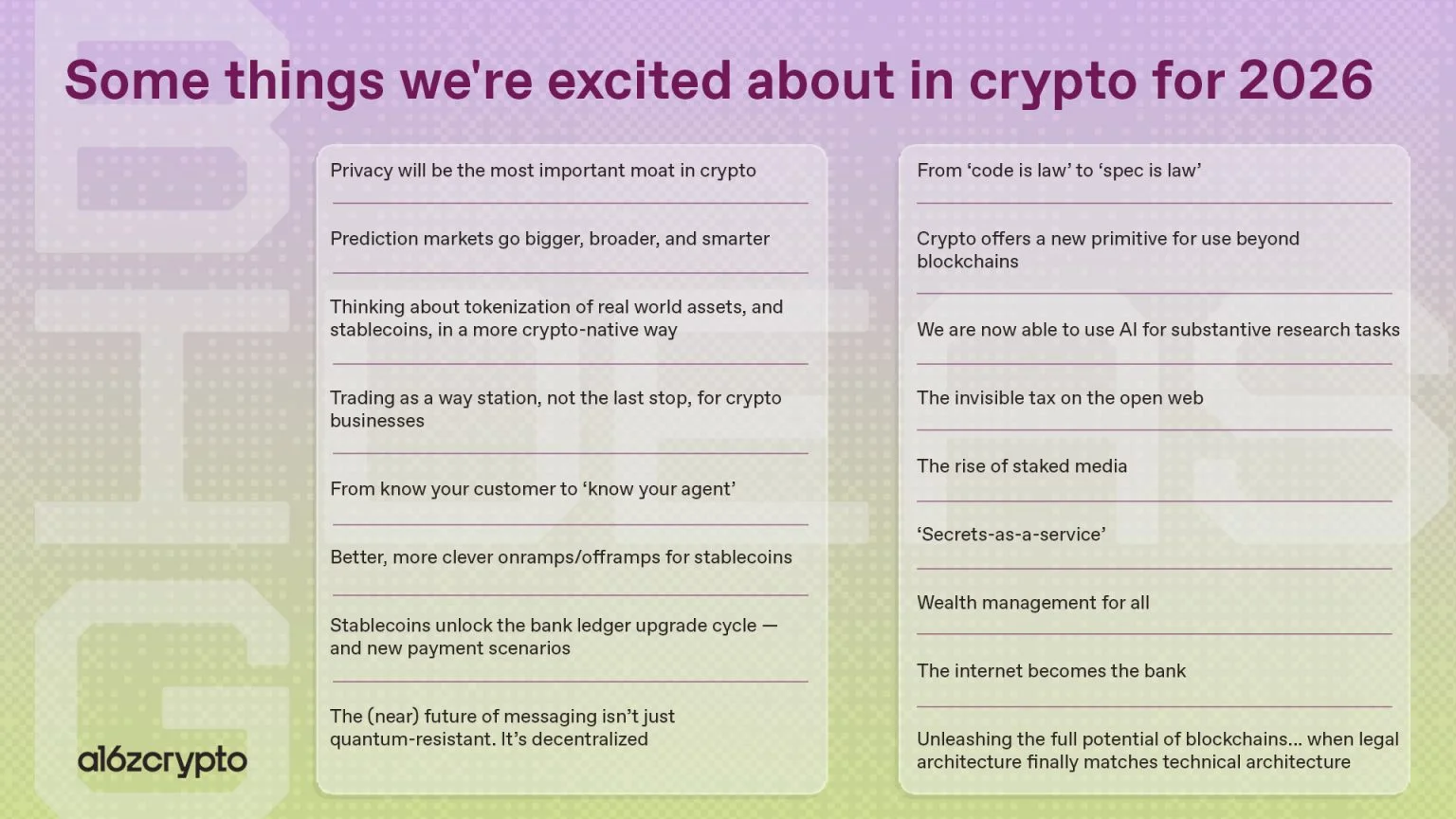
In other words, it's still not easy enough for users to seamlessly integrate stablecoins with traditional financial systems. a16z states that a new generation of startups is beginning to bridge this gap. Solutions integrated into local payment infrastructures, QR code-based networks, and card issuance platforms are making it possible to spend stablecoins in traditional stores. It is predicted that these developments could take stablecoins beyond the crypto world, making them one of the fundamental consensus layers of the internet. The tokenization of real-world assets is also highlighted as a significant topic in the report. Banks, fintech companies, and asset managers are showing increasing interest in moving stocks, commodities, and debt instruments onto the blockchain. However, a16z argues that today's tokenization models are largely “skeletal copies.” Many projects offer a digital reflection of traditional financial structures and don't fully leverage the advantages inherent to crypto. At this point, a16z points out the growing importance of crypto-specific derivative products. Perpetual futures contracts, in particular, stand out because they offer deeper liquidity and simpler implementation. The report states that the adaptation of emerging market equities to this model, called "perpification," holds significant potential. It is also expected that debt markets will shift from off-chain loans that are later tokenized to direct on-chain borrowing models. Privacy, meanwhile, emerges as another critical area of competition for 2026. According to a16z, privacy is no longer a secondary feature, but rather a powerful competitive advantage for blockchain networks. As inter-network interoperability increases, privacy-focused systems can create network effects that make it difficult for users to switch to other platforms. They can also offer stronger protection against increased transaction-based surveillance. The intersection between AI agents and crypto infrastructure is also highlighted in the report. The emergence of autonomous systems performing transactions without human intervention necessitates moving beyond the "Know Your Customer" model. a16z brings up the “Know Your Agent” approach at this point and emphasizes the need for new payment standards that will enable secure, instant value transfers between machines.
In conclusion, a16z argues that 2026 will be a transition year for crypto. Hype-driven narratives are expected to be replaced by a more predictable period of growth where regulation, institutional participation, and crypto-specific innovations intersect. According to the report, stablecoins, tokenization, and privacy infrastructures will form the cornerstones of a more resilient and sustainable on-chain economy.