A critical security vulnerability was discovered in Orchard, one of Zcash’s privacy-focused transaction pools. If exploited, the flaw could theoretically have allowed an unlimited amount of fake ZEC to be created. The vulnerability was discovered on May 29 and patched on June 1. After the issue was disclosed to the public, ZEC fell by around 35 percent within 24 hours.
AI Found the Vulnerability
Shielded Labs, an independent organization supporting Zcash, hired security engineer Taylor Hornby in April to review the protocol. Hornby used both traditional and AI-assisted methods during the audit. On May 29, he identified the Orchard circuit flaw with the help of Anthropic’s Opus 4.8 model and shared his findings with engineers at the Zcash Open Development Lab (ZODL).
Orchard is an encrypted transaction pool that allows users to send and receive ZEC with full zero-knowledge privacy. The Orchard circuit, which makes this possible, is a zero-knowledge proof system designed to ensure that only valid transactions are accepted. According to Shielded Labs, Hornby used Opus 4.8 to write a complete exploit in a local test environment, producing unlimited and undetectable fake ZEC.
The root of the vulnerability was an “underconstrained” element in the Orchard circuit. This element allowed incorrect inputs to be fed into an elliptic curve multiplication operation and still be treated as valid. The flaw had existed in the system since Orchard’s activation in May 2022, meaning it remained present for nearly three years.
Whether It Was Exploited Remains Unknown
The main concern is not only that the vulnerability existed, but that it cannot be definitively verified whether it was exploited in the past.
Orchard’s privacy architecture hides critical data in on-chain transactions. For this reason, developers cannot scan the blockchain and conclusively rule out the creation of fake coins. Shielded Labs said it does not find the likelihood of actual exploitation “too concerning,” citing the fact that the flaw went unnoticed for years by some of the world’s leading cryptographers.
“This discovery was not an accident; it was the result of a deliberate effort to identify such vulnerabilities before malicious actors could act. Hornby used the most advanced AI tools available only to white-hat security researchers, together with a carefully prepared custom AI setup. We believe he most likely won the race against attackers.”
As a next step, Shielded Labs is working on a network upgrade that would allow anyone to verify the integrity of the Zcash supply. The proposed upgrade includes the launch of a new encrypted pool and strict supply tracking for all coins in Orchard.
Price and Market Reaction
ZEC fell sharply on Thursday after the disclosure. According to data from The Block, the coin dropped 35 percent in 24 hours to $351.53, with most of the decline taking place in the first five hours after the news was published.
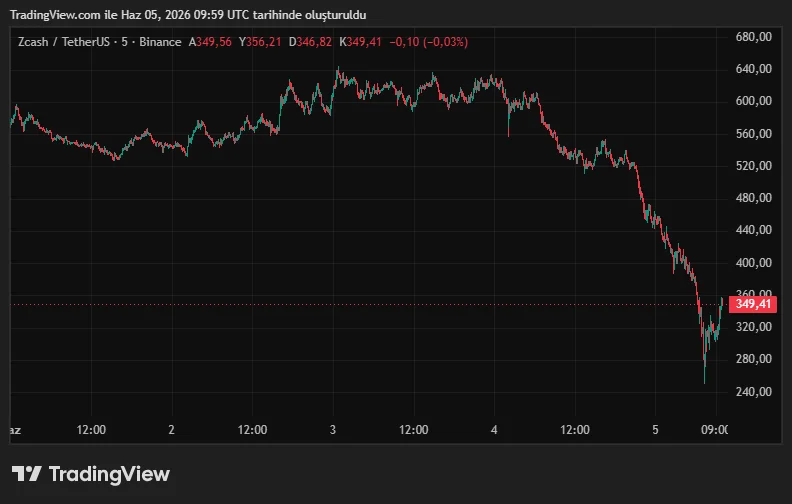
BitMEX CEO Arthur Hayes announced that he had closed his entire ZEC position. “I think any minting was extremely unlikely; however, it cannot be proven to be cryptographically impossible,” Hayes said, adding: “The privacy narrative against AI, governments, and big tech requires perfection.”
Crypto researcher Hupzy described the incident as a major blow to confidence. He argued that in an environment where no one can independently verify the integrity of the supply, the market’s real concern is not the vulnerability itself, but the uncertainty surrounding it. Hupzy also said developers would likely try to rebuild that trust through possible upgrades.
Shielded Labs had the final word on the issue: “This was a serious vulnerability, and we wanted to be transparent about what it means for Zcash users. No one wants to encounter a flaw like this; however, we are confident that Zcash is in a position to recover.”