
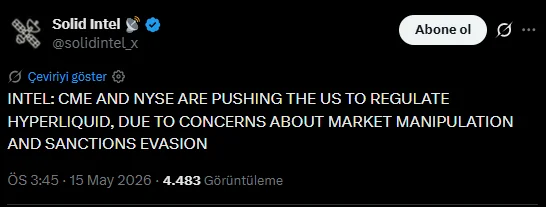
Hyperliquid has become one of the most talked-about projects of the week in the institutional cryptocurrency sector. Bitwise's spot Hyperliquid ETF, under the ticker symbol BHYP, began trading on the New York Stock Exchange, accelerating the rise in the HYPE price. However, this optimistic ETF agenda is accompanied by a striking claim from the regulatory side. According to a post by the account Solid Intel, the CME and NYSE are pushing for stricter regulation of Hyperliquid in the US due to risks of market manipulation and sanctions evasion.
Hyperliquid in the news this week
Hyperliquid has become one of the most talked-about projects of the week in the institutional cryptocurrency sector. Bitwise's spot Hyperliquid ETF, under the ticker symbol BHYP, began trading on the New York Stock Exchange. The sponsorship fee for the product was set at 0.34%, and this fee was zeroed for the first 30 days for the fund's initial $500 million in assets. The launch coincided with the sharp rise in the HYPE price seen over the past two days. The token gained approximately 20% in value as news accelerated, climbing above the $46 level. This movement was fueled not only by the anticipation of a new ETF but also by the intensification of institutional interest in the Hyperliquid ecosystem across several different areas within the same week. Bitwise's product creates a significant distinction in the US Hyperliquid ETF race. Instead of outsourcing the fund's HYPE assets to a third-party provider, the company plans to stake them through its own staking arm, Bitwise Onchain Solutions. According to Bitwise, BHYP is the first Hyperliquid ETP sponsor to utilize in-house staking infrastructure. This detail has sparked a debate in the ETF market that goes beyond fee competition. In structures where staking returns are managed through external providers, third-party operators take a share of the rewards. By keeping the staking process internal, Bitwise aims to both compete with lower fees and manage the return generated from the fund's staked HYPE assets more efficiently.
The competition, which started with 21Shares' THYP product, is growing
Bitwise's launch came just days after 21Shares' Hyperliquid ETF, THYP, began trading on Nasdaq. While 21Shares offers spot HYPE access with THYP, it also launched its 2x Long Hyperliquid ETF product, codenamed TXXH. According to the company's statement, the fee for THYP is 0.30%, while the fee for TXXH is 1.89%.
Initial data shows that demand for HYPE-focused ETFs is limited but real. 21Shares' THYP product reached a volume of $1.8 million and a net inflow of approximately $1.2 million on its first day of trading. According to news based on SoSoValue data, as of May 13, the total net inflow for THYP had reached $2.52 million. These figures may not seem large compared to Bitcoin or Solana ETF launches. However, Hyperliquid's newer and more niche nature means that initial demand is being closely watched by the market. The early performance of the funds shows that institutional investors are beginning to view HYPE not just as short-term price movement, but as a gateway to the growth of on-chain derivatives markets.
Coinbase move strengthens the momentum
Another development supporting the rise in HYPE price came from Coinbase. Coinbase announced that it will be the official treasury distributor of USDC on Hyperliquid. According to the company's announcement, USDC has reached approximately $5 billion in size on Hyperliquid and has become one of the core liquidity assets on the network. Coinbase also entered into a transition process with Native Markets that includes the right to purchase USDH branded assets. This development shows that Hyperliquid is becoming more visible not only as a DEX or perpetual trading platform, but also in terms of stablecoin liquidity and institutional market infrastructure. According to Bitwise data, Hyperliquid reached a trading volume of $2.9 trillion in 2025, representing approximately 60% of on-chain derivatives open positions and offering a structure capable of processing approximately 200,000 orders per second.
Regulatory claims attract attention
Despite market optimism, regulation remains one of the most sensitive areas for Hyperliquid. According to an account called Solid Intel, CME and NYSE are pressuring the US to regulate Hyperliquid due to risks of market manipulation and sanctions evasion. This claim has not yet been independently verified.
However, the debate over oversight of on-chain derivatives markets in the US is already growing. News that the CFTC wants to bring offshore DEXs closer to the US regulatory framework suggests that Hyperliquid may remain at the center of a stricter regulatory debate in the future. The establishment of the Hyperliquid Policy Center in Washington also indicates that the project is preparing for this process.