
Creating an AI character is no longer a technical task reserved for software teams. Holoworld AI focuses on helping creators, brands, and communities build interactive AI agents without coding, deploy them across different platforms, and develop an on-chain economy around them. HOLO serves as the ecosystem token used for staking, governance, liquidity, and project launches.
Holoworld AI: Definition and Origins
Holoworld AI is a content and application platform that combines AI agents with Web3-based digital ownership. The project describes itself as an “agentic app store,” an application marketplace built around AI agents.
The agents created on the platform go beyond text-based chatbots. They can communicate through text, voice, and digital avatars, produce content, and perform different tasks using tools added by developers.
Creators sit at the center of Holoworld’s model. Users can define a character’s appearance, personality, speaking style, and knowledge, then use that character in videos, social media, games, or community applications.
HOLO is the native utility token of the Holoworld ecosystem. The project’s official documentation describes it as a core asset for HoloLaunch, liquidity programs, staking, and governance.
There is an important distinction caused by the similarity between project names. Holoworld AI’s HOLO token is not the same asset as Holochain’s HOT token. Users should verify the project name, ticker, network, and contract address separately before making a transaction.
Why Was Holoworld AI Developed?
Most AI tools provide users with a particular service, but ownership of the character and the economic value created by its content usually remain with the company operating the platform. Holoworld AI is developing a model in which creators can build their own AI characters and form a more open economy around them.
The project lowers the technical barrier to this process. Users do not need to train a language model from scratch, build a motion-capture system, or develop three-dimensional animations.
Several modules, including Hologram Mocap, Holo3D, HoloAnimate, and HoloGPT, played a prominent role during Holoworld’s early development. According to the project’s 2024 introduction, these tools handled tasks such as motion capture, 3D asset generation, portrait animation, and character-specific response generation.
The platform gradually expanded beyond a standalone AI character marketplace. Its current model aims to bring AI agent creation, video production, community development, project launches, and developer tools into the same ecosystem.
Under this approach, an AI agent is more than a virtual character built for conversation. It can become the digital face of a brand, a continuously active content creator, a gaming character, a community manager, or a software agent connected to external applications.
Connections to BNB Chain and Solana
Holoworld AI does not operate an independent blockchain of its own. The HOLO token can be used through contracts deployed on BNB Smart Chain and Solana.
Binance published the contract details for both networks in its HOLO listing announcement. The BNB Smart Chain contract was identified as 0x1a5D7E4c3A7F940B240b7357a4bFED30D17f9497, while the Solana contract was listed as 69RX85eQoEsnZvXGmLNjYcWgVkp9r2JjahVm99KbJETU. Users should always verify contract addresses through official project documentation or exchange announcements.
Support for two networks expands access to different wallets and applications. Solana offers fast, low-cost transactions and supports the on-chain identity of AI agents, while BNB Smart Chain provides connections to EVM-compatible applications and exchange infrastructure.
The selected network is critical when sending HOLO. Transferring tokens through Solana to a BNB Smart Chain address, or through BNB Smart Chain to a Solana address, may result in a permanent loss of funds.
Transaction fees are not paid in HOLO. Users need BNB for transactions on BNB Smart Chain and SOL for transactions on Solana.
History of Holoworld AI: Major Milestones
Holoworld AI’s history goes back to Hologram Labs, a company that initially developed virtual avatars. According to the project’s official introduction, Tong Pow founded Hologram Labs in 2021, with the company initially focusing on motion capture, virtual identities, and three-dimensional avatar technology.
The company raised $6.5 million in a seed round led by Polychain Capital in July 2022. Nascent, Inflection, Quantstamp, Neon DAO, Foothill Ventures, and South Park Commons participated in the round, while Linkin Park member Mike Shinoda joined as an angel investor.
Hologram’s first products allowed users to bring NFT avatars into video calls, livestreams, and games. As generative AI advanced, the team began turning static avatars into characters capable of speaking, producing content, and performing different tasks.
The platform was introduced to the public under the Holoworld AI name on January 29, 2024. Its first version was positioned as a decentralized character marketplace and social platform where users could create AI characters in a few steps.
In March 2024, Holoworld was selected for the seventh season of the Most Valuable Builder program run by BNB Chain and Binance Labs. According to BNB Chain, 13 projects were accepted from more than 700 applicants.
HOLO Launch and Exchange Listings
The Holoworld platform and the HOLO token did not launch at the same time. Development of the platform dates back to 2021, while HOLO’s token generation event and major exchange listings took place in September 2025.
Binance announced HOLO as the latest project in its HODLer Airdrops program on September 9, 2025. Spot trading opened on September 11 with HOLO/USDT, HOLO/USDC, HOLO/BNB, HOLO/FDUSD, and HOLO/TRY pairs.
At the time of listing, the total and maximum supply was set at 2.048 billion HOLO. The initial circulating supply stood at 347,376,226 HOLO, equivalent to approximately 16.96% of the maximum supply.
Binance also allocated 30.72 million HOLO to HODLer Airdrops rewards. This amount represented 1.5% of the total supply.
HOLO was later listed on other centralized exchanges, including Bybit, MEXC, and HTX. Supported networks, trading pairs, and withdrawal conditions may vary between exchanges, so users should not make transfers based on the ticker alone.
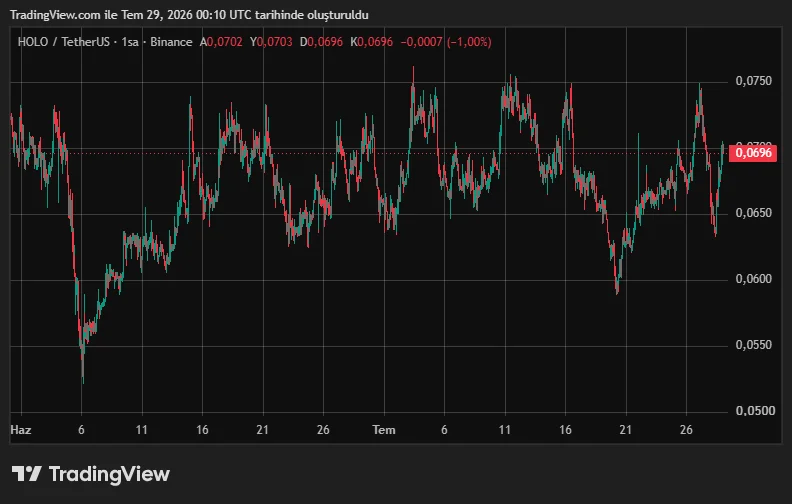
HOLO experienced sharp price movements during its initial trading period. The difference between the $0.7757 peak and the $0.05002 low recorded by CoinGecko shows how volatile newly listed tokens with a low circulating supply can become. Past price movements do not guarantee future performance.
HOLO coin price is at $0.06 at the time of writing.
HoloLaunch and Recent Ecosystem Developments
Following the token launch, Holoworld expanded its focus toward the “agentic app store” model. The project aims to build a marketplace where users can develop applications, content, and intellectual property connected to AI agents, rather than limiting the platform to an agent creation studio.
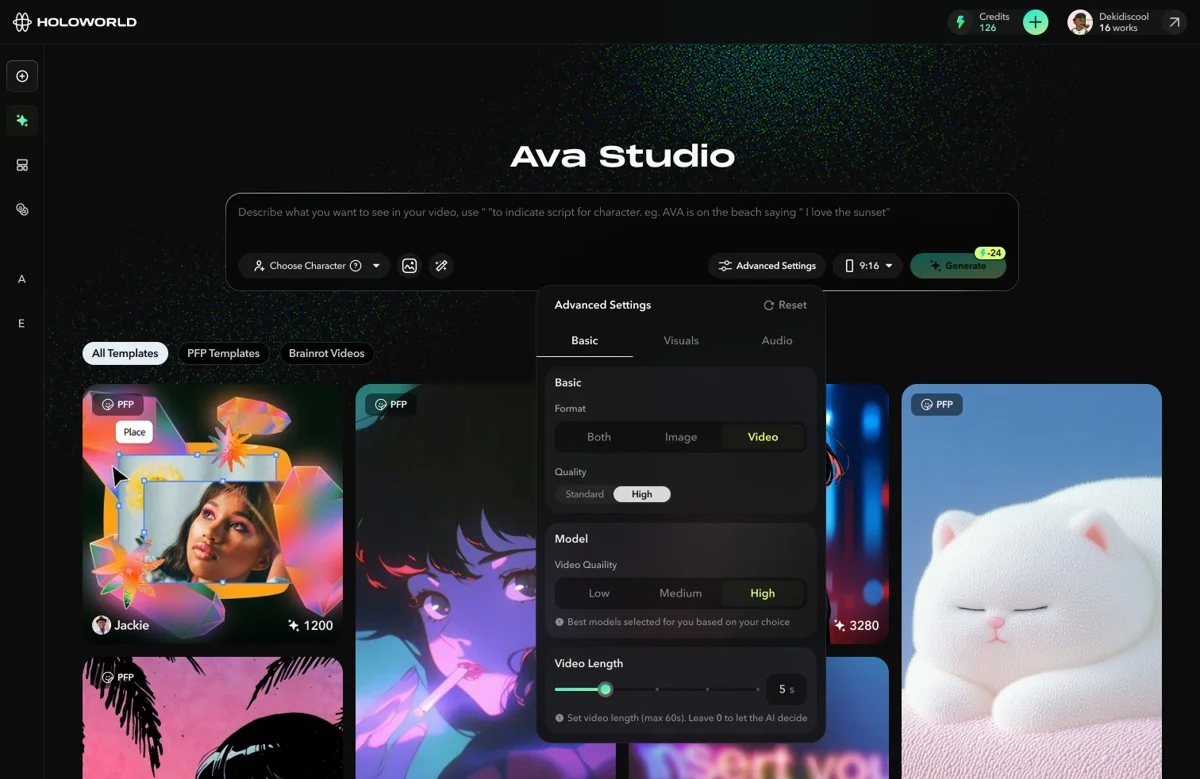
Ava Studio is one of the ecosystem’s main products. It converts written prompts into AI-generated videos, allowing users to select characters, prepare scenes, and produce short-form content without conventional video-editing software.
HoloLaunch serves as a launch platform for AI-based projects and digital intellectual property. Projects can organize presales or fair launches and customize features such as rewards, royalties, and token economics.
Holoworld announced a Robinhood Chain version of HoloLaunch in July 2026. This version focuses on launching and trading AI agents and digital IP projects on Robinhood’s Ethereum-based Layer 2 network. The development shows that HoloLaunch has expanded to a new network, but it does not mean that every HOLO function has automatically moved to Robinhood Chain.
Holoworld’s website also displays an AI-powered 24/7 livestreaming product. However, the feature was still marked as “coming soon” as of July 2026, so it should not be treated as a fully available product.
Holoworld also provides APIs and agent development tools. Developers can use these tools to create characters, connect agent interfaces to their applications, and integrate their own data sources through Model Context Protocol, or MCP, connections.
How Does the HOLO Token Work?
Staking is one of HOLO’s main use cases. Users can lock their tokens for certain periods to access ecosystem rewards and selected launches on HoloLaunch.
Staking should not be viewed as a risk-free return model. The market value of token rewards can change, while lock-up periods, smart contract vulnerabilities, and a decline in HOLO’s price may affect the overall result.
HOLO also acts as one of the core assets within the HoloLaunch economy. Some launches may offer separate participation pools or priority allocations to users who stake HOLO. Participation requirements vary between projects.
The token utility documentation describes HOLO as the primary medium of exchange within the Open MCP network. The project plans to use a shared token for economic activity between developers, data providers, and AI applications.
HOLO also has a planned governance function. Token holders are expected to participate in decisions related to network development and the wider ecosystem. However, public documentation does not explain the full scope of binding votes, proposal thresholds, or which parts of governance are currently active.
For this reason, describing HOLO as a fully community-controlled DAO token would be misleading. The maturity of its governance model may become clearer through future proposal systems and updates from the Holoworld Foundation.
HOLO Supply and Token Distribution
HOLO has a total and maximum supply of 2,048,000,000 tokens. A fixed maximum supply prevents unlimited issuance, but locked tokens can still enter circulation over time and increase the amount available on the market.
Market data showed approximately 726.3 million HOLO in circulation as of July 2026. This figure represented around 35.5% of the maximum supply.
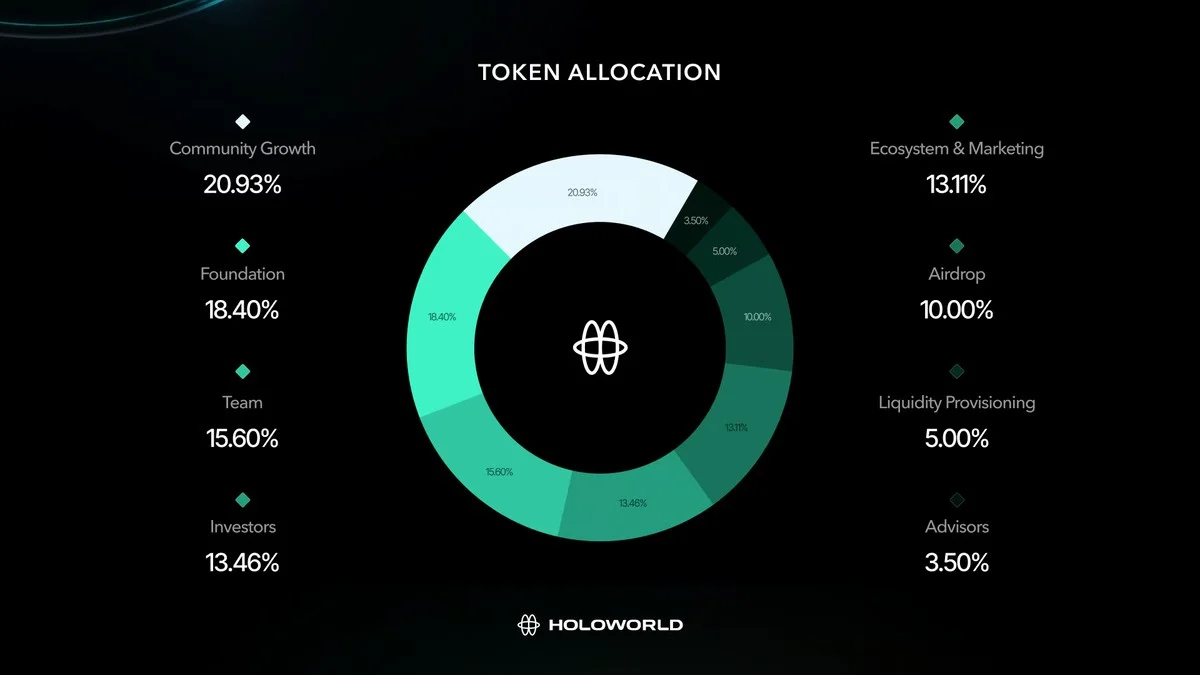
The largest allocation, 20.93%, went to community growth. This category contains 428,646,400 HOLO and covers incentives for users and developers participating in HoloLaunch and the Open MCP network.
The Foundation received 18.40%, or 376,832,000 HOLO. This allocation supports development, infrastructure, operations, and the project’s long-term activities.
Core contributors received 15.60%, equivalent to 319,488,000 HOLO. Investors received 13.46%, or 275,660,800 HOLO, while advisers were allocated 3.50%, equal to 71,680,000 HOLO.
Ecosystem and marketing activities received 13.11% of the supply. This category contains 268,492,800 HOLO.
Initial community rewards account for 10% of the supply, or 204,800,000 HOLO. Another 5%, equal to 102,400,000 HOLO, was allocated to liquidity provision.
Not all tokens entered the market on launch day. Fifteen percent of the community growth allocation was unlocked at the token generation event, followed by a three-month cliff and four years of linear vesting.
Thirty percent of the initial community rewards was unlocked at launch, with the remaining portion placed on a shorter distribution schedule. The liquidity allocation became fully available at launch to support centralized and on-chain markets.
No tokens were initially unlocked for the team, advisers, or investors. These groups have a one-year cliff, followed by three years of linear vesting for investors and advisers and four years for core contributors.
Long vesting schedules prevent the team and investors from selling their full allocations within a short period. Regular unlocks can still increase circulating supply, so investors should examine upcoming token releases alongside the maximum supply.
Multichain Transactions and Security
HOLO is a token operating on existing blockchains rather than the native coin of an independent network. Transaction security depends on the validator structure of either BNB Smart Chain or Solana.
This arrangement removes the need for Holoworld to build a separate validator network. At the same time, the project remains exposed to risks affecting the underlying networks, including outages, congestion, wallet incompatibility, and smart contract vulnerabilities.
A multichain structure can spread liquidity across different networks. Fake tokens using the same ticker may also mislead users, particularly on new networks and decentralized exchanges.
Users should not rely solely on a token’s name or logo. The contract address, selected network, destination wallet, and exchange deposit support should all be checked before making a transaction.
The identity and ownership records of AI agents created through Holoworld are mainly associated with Solana. However, the agents’ computational processes do not all take place on-chain. Running language models, generating videos, and animating characters require off-chain infrastructure.
This distinction matters when assessing security. On-chain records can verify digital asset ownership, but they cannot guarantee the accuracy of AI-generated content, its copyright status, or the uninterrupted operation of platform servers.
Why Is Holoworld AI Important?
Building an AI agent requires several components, including a language model, data connections, visual design, voice, motion, and distribution tools. Bringing these elements together can be expensive and complicated for independent creators and small communities.
Holoworld is trying to place these components within a more accessible interface. After designing a character, users can adjust its personality, knowledge, and visual features, then turn it into a video, livestream, or community experience.
For brands, the system can transform existing intellectual property into an interactive character. A cartoon character or digital collectible can become an agent that communicates with followers and continuously produces new content.
Economic infrastructure is another important element for creators. HoloLaunch allows them to build communities around their characters or applications, raise funds, and create custom reward models.
The model’s success depends on more than its technical tools. Users need to continue engaging with the characters, developers need to build new applications, and HOLO needs to gain real utility within platform activity.
Ava Studio, HoloLaunch, and Their Place in the Ecosystem
Ava Studio is one of the most accessible Holoworld products for end users. It allows users to generate character-led videos from text prompts and create different scenes without complicated editing software.
HoloLaunch represents the ecosystem’s economic layer. AI agents, content projects, and brand-related digital IPs can seek community support through the platform, while HOLO staking may play a role in access to certain launches.
The Open MCP network has a more technical objective. MCP connections help AI agents communicate with external data sources and tools through a standardized method. HOLO is intended to serve as a payment and incentive asset within this network.
Developer APIs allow Holoworld characters to move beyond the platform. An agent can therefore become a social media bot, gaming element, or branded digital assistant instead of remaining confined to the Holoworld interface.
Holoworld’s official website reports more than one million users, over 700,000 creations, and more than 35 million interactions. These figures are platform metrics shared by Holoworld and may not be fully verifiable through independent on-chain data.
Holoworld competes with Virtuals Protocol, ai16z-based projects, and other no-code agent platforms in the AI agent sector. Ease of creation, distribution, user retention, and developer revenue will all influence whether the ecosystem can maintain long-term activity.
Team, Partnerships, Token Unlocks, and Risks
Hologram Labs is the development company behind Holoworld AI. According to the project’s official introduction, Tong Pow founded the San Francisco-based company.
The team has worked on motion capture, machine learning, three-dimensional animation, and Web3 tools. This background explains Holoworld’s focus on agents with visual identities and movement capabilities rather than text-only characters.
Hologram Labs’ early customers and collaborators included L’Oréal, Bilibili, Pudgy Penguins, Milady Makers, Cool Cats, Arbitrum, and BNB Chain. The nature of each connection differs; some involved technology integrations, while others were customer relationships or character-based projects.
The community participates in the ecosystem through HOLO staking programs and HoloLaunch allocations. Governance is another planned utility, although the project has not fully explained how much decision-making power has already been transferred to the community.
A large portion of the token supply remains outside circulation. Unlocks involving the team, investors, advisers, and Foundation may increase supply pressure, particularly if demand does not grow at the same rate.
HOLO is also an altcoin sensitive to AI and crypto market narratives. Interest in these sectors can shift quickly, leading to speculative price movements that may have little connection to actual product usage.
There is also execution risk at the platform level. Ava Studio, HoloLaunch, the Open MCP network, and livestreaming products need to attract consistent users. Delays to the roadmap or weaker-than-expected demand may limit the token’s utility.
Intellectual property is another area that requires close attention. AI agents resembling real people, brands, or copyrighted characters may create legal disputes involving image, voice, and training data rights.
Smart contract vulnerabilities, incorrect network selection, fake tokens, and third-party platform connections represent additional technical risks. Users should examine contract audits, wallet permissions, and current security announcements before using the platform.
Frequently Asked Questions
Below are answers to some of the most common questions about Holoworld AI.
- What is Holoworld AI, and when was it launched? Holoworld AI is a Web3 platform that helps users create AI characters and agent-based applications without coding. Hologram Labs, the company behind the project, was founded in 2021 and introduced the Holoworld AI platform on January 29, 2024. The HOLO token launched later, with its token generation event and Binance spot listing taking place in September 2025.
- What is the HOLO token used for? HOLO was designed for staking, HoloLaunch participation, ecosystem liquidity, governance, and economic transactions within the Open MCP network. Some HoloLaunch projects may provide separate pools or priority access to users who stake HOLO.
- The token’s use cases may change as the platform develops. Users should review the latest official documentation before participating in a new feature or reward program.
- Which networks does Holoworld AI use? The HOLO token is available on BNB Smart Chain and Solana. Solana plays a prominent role in the agent identity and digital ownership system, while BNB Smart Chain supports EVM-based token usage.
- HoloLaunch also expanded to Robinhood Chain in July 2026. This product integration does not replace HOLO’s contracts on BNB Smart Chain and Solana.
- Who founded Holoworld AI? Hologram Labs is the company behind Holoworld AI. According to the project’s official introduction, Tong Pow founded the company in 2021.
- Some public databases mention a broader founding and executive team. However, the project’s current documentation does not include a comprehensive page listing every founder, executive, and role.
- What is the HOLO supply? HOLO has a total and maximum supply of 2,048,000,000 tokens. Market data shows that approximately 726.3 million HOLO are currently in circulation.
- Circulating supply can increase as locked tokens are released. A fixed maximum supply and the number of tokens available on the market at a particular time are therefore separate figures.
- Is Holoworld AI a suitable investment? Whether Holoworld AI is suitable for a particular investor depends on risk tolerance, investment horizon, and portfolio structure. HOLO is a high-risk crypto asset exposed to price volatility, token unlocks, product development challenges, competition, smart contract vulnerabilities, and regulatory uncertainty.
Follow the JR Kripto Guide series for the latest information about Holoworld AI and the Web3-based creator economy developing around AI agents.

