
ZRO Technical Analysis
The project integrated Stargate Finance by acquiring it with ZRO this year, and through this, it is aimed to provide more revenue flow to LayerZero’s cross-chain bridge infrastructure. In addition, the foundation bought back approximately 50 million ZRO from early investors, taking steps to control the circulation in the market. Such moves can be perceived positively by investors in terms of price stability and ecosystem confidence.
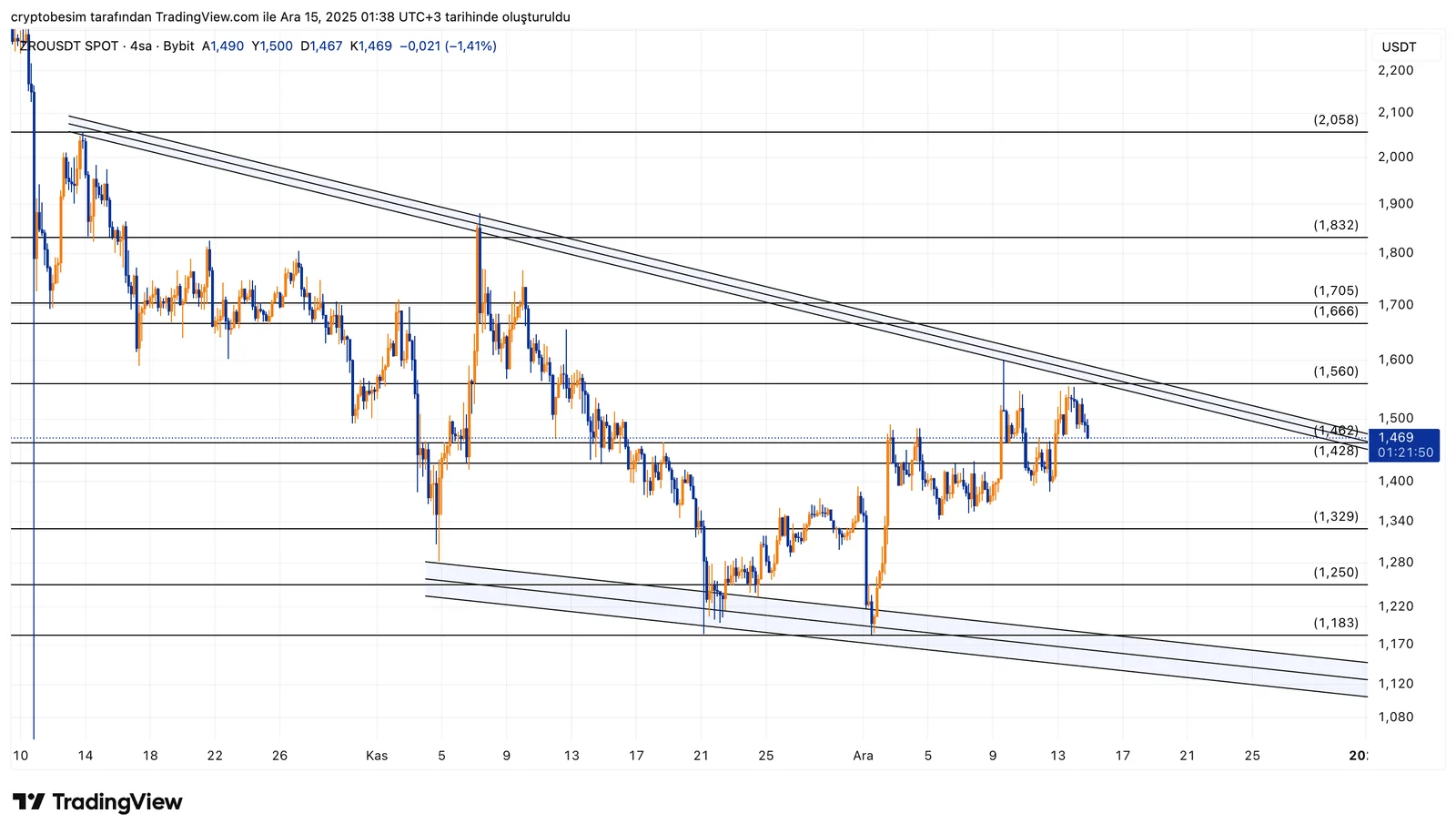
The ZRO chart structure fits a descending wedge formation quite cleanly, and the price is currently moving in the region where it is touching the upper band of the formation. In such structures, touches to the upper band generally bring forward two possibilities: either the formation does not work and a dip toward the lower band occurs again, or since the final phase of tightening is entered, preparation for an upside breakout is made.
In the current view, the price has hit the upper trend line in the 1.46–1.50 band. As long as this region is not broken, it is normal for short-term selling pressure to continue. Below, the 1.42 and 1.33 levels stand out as intermediate supports. For the continuation of the formation, it is especially important for the price to hold above 1.33; if this area is lost, the wedge structure weakens and the price may relax back toward the 1.25–1.18 band.
On the other hand, if the price manages to break above 1.50 with volume, the descending wedge formation technically starts to work upward. In this scenario, the first reaction region is 1.56, followed by the 1.66–1.70 range. The wider target region of the formation extends up to the 1.83 level.
In summary, the picture is as follows:
- The price is in a decision zone because it has touched the upper band.
- If a breakout above 1.50 comes, the formation works upward and targets get triggered quickly.
- Below, the 1.42 → 1.33 supports must be preserved; if 1.33 is lost, the structure breaks down.
These analyses, which do not provide investment advice, focus on support and resistance levels that are thought to create short- and medium-term trading opportunities depending on market conditions. However, the responsibility of trading and risk management belongs entirely to the user. In addition, it is strongly recommended to use stop loss for the positions shared.