A new bill focused on crypto taxation has cleared an important stage in the U.S. House of Representatives. The House Ways and Means Committee approved the Digital Asset Tax Certainty Act by a 38–5 vote.
Bill H.R. 10357 seeks to establish clearer tax rules for crypto transactions. It covers network fees, stablecoin sales, wash-sale rules, mining, staking and exchange reporting.
Crypto tax bill passes by 38–5 vote
The committee considered the bill during a markup meeting on September 16, 2026. According to the official meeting record, the session began at 10:00 a.m. ET.
The meeting took place at 5:00 p.m. Türkiye time. The committee ordered H.R. 10357 favorably reported to the full House as amended.
The official Ways and Means statement announced 38 votes in favor and five against. The committee also said lawmakers prepared the bill through bipartisan discussions.
The vote does not immediately change U.S. tax rules. The bill must first pass the full House.
The Senate must then approve the same text. The president would also need to sign the bill into law.
Proposed exemption for network fees under $10
One of the bill’s most notable provisions concerns small network and transaction fees. Under the current system, even very small digital asset transactions can create separate reporting requirements.
The committee said the IRS received hundreds of millions of 1099-DA forms in 2025. Many of those forms involved transactions worth less than $10.
According to the bill’s fact sheet, the proposal covers three areas:
- Gains or losses from sales of regulated U.S. dollar stablecoins.
- Gains or losses from using digital assets to pay network and transaction fees under $10.
- An election for a simplified accounting method for digital assets.
The $10 threshold applies to specific fee payments. A crypto purchase under $10 would still require separate analysis under the proposal.
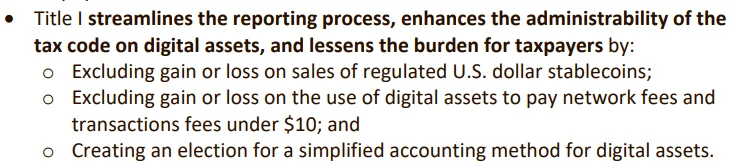
The fact sheet ties the exemption to digital assets used for network and transaction fees. It concerns gains or losses arising from that use.
The stablecoin provision also has a limited scope. It refers to sales of regulated U.S. dollar stablecoins.
Wash-sale rule would apply to digital assets
The proposal would extend existing anti-abuse rules to digital assets. These rules include wash-sale and constructive-sale provisions.
The wash-sale rule limits tax-loss strategies involving a sale at a loss and a quick repurchase. If adopted, the rule could require more detailed tracking of crypto transactions.
Exchanges and users may need to match purchase and sale records more consistently. This could affect tax-loss harvesting strategies among crypto investors.
The proposal also covers rules involving financial derivatives, U.S. territories and foreign corporations. The committee says these changes would bring digital assets closer to traditional financial instruments.
Mining and staking rules would become clearer
H.R. 10357 would clarify the tax treatment of mining and staking rewards. The fact sheet says the bill would establish sourcing and characterization rules for these rewards.
This section affects miners, validators, staking platforms and individual users. Clearer rules could make reward reporting more predictable.
The bill also aims to make it easier for exchange-traded investment products to participate in staking. It seeks to protect their tax status while they engage in staking activities.
The fact sheet does not explain every detail about tax rates or payment timing. The final scope would depend on the bill’s text and later regulations.
Exchange reporting burden could decline
One section of the bill would clarify digital asset broker reporting duties. The committee says the current system creates a large number of unnecessary tax forms.
The proposed framework seeks to streamline broker reporting and reduce compliance costs. This could affect platforms with high transaction volumes.
The bill would also direct the Treasury Department to create a voluntary disclosure program for digital assets. The program could offer reduced penalties to eligible taxpayers who report past mistakes.
The mechanism targets users who failed to comply because of uncertainty or high costs. Eligible taxpayers could gain a route for correcting earlier reporting problems.
Digital assets would move closer to traditional finance
H.R. 10357 would place digital assets closer to traditional financial instruments under the tax code. The bill would make digital assets eligible for two existing tax safe harbors.
One safe harbor would make it easier for foreign persons to invest in U.S. markets. The other would allow taxpayers to lend digital assets without triggering an immediate taxable event.
The proposal would also let digital asset dealers and traders use mark-to-market accounting. This method is already available for securities and commodities.
Common digital assets donated to charities would receive rules similar to publicly traded securities. This could matter to traders and users planning charitable donations.
The bill is separate from the CLARITY Act
H.R. 10357 is a separate bill from the CLARITY Act. It focuses directly on federal tax rules for cryptocurrencies and other digital assets.
The CLARITY Act vote that failed to advance in the Senate on Tuesday did not concern H.R. 10357. The two processes involve different texts and different legislative stages.
The committee’s 38–5 vote therefore does not represent another CLARITY Act vote. The crypto tax bill now awaits the next stage in the House.
The legislative process will continue
The committee’s favorable report opens the path to a full House vote. The committee statement did not provide a date for that vote.
If enacted, the bill could change tax processes for U.S. investors and crypto platforms. Existing rules will remain in effect until new provisions take effect.
The committee vote shows crypto taxation moving forward as a separate legislative issue. The bill’s practical impact will become clearer as the House process and effective dates emerge.