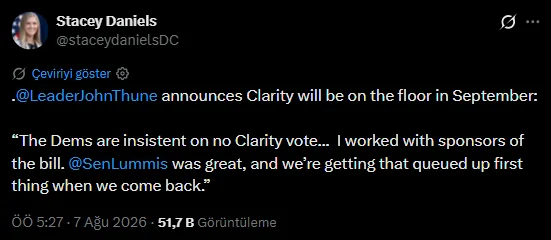
The U.S. Senate will not vote in August on the Digital Asset Market Clarity Act, which aims to establish a regulatory framework for the cryptocurrency market. Senate Majority Leader John Thune said lawmakers would take up the bill after returning to Washington on September 14.
The crypto industry had expected senators to resolve the remaining disputes before leaving for the summer recess. However, disagreements among both Democrats and Republicans pushed the vote into September.
According to the Senate’s official calendar, lawmakers will return to Washington on September 14. They will then have approximately three weeks to work on the Clarity Act and other pending matters.
John Thune points to September
John Thune confirmed through a spokesperson that the Senate would not hold a Clarity Act vote in August. He said the bill would become one of the chamber’s first priorities after lawmakers return.
Thune said Democrats opposed holding the vote in August. He also noted that he had worked with the bill’s sponsors and highlighted Republican Senator Cynthia Lummis’ role in the process.
Before the summer recess, the Senate will focus on a continuing resolution that would fund the federal government through the midterm elections. A Russia sanctions package and several federal nominations also remain among its top priorities.
The lack of a time agreement limiting debate on the Clarity Act made it even more difficult to add the bill to the August schedule. Senators reached such agreements for other pending matters, but they failed to secure a similar compromise for the crypto legislation.
Clarity Act needs 60 votes
The bill needs support from at least 60 senators to clear the procedural hurdle in the Senate. However, it remains unclear whether the legislation currently has even the 50 votes required for a simple majority.
Several Republican senators have publicly opposed the bill. Meanwhile, Democrats want President Donald Trump to accept stricter ethics rules covering his activities in the cryptocurrency industry.
The Senate Banking Committee approved the Clarity Act in May by a vote of 15 to 9. Democratic Senators Ruben Gallego and Angela Alsobrooks supported advancing the bill out of committee. However, that bipartisan support does not guarantee the 60 votes required on the Senate floor.
Lawmakers have reached agreements on most of the bill’s technical provisions. Still, the remaining disagreements increasingly focus on political issues.
Trump’s crypto income becomes central to ethics debate
The biggest dispute concerns an ethics provision governing the financial interests of President Trump and other senior government officials in the cryptocurrency industry. Trump disclosed that he earned more than $1 billion from his various crypto ventures in 2025.
Trump reportedly accepted an ethics provision brokered by Cynthia Lummis. However, Democratic senators and Republican Senator Thom Tillis argued that the existing language did not go far enough.
Tillis and Democratic Senator Ruben Gallego drafted an alternative ethics proposal and sent it to the White House at the end of July. The White House has yet to respond publicly.
Provisions under the Senate Agriculture Committee’s jurisdiction, law enforcement concerns, and yields and rewards offered to stablecoin holders also remain unresolved.
First vote could take place on September 15 or 16
The next critical step depends on when John Thune files for cloture on the bill. Cloture is a Senate procedure that limits debate and allows legislation to move toward a vote.
If Thune files for cloture before the Senate leaves for recess, lawmakers could hold the first procedural vote on Tuesday, September 15. If he waits until senators return, the first vote could take place no earlier than Wednesday, September 16.
Industry representatives remain hopeful that the bill can advance in September despite the delay. Digital Chamber CEO Cody Carbone said the parties would spend the coming weeks working to find the common ground required for a successful vote.
Crypto Council for Innovation CEO Ji Hun Kim described the delay as disappointing. According to Kim, the absence of a comprehensive market structure law continues to push U.S. users and developers offshore.
If enacted, the Clarity Act could establish clearer rules for determining whether crypto assets qualify as securities or commodities. The bill also aims to clarify the division of regulatory authority between the U.S. Securities and Exchange Commission and the Commodity Futures Trading Commission.