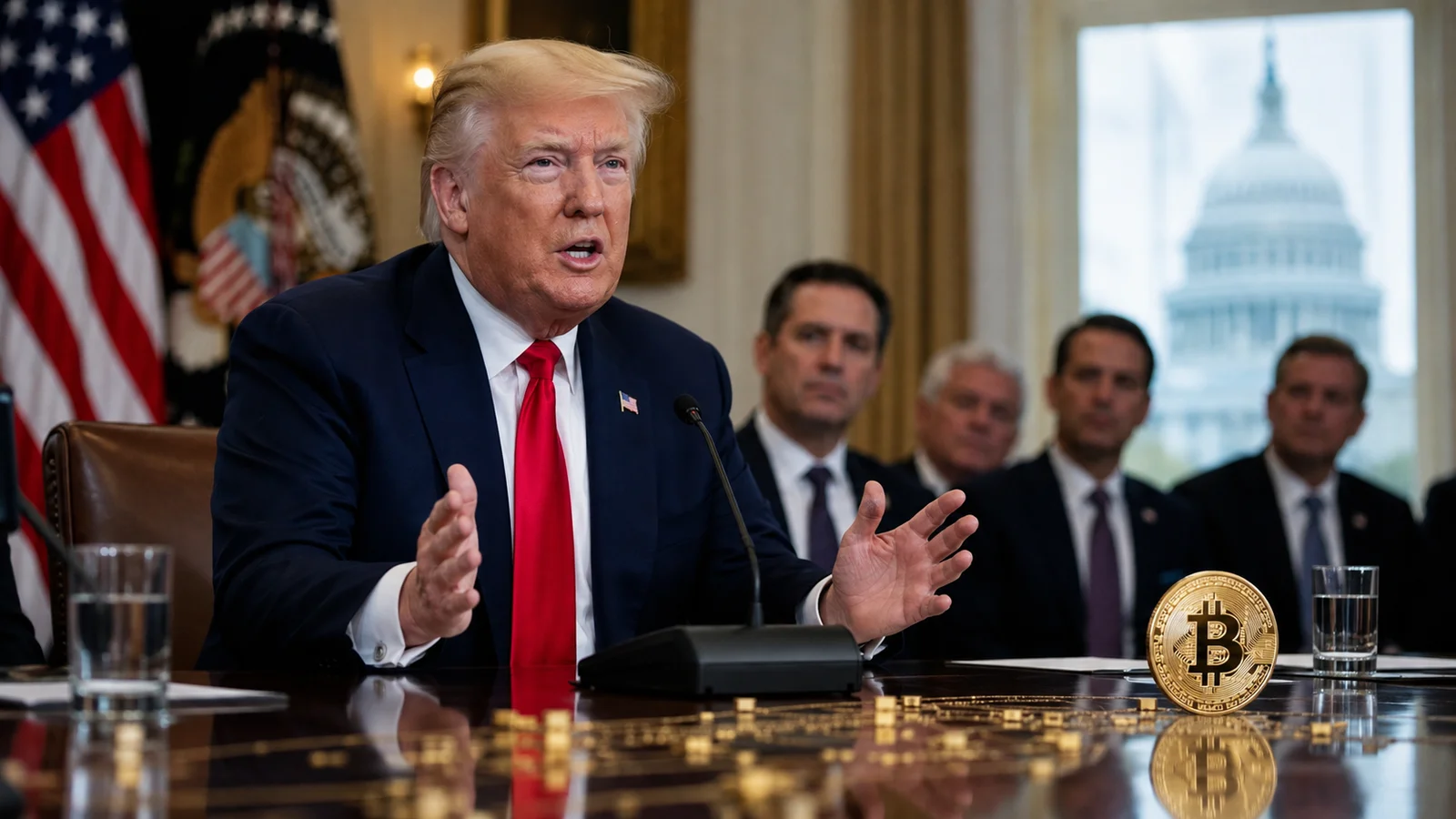
US President Donald Trump addressed Congress following the crypto summit at the White House. Trump called for the passage of a “fair version” of the CLARITY Act, which would create a legal framework for the digital asset market.
According to Reuters, Trump told leading industry executives at the meeting that Congress must now take the next step. His direct political endorsement of the bill became the summit’s clearest outcome.
Trump openly backs the CLARITY Act
Coinbase CEO Brian Armstrong, Robinhood CEO Vlad Tenev and Kraken co-CEO Arjun Sethi attended the summit on August 19. Jeffrey Sprecher, CEO of Intercontinental Exchange, the parent company of the New York Stock Exchange, also spoke alongside Trump.
SEC Chair Paul Atkins, CFTC Chair Mike Selig and White House crypto adviser Patrick Witt also attended. The lineup brought financial regulators, crypto executives and traditional finance leaders to the same table.
During his remarks, Trump called for Congress to pass a “fair version” of the CLARITY Act. However, he did not explain what he meant by a fair version or specify which changes he wanted lawmakers to make to the current text.
The White House also did not publish detailed meeting minutes or a new compromise proposal. For now, the summit’s outcome remains limited to a strong message of political support.
What would the CLARITY Act change?
The CLARITY Act aims to define when digital assets qualify as securities or commodities in the US. It would also establish clearer jurisdictional boundaries between the SEC and the CFTC.
Under the current approach, the SEC would retain authority over assets that qualify as securities. The CFTC would receive broader powers over digital commodity spot markets and the platforms where these assets trade.
Crypto companies have long argued that regulatory uncertainty forces the industry to operate through court cases and agency decisions. A permanent statutory framework could reduce the risk of major policy shifts following changes in the US administration.
The House of Representatives passed the bill in July 2025 by a vote of 294 to 134. The Senate Banking Committee advanced the legislation to the Senate floor in May 2026 by a vote of 15 to 9.
However, the Senate process remains incomplete. The current schedule indicates that a procedural vote on considering the bill could take place in September. This does not amount to a confirmed date for a final vote or passage.
Ethics and stablecoin disputes continue
One of the main disagreements surrounding the CLARITY Act concerns political figures earning money from crypto investments. Many Democrats and some Republicans want strong provisions limiting federal officials’ ability to profit from crypto ventures while in office.
Reuters reported that Trump earned more than $1.4 billion from crypto ventures linked to his family. World Liberty Financial and the TRUMP meme coin remain at the center of the conflict-of-interest debate.
Trump says he has no role in the daily operations of his family’s businesses and that independent managers oversee his investments. The White House has also rejected allegations of wrongdoing.
Another disagreement centers on rewards paid on stablecoin balances. Banks argue that allowing crypto platforms to offer returns to stablecoin holders could accelerate deposit outflows.
Crypto companies say a broad ban would restrict competition and eliminate returns earned by users. The scope of stablecoin rewards was also one of the issues that prevented the parties from reaching an agreement during previous White House talks.
Senate Banking Committee Chair Tim Scott has identified rewards, ethics provisions, DeFi, anti-money laundering rules and regulatory quorum requirements as the main areas of disagreement.
Did the summit produce a concrete regulatory outcome?
Trump’s remarks showed that the White House remains committed to passing the CLARITY Act. The presence of the SEC and CFTC chairs alongside industry executives also attracted attention as a sign of regulatory coordination.
Still, the summit produced no new legislative text, agreement on stablecoin rewards or final version of the ethics provisions. Trump’s reference to a “fair version” suggests that negotiations over the bill remain underway.
Amendments introduced in the Senate and support from Democratic senators will shape the next stage. If the Senate passes an amended version, lawmakers will also need to reconcile it with the text approved by the House of Representatives.
Trump’s call has added political pressure to the process. Congress must still resolve disputes over ethics, regulatory jurisdiction and stablecoin rewards before the CLARITY Act can become law.