
SHIB/USDT Technical Outlook
Shiba Inu (SHIB) has been drawing attention again in recent days. Coinbase has launched futures trading for SHIB. This is an important step that could increase investor interest. In addition, cards that allow payments with SHIB have started to be used in some regions. This makes it easier for the token to be used in daily life. The fact that whales continue to accumulate SHIB shows that some investors trust its long-term potential.
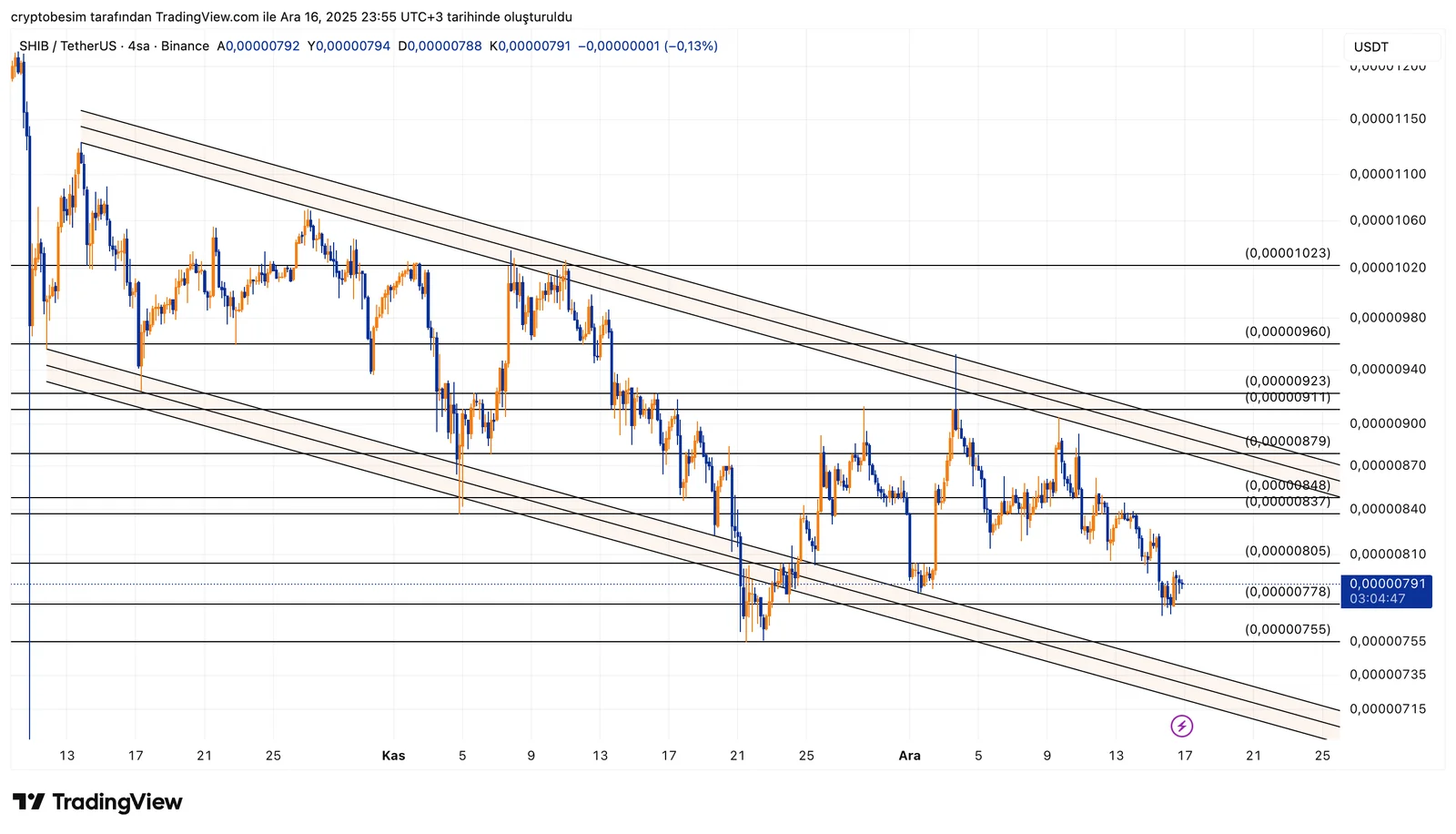
From a technical perspective, the price has been moving within a descending channel for some time, and recent price action is hovering close to the lower band of the channel. Reactions occur, but every upward attempt faces selling pressure as it approaches the upper trend line. This indicates that the downside pressure has not yet completely ended and that the market is still not fully under buyers’ control.
In the short term, the 0.00000775 – 0.00000780 band is in a critical support position. The price is currently trying to hold just above this region. Since this area has previously produced reactions, it remains technically important. As long as this support is preserved, the potential for a reaction rally within the descending channel remains on the table.
In the upside scenario, the first area to watch is the 0.00000835 – 0.00000850 band. This region corresponds to both a horizontal resistance and the mid-band of the channel. If this area is surpassed, it is possible for the price to attempt a move toward the 0.00000880 – 0.00000920 range. The truly critical zone, however, is the 0.00000960 – 0.00001020 line where the upper band of the descending channel passes. Without a high-volume break above this area, it is difficult to say that the trend has been broken.
On the downside, if closes occur below 0.00000775, selling pressure accelerates again and the price may slide toward the 0.00000720 – 0.00000700 band. Since this region is the lower extension of the channel, it acts as a last line of defense. In summary, SHIB is at a decision zone within the descending channel. If support holds, a reaction may come; if it breaks, the decline deepens. What will clarify the direction here will be the breakout within the channel.
These analyses, which do not provide investment advice, focus on support and resistance levels that are thought to create short- and medium-term trading opportunities depending on market conditions. However, the responsibility for trading and risk management belongs entirely to the user. In addition, it is strongly recommended to use stop loss for the positions shared.