
A notable wallet movement drew attention in the crypto market on Sunday. Onchain Lens, citing Arkham data, reported that a Satoshi-era miner transferred a total of 2,650 BTC to FalconX and Cumberland in three separate transactions. The transfers were worth approximately $203 million in total.
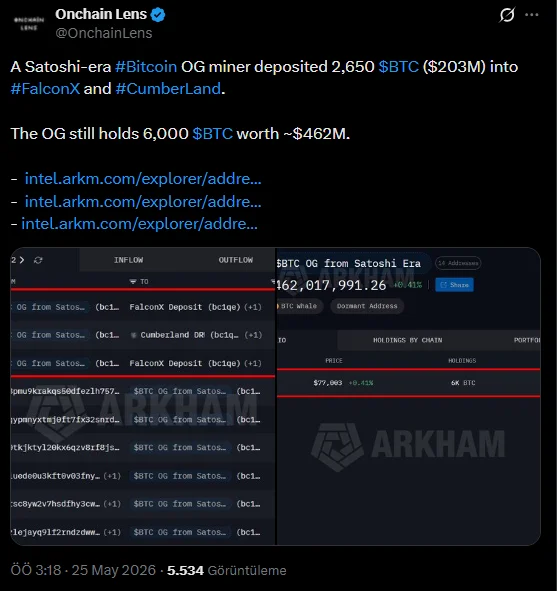
The whale still holds 6,000 BTC, worth about $462 million at current prices. It is not clear whether the transfer was made for selling purposes. However, transfers of this scale to institutional trading desks have often preceded sales in the past; the market usually does not ignore such moves.
FalconX and Cumberland are OTC trading desks that serve large portfolio holders. Large sales executed through spot exchanges can directly affect order books and push prices lower. OTC channels, on the other hand, match buyers and sellers away from public exchanges, helping distribute that pressure. This is why large BTC holders who want to convert significant amounts into cash often prefer these intermediaries. Still, it is also possible that the funds were moved for wallet management or portfolio reorganization.
The term “Satoshi-era miner” refers to addresses that produced blocks during Bitcoin’s earliest years, especially between 2009 and 2010. These wallets sometimes remain inactive for more than a decade. Since 2020, as Bitcoin’s price gained momentum, some of them have occasionally reawakened. Early miners obtained BTC at almost no cost; there was no highly competitive mining network and no serious electricity expense. This means these wallets are sitting on astronomical profits today, regardless of Bitcoin’s current price. They do not necessarily need to wait for the “right moment” to sell.
This transfer did not happen in isolation. Earlier this month, a wallet that had been dormant for 12 years became active and transferred 500 BTC, worth $40.6 million at the time. Last month, another large address sent $20 million worth of BTC to Binance. Three different dormant wallets moving within a few weeks is not a common pattern. On-chain analysts are closely watching these movements because simultaneous large supply inflows, even when routed through OTC channels, can still build pressure on the price over time.
Did Bitcoin’s price move?
The impact of large transfers on price is not always immediate or clear. Not every movement results in a sale; technical reasons such as wallet changes, custody arrangements or portfolio restructuring can also be involved. OTC channels help reduce sudden price swings on exchanges, but as the size of a transfer grows, it becomes harder for the market to ignore it completely.
Bitcoin rose 0.6% over the past 24 hours to reach $77,220. The currency had fallen as low as $74,600 on Saturday and ended the week around the $77,000 range. It is currently trading about 38% below its all-time high of $124,900, recorded in October 2025. On-chain data in the coming days will show whether old miners see this range as sufficient.