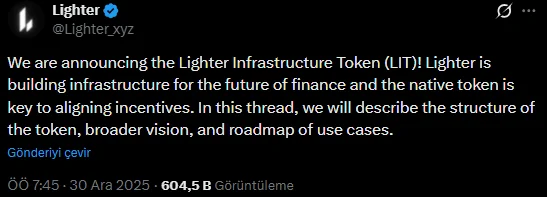
In 2025, Lighter, a prominent next-generation perpetual futures trading platform, officially launched its native crypto asset, Lighter Infrastructure Token (LIT), with the goal of growing its ecosystem. Operating on an Ethereum-based Layer-2 architecture, the platform aims to build a stronger bridge between traditional financial markets and decentralized finance (DeFi) with LIT.
25% of the LIT supply was distributed via airdrop
According to Lighter's statement, the LIT supply was equally divided into two main groups. 50% of the total supply was allocated for ecosystem growth, while the remaining 50% was allocated to the team and investors. A significant portion of the ecosystem share was distributed via airdrop to early adopters of the platform throughout 2025. This distribution, which involved the direct conversion of approximately 12.5 million points into LIT tokens, corresponds to 25% of the project's fully diluted value.
A longer-term plan was adopted for the team and investor shares. These tokens will remain locked for one year, followed by a linear vesting process spanning three years. Another noteworthy aspect is that the LIT tokens are being issued by a C-Corporation registered in the US.
Lighter doesn't just position LIT as a governance tool. The token is central to the platform's transaction execution and data validation infrastructure. Users are required to stake LIT to access different levels of transaction execution and market data services. As the network becomes more decentralized, these staking requirements increase, thus encouraging long-term commitment to the system from both data providers and traders. Users requesting market data or performing price validation on the platform pay their fees in LIT. The staked tokens aim to increase the reliability of the provided data and support risk management. The Lighter team emphasizes that this structure provides transparency on the DeFi side while offering verifiability and traceability to the traditional finance world.
The price discovery process also began with the launch of LIT. In initial transactions, the token fluctuated between approximately $2.30 and $2.80. Currently, most transactions are taking place through centralized exchanges, while the gradual introduction of native pairs on Lighter is expected. On the other hand, Lighter's trading volume data has reached remarkable levels. In the last seven days, the platform has generated an average volume of $2.7 billion. Daily volume is reported to have reached up to $4.7 billion. These figures have placed Lighter among the top perpetual DEXs projected to rise by 2025. Its position in the same league as strong competitors like Hyperliquid and Aster in terms of volume explains why the LIT launch is being so closely followed. Lighter also stands out with its promise of transparency regarding its revenue model. All revenue generated from the platform and future products will be traceable on the blockchain. The team states that a portion of this revenue may be directed towards ecosystem growth, and another portion towards LIT buybacks depending on market conditions. There is no fixed schedule for buybacks; decisions will be shaped by market dynamics and long-term strategy.