
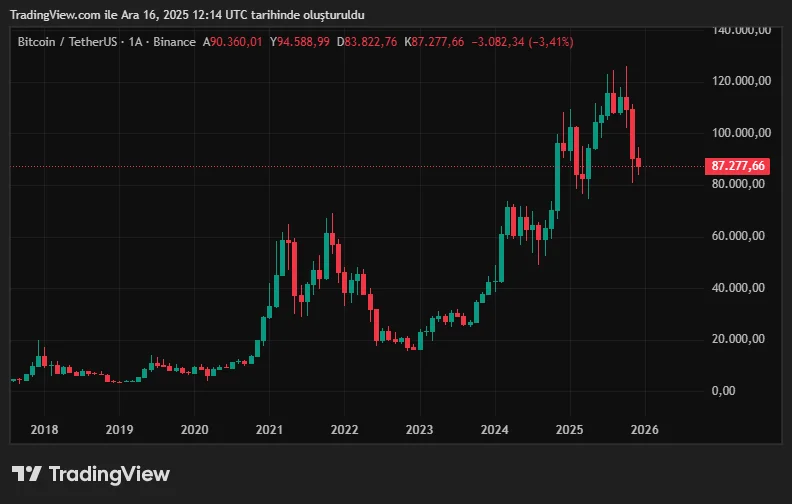
Grayscale, in its 2026 outlook report, argued that the cycle for Bitcoin is not yet over. The company, one of the world's largest digital asset managers, expects Bitcoin to reach a new all-time high in the first half of 2026. According to the report, the crypto market is moving away from the volatile and speculative structure of previous years and entering a more mature period where institutional actors are gaining weight.
Grayscale's hopeful prediction for Bitcoin
Grayscale predicts that 2026 will be a year of "accelerating structural transformations" in digital asset investments. Two main dynamics are behind this transformation. First, increasing public debt and the perception of risk towards fiat currencies are directing investors towards alternative stores of value. The second element is the clarification on the regulatory front. According to the company, while crypto assets have long been kept on the periphery of the system, they are now being drawn into the mainstream financial infrastructure. The combination of these two factors is expected to accelerate new capital inflows, increase adoption among wealth managers and institutional investors, and lead to deeper integration of public blockchains with traditional markets. Grayscale believes this environment will boost not only Bitcoin but also crypto asset valuations in general. It also argues that the classic cycle narrative, characterized by Bitcoin's halving every four years, is nearing its end.
The report notes that the crypto market is no longer a niche experience. The ecosystem, containing millions of tokens, has a total market capitalization of approximately $3 trillion. In this universe, Bitcoin and Ethereum, with their limited supply and monetary characteristics, assume the role of digital commodities and alternative currencies. According to Grayscale, rising debt levels and inflation concerns will continue to support demand for such scarce assets in portfolios.
Bitcoin's supply dynamics also reinforce this view. The annual issuance rate has fallen below 1%, and the 20 millionth Bitcoin is expected to be mined around March 2026. The company states that having a transparent and limited supply is becoming increasingly attractive to investors in an environment of rising financial imbalances. Therefore, Bitcoin and Ethereum are expected to be seen as strategic assets rather than short-term trading tools.
A "transformation" signal in terms of regulation
On the regulatory side, it is emphasized that a significant transformation is taking place in the US. While investigations and lawsuits against crypto companies have been prominent in recent years, it is stated that this approach is beginning to soften. Court decisions paved the way for spot exchange-traded products; Bitcoin and Ethereum ETPs were launched in 2024, and the GENIUS Act for stablecoins was enacted in 2025. Grayscale expects a comprehensive crypto market structure law to come into effect in 2026 through bipartisan agreement.
These developments are also accelerating institutional capital inflows. It is stated that there has been a net inflow of approximately $87 billion into global crypto ETPs since the launch of spot Bitcoin products in the US in January 2024. Despite this, less than 0.5% of assets under management in the US are allocated to crypto. Grayscale believes this percentage could gradually increase in the coming years. Institutions such as Harvard Management Company and Abu Dhabi-based Mubadala are cited as early examples. The increasing institutional weighting has also changed the character of Bitcoin price movements. While previous bull periods saw annual increases exceeding 1,000%, the highest annual increase recorded in this cycle until March 2024 was approximately 240%. Grayscale interprets this as an indicator of more stable and long-term buying and sees the possibility of a deep and prolonged decline in 2026 as relatively low.