
Cryptocurrency investment products saw a strong rebound last week. According to CoinShares data, a total of $1.1 billion in inflows were recorded globally. This figure stands out as the strongest weekly performance seen since the beginning of the year.
This market recovery was influenced by lower-than-expected inflation data in the US and a relative easing of geopolitical tensions. CoinShares Research Director James Butterfill states that the increase in risk appetite has redirected investors back to crypto assets.
While only $224 million in inflows were seen the previous week, the recent data shows a significant increase. Despite this, trading volumes still remain below the year-to-date average. Although weekly volume increased by 13 percent to $21 billion, it is still below the average of $31 billion since the beginning of the year. On the other hand, total assets under management (AUM) have returned to their highest levels since the beginning of February.
Bitcoin takes center stage again.
The majority of capital inflows were concentrated in Bitcoin-focused products. Bitcoin funds, which recorded weekly inflows of $872 million, have brought their total inflows since the beginning of the year to approximately $2 billion. US-based spot ETF products appear to be particularly decisive in this picture. However, a cautious stance in the market has not completely disappeared. Short Bitcoin funds, or products based on open positions, had their strongest week since November 2024 with inflows of $20.2 million. In other words, investors are maintaining their hedging positions despite the rise.
Mixed outlook in altcoins
Ethereum experienced a remarkable recovery. Ethereum investment products saw weekly inflows of $196.5 million. However, it is still in net outflow territory for the year as a whole.
Looking at other altcoins, the picture is more balanced and sometimes weaker. XRP funds recorded inflows of $19.3 million, while multi-asset products saw a limited increase of $3 million. In contrast, Solana funds saw a noticeable outflow of $2.5 million.
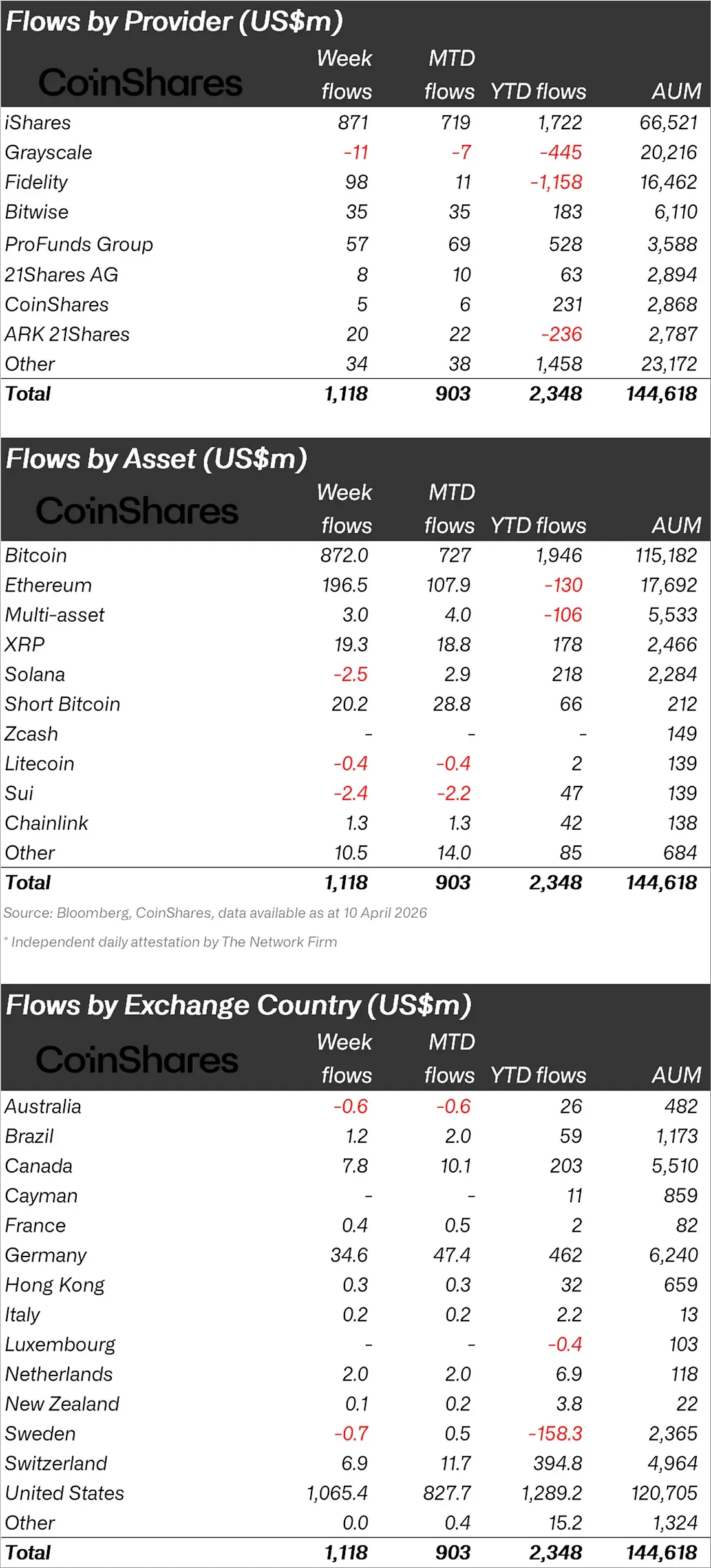
Sui experienced outflows of approximately $2.4 million, while Litecoin saw a limited decline. In contrast, Chainlink attracted a small but positive inflow of $1.3 million. Multi-asset products and other categories continued to show low-volume but positive flows.
US influence is significant
When the regional distribution is examined, it is seen that capital inflows largely originated from the US. The US alone accounted for approximately 95% of total flows with $1.065 billion inflows. Thus, we see that a large part of institutional demand is still from the US.
On the European side, there is a more limited but positive picture. Germany stands out with $34.6 million inflows, while Canada and Switzerland recorded inflows of $7.8 million and $6.9 million respectively. Inflows remained quite limited in other countries.