
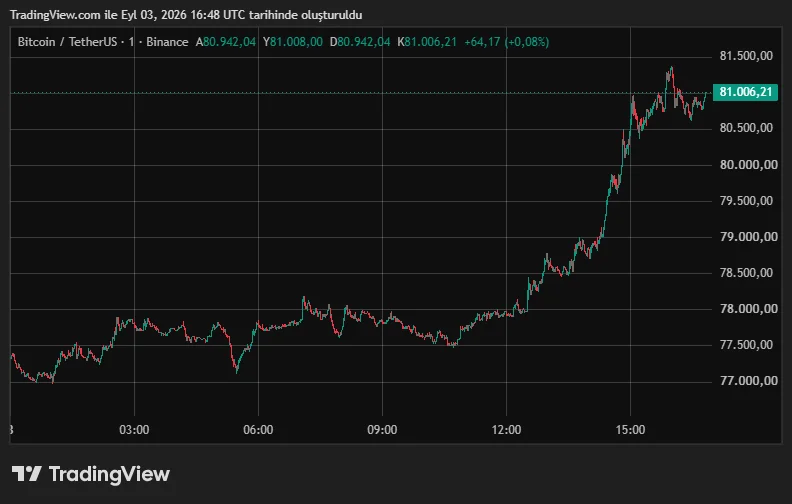
Bitcoin surged back above $81,000 on the evening of September 3. BTC had been trading around $77,000 earlier in the day before gaining more than 4% within a few hours.
Liquidations of short positions helped accelerate the move. On the macro side, comments from Federal Reserve Governor Christopher Waller suggesting that interest rates could remain unchanged also supported risk appetite.
Bitcoin was trading at around $80,700 at the time of writing after briefly moving above $81,000.
Why did Bitcoin suddenly rise?
Bitcoin’s rally gained clear momentum after U.S. markets opened. Changes in the macroeconomic outlook emerged as one of the main drivers.
Federal Reserve Governor Christopher Waller said he would support keeping interest rates unchanged at the September meeting if incoming data confirmed that inflation pressures were continuing to ease.
Following his remarks, market expectations for a Fed rate hike declined. According to Reuters, the probability of a September rate increase fell from 59% to 46%.
At the same time, the U.S. Dollar Index dropped 0.58% to 99.02. A weaker dollar and lower expectations for further rate increases supported risk assets, including Bitcoin.
Wall Street also moved higher following the comments. The S&P 500 and Nasdaq gained around 1%, while crypto-linked stocks such as Coinbase and Strategy posted stronger advances.
Spot Bitcoin ETF flows also drew attention. U.S. spot Bitcoin ETFs recorded around $101.1 million in net inflows on September 2. BlackRock’s IBIT alone attracted $115.4 million.
Short liquidations accelerated the rally
Bitcoin’s rapid multi-thousand-dollar move put pressure on short positions in the derivatives market.
According to the latest market data released during the day, total crypto liquidations over the previous 24 hours reached around $239.3 million. Short positions accounted for approximately $135.7 million of that amount.
Earlier data for Bitcoin showed that BTC liquidations over the previous 24 hours had reached $53.19 million. Around 51.34% of those positions were shorts.
However, these figures were published before Bitcoin’s latest move toward $81,000. As a result, total short liquidations may have increased further following the rally.
Short liquidations can amplify rapid upward price moves. As prices rise, leveraged bearish positions are forced to close. These liquidations create additional buying pressure and can accelerate the rally within a short period.
A similar dynamic was seen during Bitcoin’s strong recovery in August. Billions of dollars in short positions were liquidated during the previous rally, making short covering one of the key factors behind the move.
Bitcoin fell from $81,000 to $76,000 over the past week
Bitcoin’s latest rally came after a highly volatile week.
BTC closed at around $80,250 on August 27. A day later, the price climbed toward $81,400 but failed to hold its gains.
Bitcoin then fell around 3% on August 28, closing near $77,800. Over the weekend, the price mostly traded between $77,000 and $79,000.
Bitcoin ended August 31 at around $78,550. Selling pressure returned on September 1, pushing BTC down toward $77,400.
During this period, Bitcoin reached one of its weekly lows near $76,400. This meant BTC had fallen roughly 6% from above $81,000 to the $76,000 area within only a few days.
The picture changed again on September 3. BTC traded near $77,000 in the morning before moving above $78,000. Buying then accelerated during the U.S. session, pushing the price back above the $81,000 mark.
Bitcoin’s net weekly change therefore appears limited at first glance. However, the cryptocurrency traded within a wide range of roughly $76,400 to above $81,000 during the same period.
Bitcoin approaches the $82,000 resistance zone
Bitcoin’s return above $80,000 has shifted attention toward the next resistance area.
According to Reuters technical analysis, the $82,793 region stands out as an important resistance level. The area is also close to Bitcoin’s May peak.
On-chain data had also indicated a concentration of BTC supply between $77,500 and $80,300. According to an analysis based on Bitfinex Alpha data, around 880,000 BTC changed hands within this price range.
Whether Bitcoin can remain above $80,000 will therefore be important in the short term. The next major macroeconomic event for markets will be the U.S. employment report scheduled for September 4.
The data could once again shift expectations ahead of the Fed’s September 15-16 meeting. As a result, the elevated volatility seen in Bitcoin over the past several hours could continue in the near term.