
Bitcoin was trading at $64,834 as activity in Deribit’s options market clustered around two key price levels: $70,000 and $72,000. The positioning points to a clear expectation among traders that Bitcoin could climb above these levels.
Options contracts at the $70,000 and $72,000 strikes have accumulated approximately $5 billion in notional open interest. That represents around 18% of the total $28 billion in Bitcoin options open interest on Deribit.
Since each contract represents one Bitcoin, these two strikes have become the most heavily traded contracts on the exchange.
The figures reinforce the bullish picture. According to data from Laevitas, the $70,000 strike has roughly 39,000 call contracts, compared with only 3,800 puts.
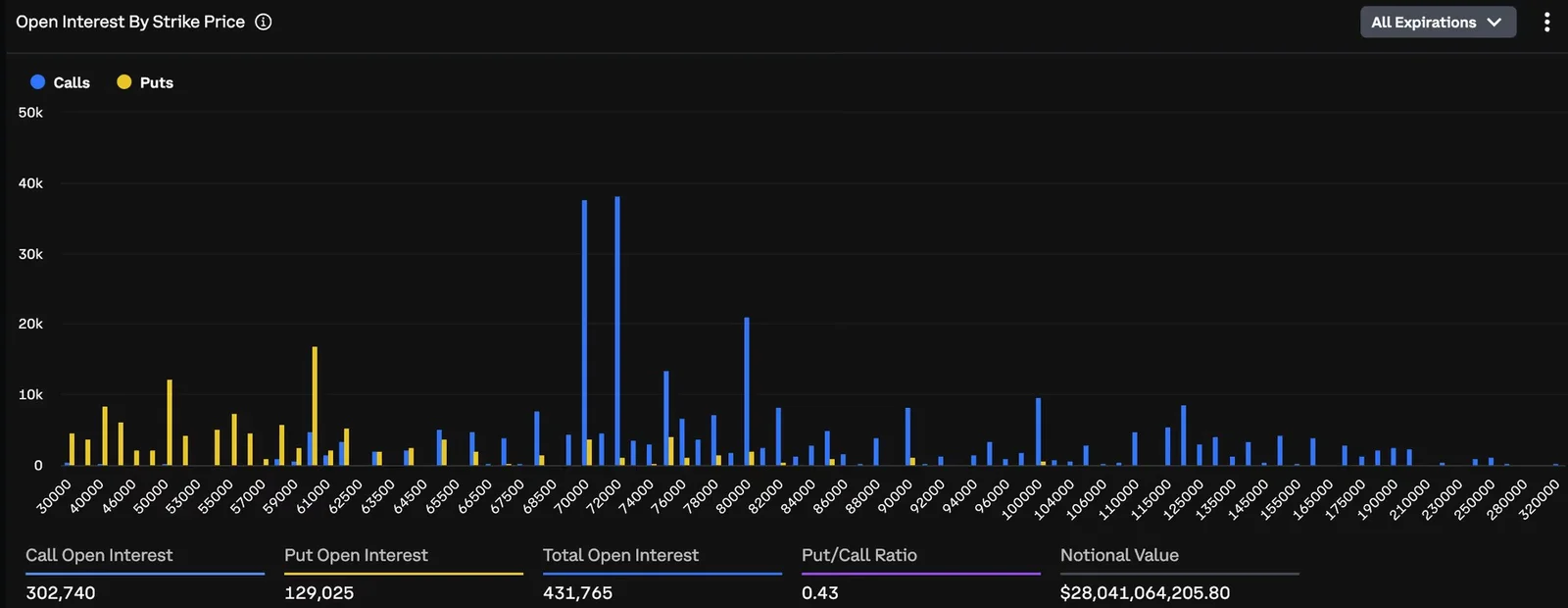
The picture is even more one-sided at $72,000. Traders hold approximately 37,900 calls at that strike, against just 1,200 puts. The wide gap between calls and puts reflects the strength of the market’s upward bias.
A call option gives its buyer the right, without the obligation, to purchase Bitcoin at a predetermined price before or on a specified date. In this case, traders are betting that Bitcoin will rise above $70,000 or $72,000.
A put option works in the opposite direction. It gives the buyer the right to sell at a predetermined price and is commonly used to hedge against losses or speculate on a price decline.
Bull call spread takes center stage
The concentration at these two strikes is no coincidence. Laevitas identified a large bull call spread involving the purchase of $70,000 calls and the simultaneous sale of $72,000 calls.
As its name suggests, the strategy targets a measured increase in Bitcoin’s price, with maximum gains reached if the asset climbs to $72,000. It allows traders to reduce the upfront cost of the bullish position, although it also caps their potential profit.
According to Laevitas, this single structure accounts for 49% of the total call open interest at $70,000 and 50% of the call open interest at $72,000. In other words, roughly half of the enormous positioning at both strikes comes from one strategy.
Calendar spreads were also among the notable trades. These strategies seek to profit from differences in volatility and pricing between options with different expiration dates.
In another major transaction, a trader or group of traders purchased a large number of $70,000 calls to gain direct exposure to an upward Bitcoin move. The position cost approximately $3.4 million in premiums.
Jimmy Yang, co-founder of institutional digital asset liquidity provider Orbit Markets, also highlighted similar trading activity. According to Yang, optimism over the possible passage of the CLARITY Act helped drive the positioning.
Earlier this month, Orbit Markets saw strong demand for $70,000 and $72,000 calls expiring on July 31. Yang said much of that demand came from expectations that Congress could pass the CLARITY Act before the end of the month.
That optimism has weakened over the past 24 hours. Yang noted that traders have started scaling back their expectations, prompting some bullish positions to be unwound.
CLARITY Act expectations lose momentum
Polymarket data reflects the shift in sentiment. The probability of the CLARITY Act becoming law this year has fallen from 51% at the beginning of the week to 38%.
The reason for the decline is clear. Senate Majority Leader John Thune said he did not expect the Senate to vote on the bill before lawmakers leave Washington for the August recess.
The performance of the July 31 options during their final days will therefore depend heavily on further developments from Washington.