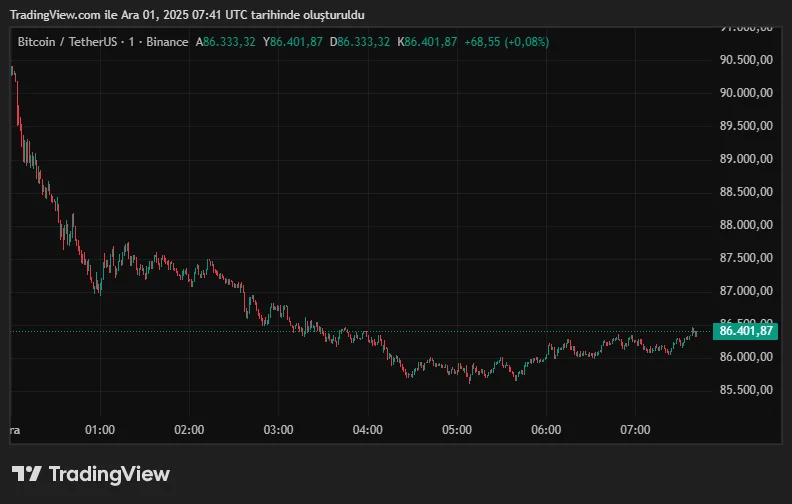
Bitcoin began the new week with a sharp decline. The price's drop below $87,500 isn't a move that can be explained by a single factor; multiple pressures, ranging from macro shocks and seasonal sell-offs to technical weakness and a liquidity squeeze stemming from Japan, have simultaneously come into play.
Developments in Japan Impacted the Crypto Market
Japan's 2-year government bond yield rose to 1.01 percent in the morning, reaching a level not seen since 2008. This movement reinforced market expectations that the Bank of Japan was nearing abandonment of its long-standing ultra-loose monetary policy. BOJ Governor Kazuo Ueda's statement, "We will assess the appropriateness of an interest rate hike at this month's meeting," abruptly dampened risk appetite.
The sharp shift in interest rate expectations accelerated the unraveling of yen carry trades, in particular. The crypto market reacted most quickly when this fund flow, which had supported risk assets throughout the year, reversed. With the yen's recovery in the morning, liquidity rapidly contracted; Bitcoin lost the $90,000 threshold, falling below $87,500. Ethereum followed suit, falling towards the $2,850 level.
Market participants, based on Polymarket pricing, see a 50% chance of Japan hiking interest rates in December. This uncertainty is creating a backdrop that could increase volatility across Asia. Meanwhile, expectations for China's upcoming manufacturing data and the Fed's December meeting are among other factors weighing on risk appetite.
However, it would be insufficient to explain the decline solely on macro developments. Bitcoin entered its historically weak December with a similar pattern. Year-end tax sales in the US and Europe are putting additional pressure on the market, particularly as funds seeking to write off losses are reducing their BTC positions. According to Coinglass data, November closed with a decline of more than 17%, increasing the likelihood of continued weakness in December, given past cycles. In examples like 2018, 2019, and 2022, a red November was followed by a red December.
Leverage has decreased
There's also an important signal on the liquidation front. The lowest leverage level in recent weeks is being observed; this reduces the "fuel" needed for a strong upward move and allows selling to more easily exert price pressure. The liquidation of over $150 million of long positions on the BTC side alone this morning indicated that the decline was deepening without difficulty.
In summary, Bitcoin's sharp decline to the $86,000–$87,000 range was caused by the confluence of both macro shocks originating in Asia and year-end selling pressure. Technical indicators suggest the trend has not yet strengthened; therefore, investors will be watching for both signals from the BOJ and a new catalyst that will allow risk appetite to recover. December is often volatile in the crypto market, and this year looks no different.