
Bhutan has officially announced TER, a new gold-backed digital asset, expanding the scope of its national blockchain strategy. Developed by Gelephu Mindfulness City, an innovative development project in the country, and operating on the Solana network, TER will be held by DK Bank, Bhutan's first licensed digital bank. This structure guarantees that the token is fully backed by audited physical gold reserves on a 1:1 basis.
Bhutan opts for gold tokenization
In introducing TER, the Bhutanese government emphasized that the main goal of the project is to combine traditional store of value, especially gold, with modern blockchain infrastructure. This approach is a key part of the country's digital transformation vision, which has gained momentum in recent years. Pursuing a broad technology strategy ranging from Bitcoin mining to digital identity projects, Bhutan is taking another step to embody this vision with TER.
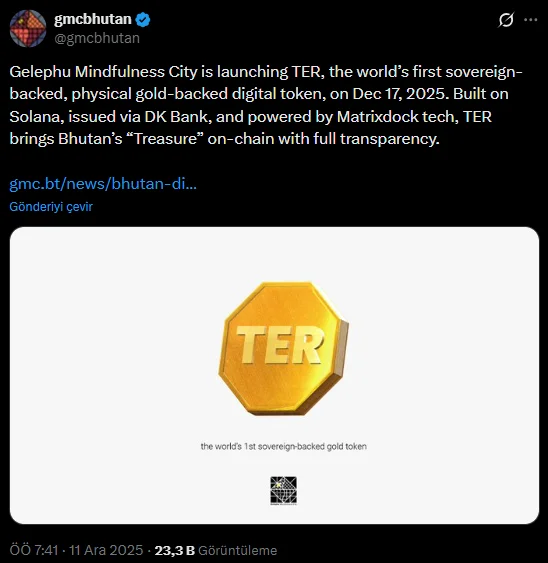
The token's operation on the Solana network is no coincidence. Solana offers low transaction fees, transactions verified in seconds, and high scalability. Bhutanese authorities state that transparency and speed are critical, especially for international investors, which is why Solana was chosen. Through this structure, TER digitizes the traditional procedures of gold purchasing; investors both own real gold assets and can transfer them globally in seconds. Gelephu Mindfulness City, which launched TER, is established as a special zone within the country's "mindfulness-based development model." The zone aims to attract global capital, strengthen the digital economy, and serve Bhutan's long-term sustainable growth goals. Authorities state that initially, TER will connect with investors through DK Bank, and its use cases will be expanded as demand increases. Bhutan's move is not unique. Recently, Kyrgyzstan also announced its gold-backed digital token, USDKG, pegged to the US dollar. The initial issuance of USDKG was $50 million, making it one of the first state-sponsored tokenization examples in Central Asia. Bhutan's TER and Kyrgyzstan's USDKG demonstrate how smaller countries are attempting to diversify their financial systems by transferring their traditional asset reserves to digital infrastructure. Experts say this trend is accelerating. Gold tokenization is increasingly seen as an attractive option, both for portfolio diversification and for making real assets latchable on-chain. Bhutan's TER stands out as a state-backed example of this new model; moreover, its reliance on fully audited gold reserves lends credibility to the project.
Bhutan's years of quiet but steady digitalization efforts (Bitcoin mining with hydroelectric power, national digital identity projects, Binance Pay integration, and support for local fintech initiatives) strengthen the infrastructure of TER. Therefore, the country positions the idea of digital gold not only as an economic but also as a technological move.
With the launch of TER on December 17th, Bhutan will open a new chapter in the production of digital assets based on its national reserves. This new digital asset race, which began among smaller countries, may gain momentum in the coming period as more governments transfer their gold and similar tangible reserves to the blockchain.