
ZKsync is a Layer 2 network that aims to solve Ethereum's scalability problem using zero-knowledge proofs. Developed by Matter Labs, the project launched one of Ethereum's first ZK rollup networks and now focuses on providing blockchain infrastructure for banks and institutions. ZK is the governance token of the ZKsync ecosystem.
Although the token has lost significant value since its launch in 2024, ZKsync remains one of the most widely discussed projects in Ethereum scaling technology.
The Definition and Origins of ZKsync
Matter Labs, the company behind ZKsync, was founded in 2019 by Alex Gluchowski and Alex Vlasov. The team's goal was to make transactions faster and cheaper without compromising Ethereum's security. To achieve this goal, the project adopted rollup technology based on zero-knowledge proofs.
How Does a ZK Rollup Work?
Rollups are networks that process transactions outside the Ethereum mainnet and record them on Ethereum in batches. In ZK rollups, a cryptographic validity proof is generated for each batch of transactions. Ethereum verifies this proof to confirm that the transactions are valid without having to execute each transaction individually.
This structure differs from optimistic rollups such as Optimism and Arbitrum. Optimistic rollups assume transactions are valid and provide a challenge period, which means withdrawing funds to Ethereum can take several days. In ZK rollups, transactions become final once the proof is verified.
ZKsync Era and ZKsync Lite
ZKsync Lite, the first version of ZKsync formerly known as zkSync 1.0, launched in 2020 and supported only basic token transfers. ZKsync Era, launched in March 2023, is a zkEVM compatible with the Ethereum Virtual Machine (EVM). This allows developers to migrate smart contracts written for Ethereum to ZKsync.
ZKsync Era became one of the first networks to natively support account abstraction. This feature allows users to pay transaction fees using different tokens and enables wallets to implement more flexible security rules.
ZK Stack and Elastic Network
ZK Stack is an open-source development toolkit for projects looking to build their own blockchains using ZKsync technology. Networks such as Abstract and Sophon were built using ZK Stack. These networks form the Elastic Network, a collection of chains that can communicate with one another under a shared framework.
Prividium
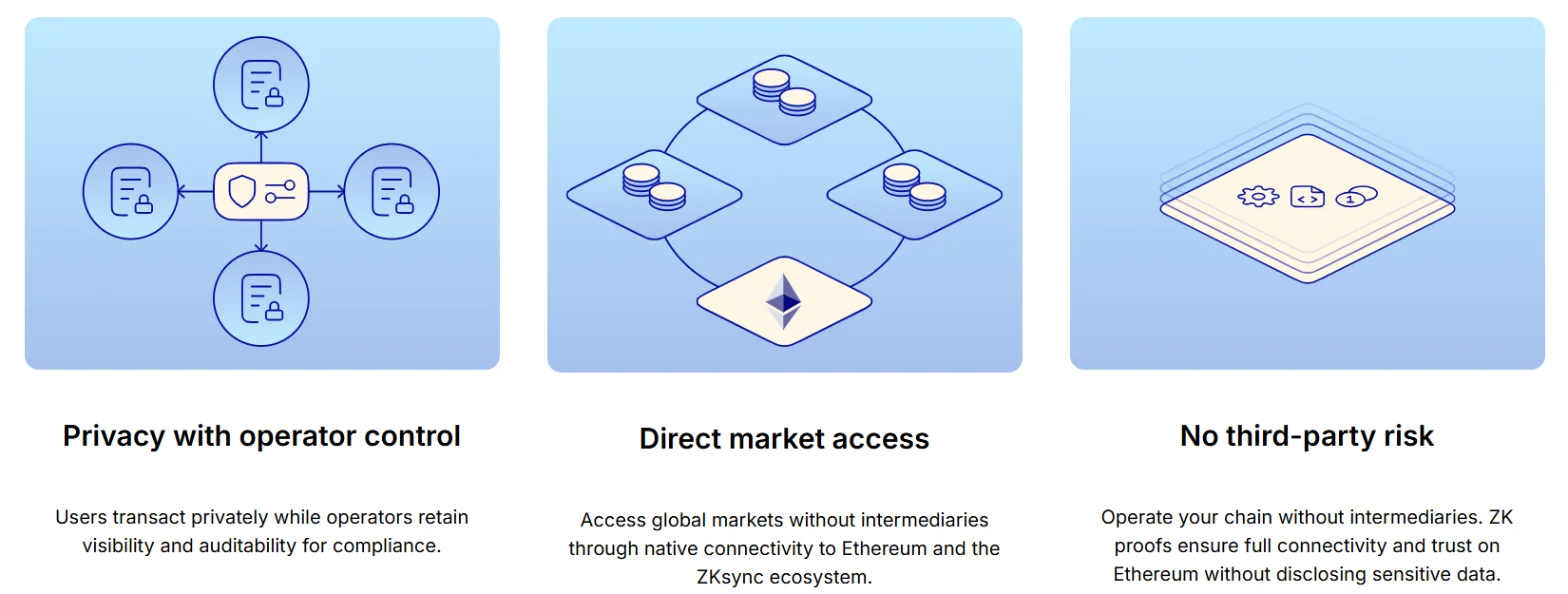
Prividium is a privacy-focused blockchain platform developed by ZKsync for banks and institutions. On networks built with Prividium, transaction data is stored so that only authorized parties can access it, while transaction validity is recorded on Ethereum through zero-knowledge proofs.
ZKsync placed Prividium at the center of its enterprise strategy in its 2026 roadmap.
How to Get Started With ZKsync
To use ZKsync Era, you first need an EVM-compatible wallet such as MetaMask or Rabby. ZKsync Era can be added to these wallets as a separate network.
Once the network is added, users need to transfer some ETH to their wallets to cover transaction fees. There are two ways to do this. The first is to transfer funds from the Ethereum mainnet to ZKsync Era through a bridge. The second is to withdraw funds directly to a ZKsync Era address from a cryptocurrency exchange that supports the network.
Once the funds arrive, users can access decentralized exchanges, lending protocols, and other applications operating on ZKsync at significantly lower fees than on Ethereum. However, it is important to use official or trusted bridges and remain cautious of fraudulent websites. Users should also keep in mind that withdrawing funds from ZKsync back to Ethereum may take longer than regular mainnet transactions.
The History of ZKsync: Key Milestones
Following its establishment in 2019, Matter Labs launched ZKsync Lite on the Ethereum mainnet in 2020. As one of Ethereum's first ZK rollup networks, ZKsync Lite demonstrated that the technology could work in practice.
Funding Rounds and ZKsync Era
In November 2021, Matter Labs raised $50 million in a Series B funding round led by a16z. In November 2022, it completed a $200 million Series C round led by Blockchain Capital and Dragonfly. The company's total funding exceeded $450 million.
In March 2023, ZKsync Era opened to all users. Era quickly became one of the most widely used Layer 2 networks. Much of this growth was also driven by users interacting with the network in anticipation of a potential airdrop.
The ZK Token and Airdrop
In June 2024, the project changed its branding from "zkSync" to "ZKsync" and launched the ZK token. Approximately 3.6 billion ZK, representing 17.5% of the total supply, was distributed to early users through an airdrop on June 17, 2024.
The airdrop became one of the largest in Layer 2 history. However, its distribution criteria and the presence of bot wallets sparked controversy within the community.
2025: Security Breach, Token Unlocks, and a New Token Model
On April 15, 2025, an administrator account managing ZKsync's airdrop distribution contracts was compromised. The attacker minted approximately 111 million unclaimed ZK tokens, causing the ZK price to fall by more than 14% in a single day. The team stated that the attack was limited to the airdrop contracts and that the ZK token contract remained unaffected.
In June 2025, the one-year lockup period for team and investor tokens expired, releasing 3.6% of the total supply into the market. In October 2025, the Atlas upgrade went live, improving the speed and flexibility of ZK Stack for enterprise applications.
On November 4, 2025, Alex Gluchowski published a proposal to redesign the ZK token. Under the proposal, ZK would be supported by revenue generated from cross-chain communication fees and enterprise licensing agreements. This revenue could be used for token buybacks, burns, and staking rewards.
2026: Enterprise Focus
In December 2025, Matter Labs announced that it would shut down ZKsync Lite in 2026. ZKsync Lite stopped producing blocks on May 4, 2026, and its final network state was frozen. Funds remaining on the network will be available for withdrawal to the Ethereum mainnet once the Security Council verifies the final state.
In its roadmap published on January 12, 2026, the company identified real-world infrastructure for banks, asset managers, and large corporations as its primary focus. Prividium, ZK Stack, and a proving engine called Airbender form the core of this roadmap.
The first step toward implementing the new ZK token model was taken in February 2026. The ZKnomics staking pilot program, launched on February 9, 2026, began distributing rewards to ZK holders who delegated their voting power to an active governance delegate.
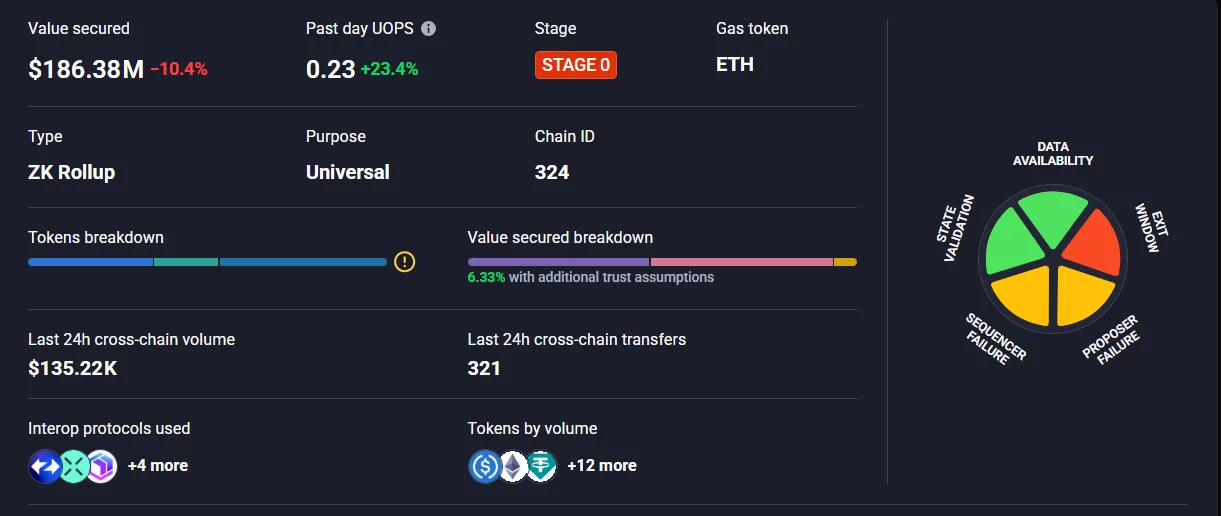
Meanwhile, ZKsync Era's usage remains well below its peak. According to ETHBEAT, formerly known as L2BEAT, the total value secured on Era stands at approximately $186 million.
How Does the ZK Token Work?
ZK is the governance token of the ZKsync ecosystem. The token was issued on ZKsync Era and can also be transferred to the Ethereum mainnet.
Through the governance system known as ZK Nation, ZK holders can vote on protocol upgrades, treasury spending, and token programs, or delegate their voting power to a representative.
Transaction fees on ZKsync Era are paid in ETH, and the ZK token currently has no direct fee-related function. This has long drawn criticism that ZK is a governance-only token without a value accrual mechanism.
Gluchowski's November 2025 proposal aims to address this issue. The ZKnomics staking pilot, the first concrete step toward implementing the proposal, launched in February 2026.
The program's first season was designed to distribute up to 10 million ZK in rewards over three months. To qualify for rewards, holders must delegate their tokens to an active representative who has voted on at least two of the last five governance proposals. Tokens are not locked and can be withdrawn at any time.
ZK Supply and Tokenomics
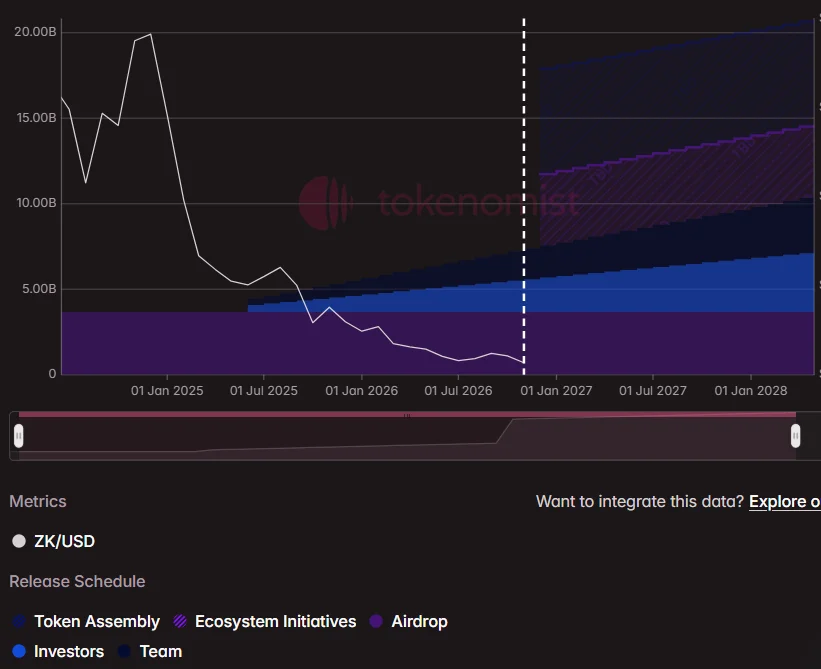
ZK has a maximum supply of 21 billion tokens. Most tokens were not minted at launch. Instead, they are minted as needed through capped minter contracts.
According to JR Kripto data, the total supply minted so far stands at approximately 15.5 billion ZK, while the circulating supply is around 11.36 billion ZK.
Allocation | Percentage |
Token Assembly | 29.27% |
Ecosystem Initiatives | 19.90% |
Investors and Advisors | 19.78% |
Airdrop | 17.50% |
Team (Matter Labs) | 13.55% |
The allocation reserved for the Token Assembly is directed toward token programs through governance decisions. The ZKsync Foundation manages the allocation for ecosystem initiatives.
Investor and team tokens follow a four-year vesting schedule running from June 2024 to June 2028. Following a one-year lockup period, 3.6% of the total supply entered the market in June 2025.
Since then, up to 0.8% of the total supply has been unlocked each month. Regular token unlocks are considered one of the main sources of selling pressure on the ZK price.
ZK Coin Price and Market Data
According to JR Kripto data, ZK's market overview as of November 24, 2026, at 03:40 Türkiye time (UTC+3) is as follows:
Metric | Value |
Current Price | $0.0067888 |
Market Cap Ranking | #178 |
Market Capitalization | $77.30 million |
Fully Diluted Valuation | $105.65 million |
24-Hour Trading Volume | $7.79 million |
Circulating Supply | 11,387,023,123 ZK |
Total Supply | 15,503,438,046 ZK |
Maximum Supply | 21,000,000,000 ZK |
All-Time High | $0.3210 |
All-Time Low | $0.0064209 |
The ZK coin price gained 0.15% over the past 24 hours while losing 12.47% over the past seven days and 44.46% over the past 30 days. The token is currently trading 97.88% below its all-time high and just 6.14% above its all-time low.
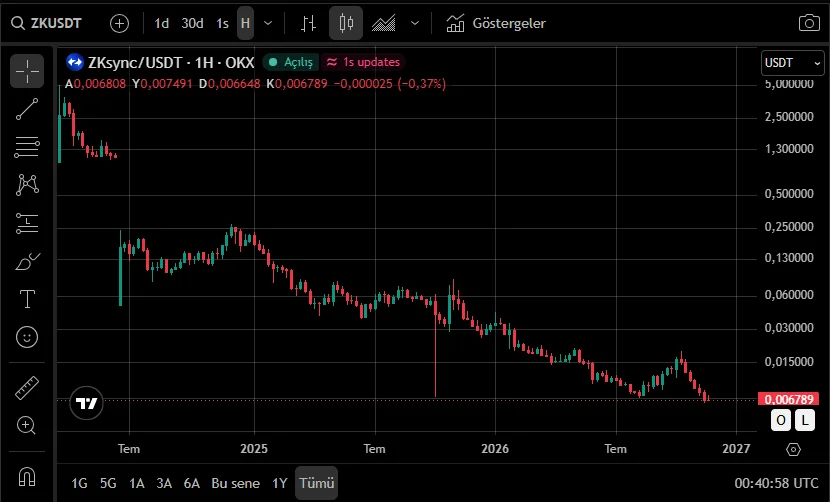
Following its June 2024 launch, ZK declined rapidly as airdrop recipients sold their tokens. In December 2024, the token approached $0.30 amid a broader market rally, but it failed to maintain that level.
Throughout 2025, ZK continued its downward trend amid the April security breach, token unlocks beginning in June, and declining interest in Layer 2 tokens.
This trend remained unchanged in 2026. After a brief recovery in the autumn, ZK lost nearly half its value over the past month, approaching its all-time low. The difference between its fully diluted valuation and market capitalization indicates that tokens yet to enter circulation remain a significant source of potential supply.
Why Is ZKsync Important?
ZKsync became one of the pioneering projects demonstrating that zero-knowledge proofs could be used to scale Ethereum in practice. ZKsync Lite was one of Ethereum's first operational ZK rollup networks, while ZKsync Era was among the first projects to bring an EVM-compatible zkEVM to the mainnet.
Ethereum co-founder Vitalik Buterin also sees zero-knowledge proofs as a central component of Ethereum's long-term scaling roadmap.
ZKsync's current strategy focuses on enabling banks and large institutions to benefit from the security of a public blockchain while keeping their transaction data private. Prividium and ZK Stack are positioned as solutions to this challenge.
If this strategy succeeds, ZKsync could evolve into an infrastructure provider serving primarily traditional financial institutions rather than individual cryptocurrency users.
Where to Buy ZK Coin
ZK is available on four major cryptocurrency exchanges accessible from Türkiye. BtcTurk, Paribu, and Binance TR offer the ZK/TRY trading pair. Binance's global platform supports both ZK/USDT and ZK/TRY trading pairs.
The token is also listed on international exchanges such as Bybit, OKX, and Upbit.
To buy ZK, follow these steps:
- Open an account on a licensed cryptocurrency exchange in Türkiye and complete identity verification.
- Deposit Turkish lira into your account through a bank transfer or EFT.
- Locate the ZK/TRY trading pair on the exchange.
- Enter the amount you wish to purchase and place a market or limit order.
If you intend to stake ZK or participate in governance, you will need to withdraw your tokens to a personal wallet. Since ZK is available on both ZKsync Era and the Ethereum mainnet, make sure you select the correct network when withdrawing your tokens.
The ZKsync Team and Community
Alex Gluchowski and Alex Vlasov are the co-founders of Matter Labs, the company behind ZKsync. Alex Gluchowski, the company's CEO, is the most prominent figure in discussions surrounding the project's roadmap and token model.
Matter Labs' backers include a16z, Blockchain Capital, Dragonfly, Placeholder, and Union Square Ventures. Protocol governance operates under ZK Nation through a structure consisting of the Token Assembly, the ZKsync Foundation, and the Security Council.
The ZKsync community has also taken a more critical stance at times. Some community members on the ZK Nation forum have expressed concerns about treasury spending and the decline in the ZK price.
The Risks of ZKsync
- Token unlocks: Investor and team token vesting continues until June 2028. Up to 0.8% of the supply can be unlocked each month.
- Token value accrual: The proposed revenue and buyback model for ZK has yet to be fully implemented. It remains uncertain how much demand enterprise adoption will generate for ZK.
- Declining usage: Activity and locked value on ZKsync Era remain well below their peak levels.
- Centralization: ETHBEAT classifies ZKsync Era as "Stage 0," indicating that the network remains dependent on trusted operators.
- Security: The April 2025 attack on the airdrop contracts demonstrated that vulnerabilities involving administrator keys can have serious consequences.
- Competition: ZKsync faces strong Layer 2 competitors, including Arbitrum, Base, Optimism, and Starknet.
Frequently Asked Questions (FAQ)
Below are some of the most frequently asked questions about ZKsync and the ZK token.
What is ZKsync?: ZKsync is a Layer 2 network developed by Matter Labs that scales Ethereum using zero-knowledge proofs.
What is ZK coin used for?: ZK is the governance token of the ZKsync ecosystem. It grants holders voting rights through ZK Nation and offers opportunities to earn rewards through the staking pilot program.
What is the difference between a ZK rollup and an optimistic rollup?: ZK rollups verify the validity of each transaction batch through a cryptographic proof. Optimistic rollups assume transactions are valid and provide a challenge period during which disputed transactions can be challenged.
What is Prividium?: Prividium is a blockchain platform developed by ZKsync for banks and institutions that keeps transaction data private.
What is the total supply of ZK?: ZK has a maximum supply of 21 billion tokens, approximately 11.36 billion of which are currently in circulation.
Which Turkish exchanges list ZK?: ZK is available for trading against the Turkish lira on BtcTurk, Paribu, and Binance TR.
Is ZK a good investment?: ZK is a high-risk asset trading more than 97% below its all-time high, with regular token unlocks still ongoing. Before making an investment decision, it is important to conduct your own research and consider your risk tolerance. This content does not constitute investment advice.
If you are considering buying ZK, start by reviewing the monthly token unlock schedule and the requirements of the ZKnomics staking program. Follow the JR Kripto Guide series to stay informed about institutions adopting Prividium, changes to the ZK token model, and new chains built on ZK Stack, as well as to explore other ZK projects such as Starknet and Linea.

