
Wormhole is a cross-chain messaging protocol that enables different blockchains to communicate with one another. The protocol allows tokens, data, and messages to be transferred across dozens of networks, including Ethereum, Solana, Sui, and Arbitrum.
Initially launched as a simple bridge between Solana and Ethereum, Wormhole has evolved into an infrastructure that many projects use to make their tokens available across multiple chains. W is the governance token of the Wormhole ecosystem.
Definition and Origins of Wormhole
Blockchains are inherently isolated systems. The Ethereum network cannot independently know what is happening on Solana. Therefore, using an asset from one blockchain on another requires a reliable communication channel between the two networks. Wormhole was developed to address this problem.
Wormhole launched in 2020 to facilitate token transfers between Solana and Ethereum. The Certus One and Jump Crypto teams played important roles in the project's development. With the introduction of Wormhole V2 in 2021, the protocol evolved into a general-purpose messaging protocol and began expanding to additional blockchains.
How Does Wormhole Work?
At the heart of Wormhole is a network of 19 validators known as Guardians. These Guardians are nodes operated by independent organizations that monitor all supported blockchains. The process works as follows:
- A user or application sends a message to Wormhole's core contract on the source chain. This message could contain a token transfer instruction, for example.
- The Guardians observe and verify the message.
- Once at least 13 of the 19 Guardians sign the message, a signed document called a Verified Action Approval (VAA) is created.
- The VAA is transmitted to the destination chain, where the Wormhole contract verifies the signatures and executes the message.
This structure makes Wormhole's security dependent on the majority of its Guardians acting honestly. The Guardian network includes established validator companies such as Everstake, Chorus One, Figment, and P2P Validator.
Wormhole's Products
- Portal: A bridge application built on Wormhole that allows users to transfer their tokens across different blockchains.
- Native Token Transfers (NTT): A framework that enables projects to make their tokens available natively across multiple chains without creating wrapped versions. The W token is also natively available on networks such as Solana and Ethereum through NTT.
- Connect: A tool that allows developers to easily integrate cross-chain transfer functionality into their applications.
- Queries: Enables applications to query data from different blockchains through the Guardians.
- Sunrise: An asset gateway developed by Wormhole Labs that aims to bring new assets to Solana.
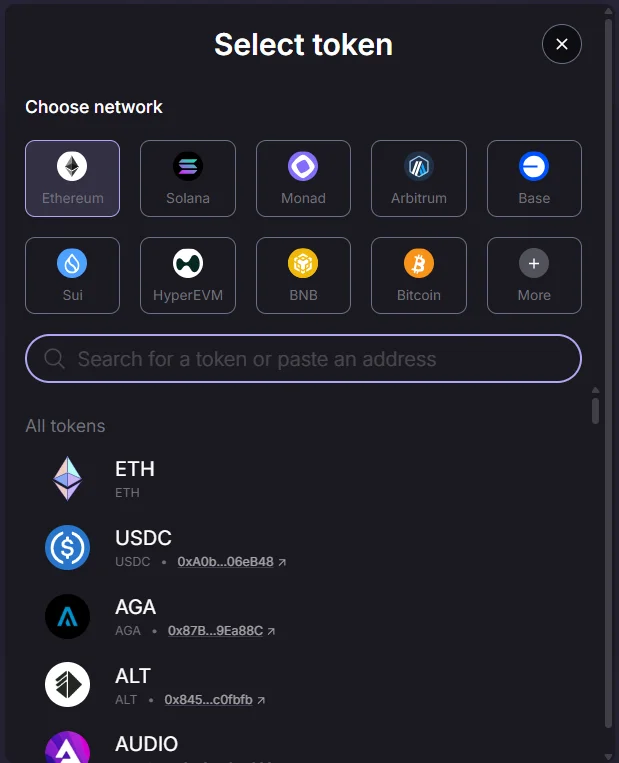
In Portal's interface, users initiate a transfer by selecting the source network and token, followed by the destination network. Networks such as Ethereum, Solana, Arbitrum, Base, Sui, and BNB Chain can be selected directly within the application.
History of Wormhole: Key Milestones
Wormhole launched in 2020 as a bridge for transferring tokens between Solana and Ethereum. With the release of V2 in 2021, the protocol evolved into a general-purpose infrastructure capable of transmitting various types of messages alongside tokens. It soon expanded to support dozens of blockchains.
February 2022: The $320 Million Hack
On February 2, 2022, Wormhole suffered one of the largest bridge hacks in cryptocurrency history. The attacker exploited a signature verification vulnerability in Wormhole's Solana-side contract to mint 120,000 unbacked wETH. Some of these tokens, worth approximately $320 million at the time, were transferred to Ethereum and converted into ETH.
Jump Crypto, which played a major role in Wormhole's development, covered user losses the following day by transferring 120,000 ETH from its own reserves to the bridge. This restored the one-to-one ETH backing of wETH on Solana. The incident demonstrated that cross-chain bridges rank among the riskiest infrastructure components in the cryptocurrency ecosystem.
Funding and the W Token
Following the attack, Wormhole strengthened its security processes and continued to expand. In November 2023, the project raised $225 million at a valuation of $2.5 billion in a funding round involving investors such as Brevan Howard, Coinbase Ventures, Multicoin Capital, and Jump Trading.
In February 2024, Wormhole announced its W tokenomics and airdrop plans. W entered the market through an airdrop in April 2024, reaching an all-time high of $1.66 during its first trading days. However, the price fell rapidly after launch as airdrop recipients sold their tokens.
September 2025: W 2.0
On September 17, 2025, Wormhole announced W 2.0, a comprehensive update to the W token. The update introduced Wormhole Reserve, which directs the protocol's on-chain and off-chain revenue toward W, a target staking yield of 4%, and biweekly token unlocks replacing large annual unlocks.
The year 2025 was also significant for Wormhole in terms of institutional adoption. Wormhole's infrastructure supported the cross-chain expansion of BlackRock's tokenized BUIDL fund and tokenization projects involving asset managers such as Apollo and VanEck. According to reports, $17.6 billion in cross-chain transfers took place through Wormhole in 2025.
2026: Sunrise and Network Changes
On April 3, 2026, approximately 600 million W tokens were unlocked in a single event. This amount represented approximately 6% of the total supply.
In November 2026, Sunrise, developed by Wormhole Labs, released an API enabling Solana applications to access 90 tokenized U.S. stocks and exchange-traded funds (ETFs). In the same month, Wormhole announced that support for the Linea, Moca, and Plume networks would end on December 2, urging users with bridged assets on these networks to transfer them back to their source chains.
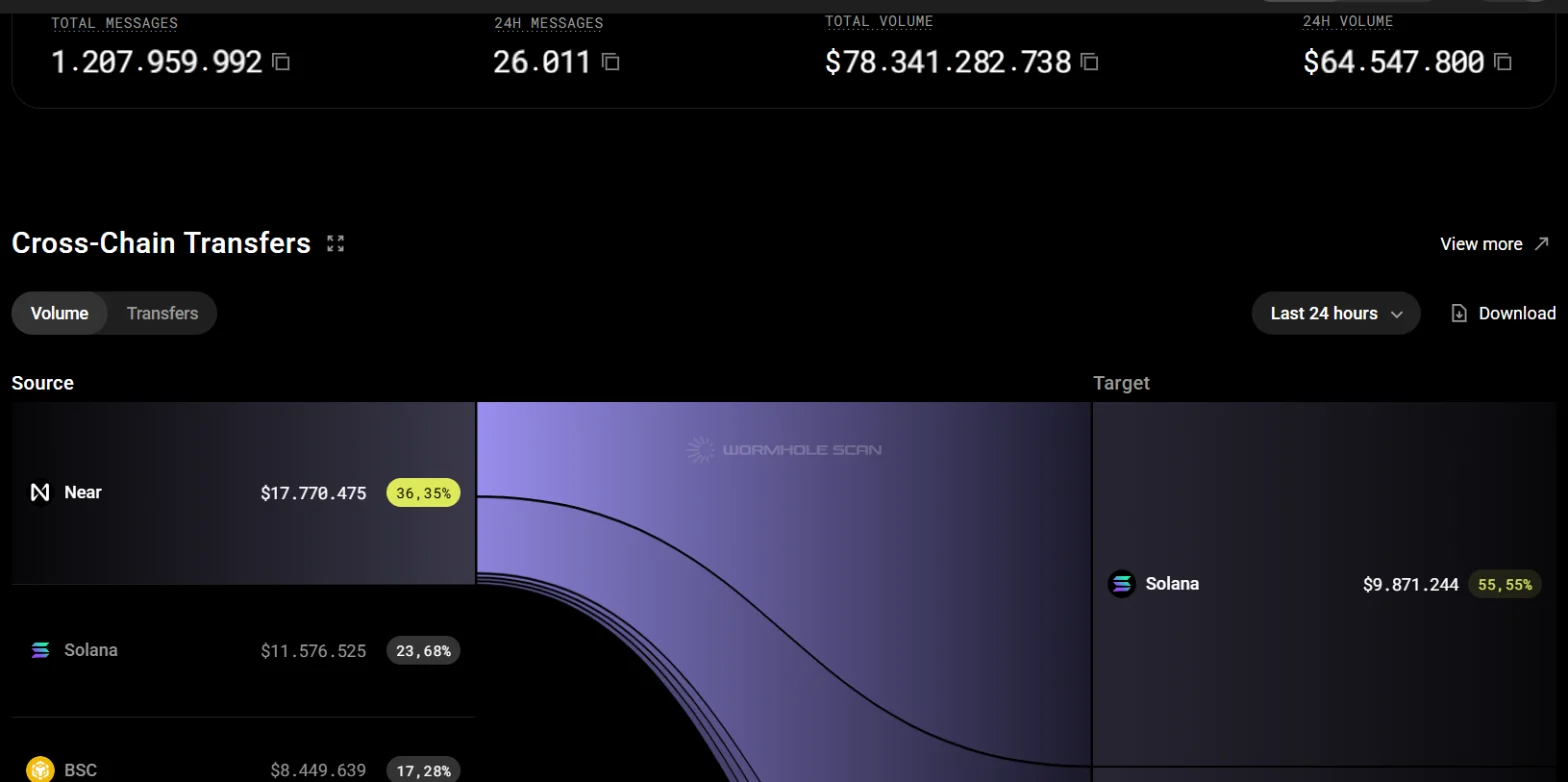
According to WormholeScan data, more than 1.2 billion messages have been transmitted through the protocol to date, while total transfer volume has exceeded $78 billion.
How Does the W Token Work?
W is the governance token of the Wormhole ecosystem. The token was initially issued on Solana using the SPL standard. Thanks to Wormhole's Native Token Transfers framework, W can also be used natively on Ethereum and other EVM-compatible networks without requiring a wrapped version.
The main functions of W within the ecosystem are as follows:
- Governance: W holders can vote on matters such as expanding the Guardian set, supported blockchains, fee structures, and treasury allocation. Wormhole's governance system allows W holders across different chains to participate in voting.
- Staking: W 2.0 introduced a target base staking yield of 4% for W holders participating in governance. This yield is funded through the existing token supply and protocol revenue. Wormhole emphasizes that the yield is variable and is not guaranteed. The team also states that no additional inflation has been introduced to W.
- Wormhole Reserve: Revenue generated by Wormhole, Portal, and ecosystem applications is intended to be converted into W and accumulated in a reserve. The reserve aims to establish a direct link between protocol usage and token value.
W Supply and Tokenomics
The maximum supply of W is capped at 10 billion tokens. According to JR Kripto data, the circulating supply stands at approximately 6.81 billion tokens, representing around 68% of the total supply.
The total supply allocation is as follows:
Allocation | Percentage |
Ecosystem and incubation | 31% |
Foundation treasury | 23.3% |
Community and launch | 17% |
Core contributors | 12% |
Strategic network participants | 11.6% |
Guardian nodes | 5.1% |
Before W 2.0, large quantities of locked W tokens entered the market once a year. These large token unlocks created significant selling pressure on the price.
With W 2.0, allocations for Guardian nodes, the community, the ecosystem, and strategic network participants transitioned to a biweekly unlock schedule starting October 3, 2025. This process will last approximately 4.5 years.
Tokens allocated to the foundation treasury retained their four-year daily unlock schedule. Meanwhile, the lock-up periods for investors and Guardian validators were extended by six months until October 2028. Tokens allocated to core contributors are transferred to the foundation every two weeks but remain in escrow according to the original annual schedule.
Dividing token unlocks into smaller installments reduces the selling pressure associated with large, one-time unlock events. However, approximately one-third of the supply remains locked, meaning new tokens will continue entering the market for an extended period.
W Coin Price and Market Data
According to JR Kripto data, W's market performance as of November 24, 2026, is as follows:
Metric | Value |
Current price | $0.008391 |
Market capitalization ranking | #296 |
Market capitalization | $57.15 million |
Fully diluted valuation | $85.00 million |
24-hour trading volume | $160.65 million |
Circulating supply | 6,811,245,725 W |
Maximum supply | 10,000,000,000 W |
All-time high | $1.66 |
All-time low | $0.0074726 |
The W coin price has increased by 1.22% over the past 24 hours, while declining by 2.32% over the past seven days and 31.75% over the past 30 days. The token is currently trading 99.49% below its all-time high and 13.74% above its all-time low.
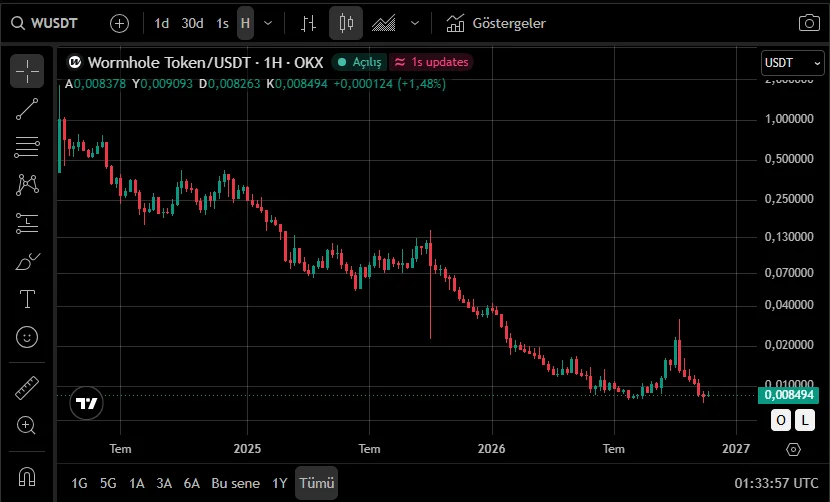
W's price history reflects a pattern frequently observed among tokens launched through large airdrops. After reaching $1.66 during the first days of its April 2024 launch, the token declined rapidly due to airdrop-related selling and regular token unlocks. Although the broader market rally in December 2024 provided a limited recovery, the downward trend continued throughout 2025.
The W 2.0 announcement in September 2025 triggered a short-lived rally. W traded around $0.01 for much of 2026. After climbing above $0.03 in the autumn, the token suffered renewed losses in recent weeks, approaching its all-time low.
Another notable metric is that W's 24-hour trading volume is approximately three times its market capitalization. This indicates a high level of speculative trading activity surrounding the token.
Despite Wormhole's strong institutional adoption, W's weak price performance suggests that protocol usage has yet to translate into sufficient value for the token.
Why Is Wormhole Important?
The blockchain industry has expanded across dozens of different networks. Ethereum, Solana, Sui, BNB Chain, and numerous Layer 2 networks form separate ecosystems, each with its own users and liquidity pools.
This fragmented structure makes the secure transfer of assets and data between blockchains increasingly important. Wormhole is one of the most widely used protocols addressing this need.
Wormhole's importance is particularly evident in the tokenization of real-world assets (RWAs). The use of Wormhole by institutions such as BlackRock, Apollo, and VanEck to expand their tokenized funds across different chains demonstrates the protocol's role as a bridge between traditional finance and blockchain technology.
Native Token Transfers also enables projects to make their tokens available across multiple blockchains without the fragmentation caused by wrapped token versions.
Where to Buy W Coin?
W is traded on four major cryptocurrency exchanges accessible from Türkiye. BtcTurk, Paribu, and Binance TR offer the W/TRY trading pair. Binance's global platform supports trading through the W/USDT pair.
The token is also listed on global cryptocurrency exchanges such as Coinbase, OKX, and Bybit. However, Turkish cryptocurrency exchange CoinTR delisted its W/USDT and W/TRY trading pairs in November 2026.
Follow these steps to purchase W:
- Open an account on a licensed cryptocurrency exchange in Türkiye and complete identity verification.
- Deposit Turkish lira into your account via bank transfer or EFT.
- Locate the W/TRY trading pair on the exchange.
- Enter the amount you wish to purchase and place a market or limit order.
If you intend to stake W or participate in governance, you will need to withdraw your tokens to your own wallet. Since W is available on both Solana and EVM-compatible networks, make sure you select the correct network when withdrawing your tokens.
Wormhole Team and Community
The Wormhole ecosystem is developed by multiple organizations. Wormhole Foundation supports the protocol's growth and governance, while Wormhole Labs is one of its core development companies, working on new products such as Sunrise. Jump Crypto, one of Wormhole's original developers, also played an important role in the project for an extended period.
The 19 Guardians responsible for securing Wormhole include institutional validators such as Everstake, Chorus One, Figment, and P2P Validator. The project's backers include Brevan Howard, Coinbase Ventures, Multicoin Capital, and Jump Trading.
Risks Associated with Wormhole
- Bridge security: Cross-chain bridges are among the most frequently targeted infrastructure components in the cryptocurrency ecosystem. The $320 million hack in 2022 is a concrete example of this risk.
- Reliance on Guardians: Wormhole's security depends on the majority of its 19 Guardians acting honestly. This structure represents a more centralized trust model compared with fully trustless systems.
- Token unlocks: Approximately one-third of the supply remains locked, with new tokens entering the market every two weeks. Investor and Guardian allocations remain subject to lock-up periods until October 2028.
- Value accrual: The impact of Wormhole Reserve on the W price remains limited. Institutional adoption of the protocol is increasing, but this usage has yet to translate into sufficient token value.
- Competition: LayerZero and Chainlink CCIP are strong competitors targeting the same institutional customers.
Frequently Asked Questions (FAQs)
Below are some of the most frequently asked questions about Wormhole and the W token, along with their answers.
- What is Wormhole? Wormhole is a cross-chain messaging protocol that enables the transfer of tokens, data, and messages between different blockchains.
- What is W coin used for? W is Wormhole's governance token. It gives holders voting rights over protocol decisions and allows them to earn rewards through staking.
- What are Wormhole Guardians? Guardians are 19 validators that monitor the blockchains supported by Wormhole and approve cross-chain messages. A message requires signatures from at least 13 Guardians to be considered valid.
- What is Portal? Portal is a bridge application that uses Wormhole's infrastructure to facilitate token transfers between different blockchains.
- What is the total supply of W? The maximum supply of W is 10 billion tokens, approximately 6.81 billion of which are in circulation.
- Which Turkish exchanges list W? W is available for trading against the Turkish lira on BtcTurk, Paribu, and Binance TR.
- Is W a good investment? W is a high-risk asset trading more than 99% below its all-time high, with ongoing token unlocks. Before making an investment decision, it is important to conduct your own research and consider your risk tolerance. This content does not constitute investment advice.
If you are planning to make your first cross-chain transfer using Portal, start with a small amount and ensure that your destination network is still supported by Wormhole.
Follow the JR Kripto Guide series to stay informed about Wormhole Reserve accumulation, biweekly token unlocks, and tokenized stocks arriving on Solana through Sunrise, as well as competing cross-chain protocols such as LayerZero and Chainlink.

